National Defense Academy of Japan
In 1984, a 29-year-old political science professor from Stanford arrived at the National Defense Academy in Yokosuka for a three-week visiting professorship. Condoleezza Rice, who would later become the United States Secretary of State, found the experience disorienting. She "had a hard time adjusting to the rigid hierarchy," she wrote in her 2010 memoirs. The anecdote captures something essential about this institution: the NDA operates with an intensity and formality that can startle even those accustomed to military culture. Founded in 1952, in the rubble of Japan's postwar reinvention, the academy was designed from the ground up to prevent the kind of interservice rivalry that had helped lead Imperial Japan to catastrophe.
Born from Division
Before the war, Japan's Imperial Navy and Imperial Army each maintained separate academies -- the Naval Academy at Etajima and the Army Academy in Ichigaya, Tokyo. The two branches famously despised each other, and their institutional separation reinforced a sectionalism that crippled strategic coordination throughout the Pacific War. When Japan rebuilt its military as the Self-Defense Forces in the early 1950s, the planners made a deliberate choice: one academy, all branches. The institution opened in 1952 as the National Safety Academy, taking its current name in 1954 when the National Safety Force was reorganized into the Japan Self-Defense Forces. The unification was not just administrative convenience. It was an architectural response to a historical failure, embedding cross-service cooperation into the foundation of officer training.
The Yokosuka Campus
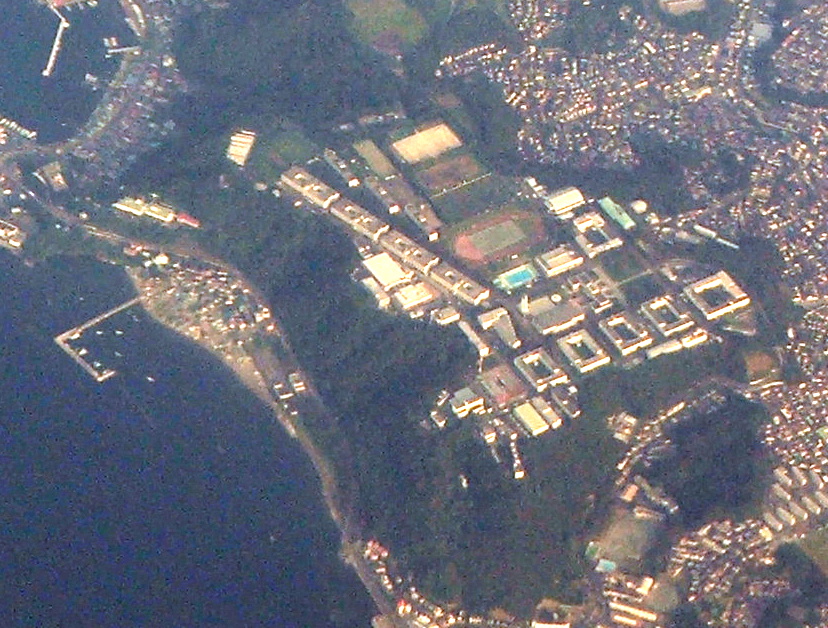
The academy sits in Yokosuka, on the western shore of the Miura Peninsula overlooking Tokyo Bay. Yokosuka has been a naval city since the Meiji era, home to both the Japan Maritime Self-Defense Force headquarters and the United States Fleet Activities Yokosuka. The NDA campus occupies a hillside setting typical of Japanese military installations -- elevated, defensible, and removed from the bustle of the port city below. Students from all three branches -- Ground, Maritime, and Air Self-Defense Forces -- live, study, and train together on this single campus for four years. They are paid a salary as employees of the Ministry of Defense, and after graduation, they are posted to Officer Candidate Schools in their respective branches for an additional year or two of specialized training before receiving their commissions.
Cadets, Scholars, and an Astronaut
The NDA draws its students from civilian high school graduates who have completed twelve years of formal schooling, selecting them through a competitive examination process. The academy also runs master's and doctoral programs for serving officers endorsed by their branch supervisors. Its graduates have risen to the highest echelons of Japan's defense establishment: Yoshifumi Hibako and Yuji Fujinawa both served as chief of staff of the Japan Ground Self-Defense Force, and Toshio Tamogami led the Air Self-Defense Force. Gen Nakatani served as Minister of Defense under Prime Minister Junichiro Koizumi. Beyond the military, NDA alumni have moved into politics and public service -- Yoshihiro Murai became governor of Miyagi Prefecture, and Masahisa Sato serves in the House of Councillors. Perhaps the most remarkable alumnus is Kimiya Yui, who graduated from the NDA in 1992, joined the Air Self-Defense Force, was selected as a JAXA astronaut, and spent 142 days aboard the International Space Station during Expedition 44/45 in 2015.
A Degree with an Asterisk
One of the academy's peculiarities reflects Japan's strict bureaucratic boundaries. Because the NDA falls under the Ministry of Defense rather than the Ministry of Education, Culture, Sports, Science and Technology -- known as MEXT -- it cannot issue its own academic degrees. Instead, graduates must apply to the National Institution for Academic Degrees and Quality Enhancement of Higher Education, an independent body, to receive formal recognition of their coursework. It is an odd arrangement for an institution that produces some of the country's most capable leaders, but it underscores the NDA's unusual position in Japanese society: fully military, partially academic, and belonging to neither world entirely. The academy admitted its first female student in 1992, the same year Kimiya Yui graduated, marking another step in the institution's ongoing evolution from its rigid postwar origins toward something more reflective of modern Japan.
From the Air
Located at 35.258N, 139.722E in Yokosuka, on the western shore of the Miura Peninsula. The campus is visible as a complex of buildings on elevated terrain above the port city. Yokosuka's extensive naval facilities -- both JMSDF and US Navy -- dominate the waterfront nearby. Tokyo Bay stretches to the north and west, with heavy ship traffic in the Uraga Channel. Nearest airports: Tokyo Haneda (RJTT) approximately 25nm north, Atsugi Naval Air Facility (RJTA) approximately 15nm northwest. The Yokosuka naval base (with US Navy warships often visible at berth) provides a strong visual landmark. Yokosuka is also home to the historic Mikasa memorial ship near Mikasa Park.