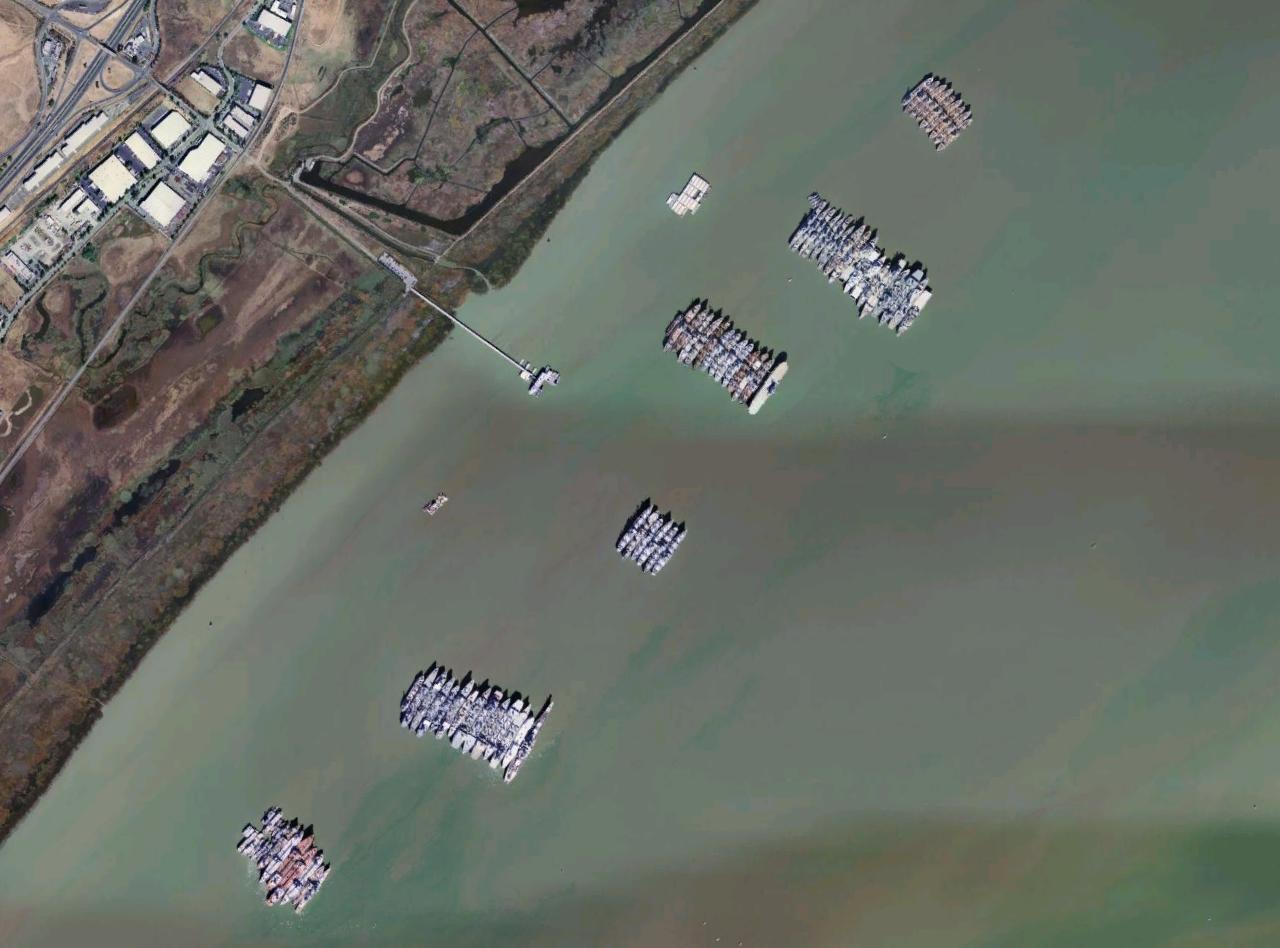
The Ghost Fleet of Suisun Bay
From the air, they looked like a city that had fallen into the water. Hundreds of gray hulls arranged in neat rows across Suisun Bay, their superstructures rising from the brackish shallows northeast of San Francisco like the skyline of some drowned metropolis. These were the ships of the National Defense Reserve Fleet -- merchant vessels and naval auxiliaries mothballed after World War II, preserved in a state of suspended animation so the nation could summon them back to life if the next crisis demanded it. At its peak in 1950, the fleet held 2,277 ships. By 2021, only 91 remained. The story of what happened to the rest is a chronicle of American wars, Cold War logistics, environmental reckoning, and the strange melancholy of machines built for purpose and then left to wait.
Born from the Arsenal of Democracy
The National Defense Reserve Fleet was established by the Merchant Ship Sales Act of 1946, born from a straightforward problem: America had built an enormous merchant marine to win World War II, and now the war was over. Scrapping the ships would have been wasteful; selling them all would have gutted the maritime industry. So the government chose a third option -- mothballing. Ships were dehumidified internally to slow corrosion, fitted with cathodic protection systems that ran electrical current through their hulls to ward off rust, and anchored at sites across the country. Suisun Bay in California held the largest concentration, but fleets also gathered on the James River in Virginia, near Beaumont, Texas, on the Hudson River in New York, and at anchorages in Wilmington, Mobile, Astoria, and Olympia. The Maritime Administration managed them all, maintaining a navy-in-waiting that could be activated within 20 to 120 days.
Called Back to Service
The mothball fleet was never merely a monument to preparedness. It was a working reserve, and the calls came often. When the Korean War began in 1950, 540 vessels were broken out of layup to move military forces across the Pacific. A global shipping shortage between 1951 and 1953 pulled more than 600 ships back into service to haul coal to Northern Europe and grain to India. When Egypt nationalized the Suez Canal in 1956 and choked off international shipping, another 223 cargo ships and 29 tankers were reactivated. The Berlin Crisis of 1961 brought 18 vessels back to duty -- they served until 1970. The Vietnam War activated 172 more. Even the Department of Agriculture found a use for them: from 1955 through 1964, some 600 ships served as floating grain silos. In an era before containerization transformed global shipping, these old workhorses remained indispensable.
Keeping the Dead Alive
Preserving a mothballed ship is a quiet, exacting labor. Workers maintain dehumidification systems that keep mold and corrosion at bay inside sealed compartments. Anodes distribute direct current to the hull's underwater surfaces, creating an electric field that suppresses the relentless chemistry of saltwater meeting steel. Cosmetic work -- painting, scraping, polishing -- is generally skipped, since appearance has no bearing on whether a ship can be reactivated. The result is a fleet that looks abandoned but is technically alive, each vessel a dormant machine that could, in theory, steam again. In 1976, the government formalized the most critical subset as the Ready Reserve Force: 72 ships kept at higher readiness, crewed with skeleton teams, and maintained for activation within as few as four days. These are the ships that would move tanks and ammunition if a major conflict erupted on short notice.
Poison in the Shallows
The ghost fleet's greatest crisis had nothing to do with war. By the late 1990s, the Suisun Bay anchorage -- which had held 324 ships in 1959 -- was shedding its skin into the estuary. Paint containing lead, copper, zinc, and barium had been flaking off hulls and superstructures for decades. By June 2007, an estimated 21 tons of toxic paint debris had settled into the bay sediment, with another 65 tons threatening to follow. The state of California and environmental regulators demanded action. Fifty-two of the worst offenders were identified and scheduled for removal. The cleanup was slow, expensive work. Ships had to be stripped of hazardous materials before being towed to breakers in Texas, California, or Asia. The SS Winthrop, the last Victory ship in the California fleet, left Suisun Bay in March 2010 -- towed first to a San Francisco dry dock for hull cleaning, lest California barnacles hitchhike to the ship-breaking yards of Brownsville, Texas. Twenty of the most polluting hulls were recycled by 2012, and another 32 followed by 2017.
A Shrinking Silhouette
Today the rows are thinner. The fleet that once stretched across the bay in formation dense enough to walk from deck to deck has dwindled to a fraction of its Cold War self. Fifty-one former NDRF vessels now serve as artificial reefs off the coasts of ten states, from Texas to New Jersey -- wartime merchant ships repurposed one final time as habitat for fish and coral. Others have been transferred to memorial associations and maritime heritage organizations, preserved as museum ships or floating monuments. The rest have gone to the breakers. What remains in Suisun Bay is still visible from the air: a handful of gray shapes anchored in the shallows, their superstructures catching the flat light of the Sacramento-San Joaquin Delta. They are the last of a fleet that once embodied a particular kind of American anxiety -- the fear that the next war would come before the nation was ready, and the belief that readiness could be stored in steel and held in reserve against an uncertain future.
From the Air
Located at 38.07N, 122.10W in Suisun Bay, northeast of San Francisco Bay proper. The remaining mothballed ships are visible from altitude as gray shapes arranged in rows in the shallow waters between Benicia and Pittsburg. The Benicia-Martinez Bridge and Carquinez Strait provide visual reference to the southwest. Nearby airports include Buchanan Field (KCCR) approximately 10nm south, Travis AFB (KSUU) 15nm northeast, and Napa County Airport (KAPC) 25nm northwest. Best viewed at 3,000-5,000 feet on clear days when hull reflections contrast with the dark bay water.