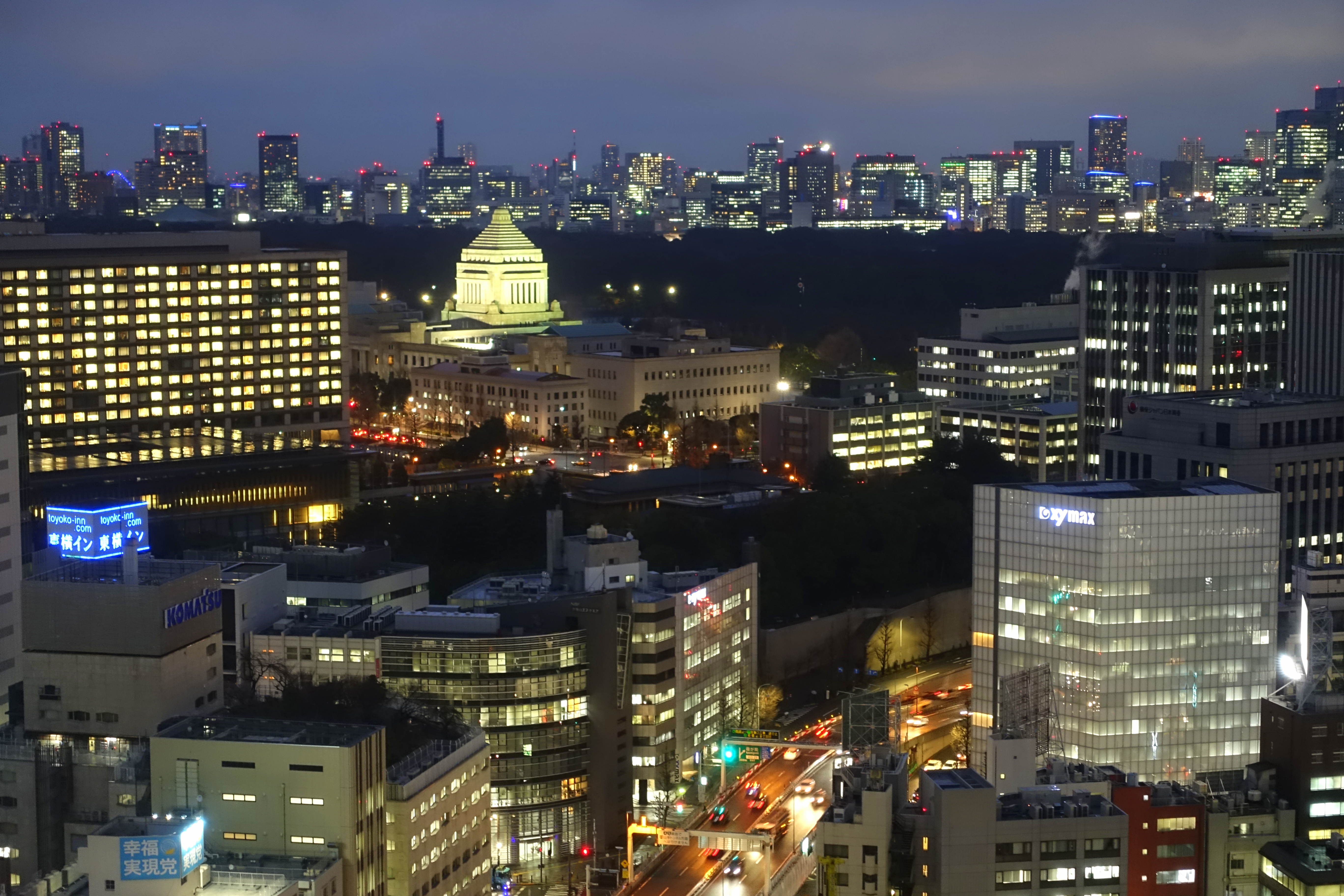
National Diet Building: The Door That Never Opens
In the central hall of Japan's parliament building, three bronze statues stand in three of four corners -- Itagaki Taisuke, Okuma Shigenobu, and Ito Hirobumi, the founding architects of constitutional government in Japan. The fourth corner holds an empty pedestal. No one agrees on why. Some say the designers could not reach consensus on a fourth figure. Others claim the emptiness represents the idea that politics is never complete, an open challenge to future leaders to outstrip their predecessors. On the first day of each Diet session, a pine bonsai is placed on the vacant plinth. The mystery pedestal encapsulates the National Diet Building itself -- a structure that took Japan nearly fifty years of failed designs, competing egos, and two catastrophic fires to construct.
Two Buildings, Two Fires
Japan's parliament met in temporary structures for the first fifty years of its existence. German architects Wilhelm Bockmann and Hermann Ende were invited to Tokyo in 1886 and 1887 to design a permanent home, producing two competing visions -- one Western, one deliberately Japanese -- for a grand government ring south of the Imperial Palace. Neither was built. In 1898, American architect Ralph Adams Cram proposed an Oriental design with tiled roofs and walls; the government that hired him fell before he reached the United States. With deadlines looming, a temporary two-story wooden building opened in Hibiya in November 1890. An electrical fire destroyed it in January 1891, just two months later. Its replacement, a larger structure of similar design, housed the Diet until 1925, when another fire reduced it to ashes. Japan's lawmakers had debated through half a century without a permanent roof over their heads.
The Pyramid on Nagatachō Hill
Construction of the present building began in 1920 and took sixteen years. A public design competition in 1918 drew 118 entries. The winning design by Watanabe Fukuzo formed the basis for the floor plan, but the building's most distinctive feature -- the pyramid-shaped central tower -- may have been borrowed from third-prize winner Takeuchi Shinshichi. The tower stands 65.45 meters tall and was the tallest structure in Tokyo until the Hotel New Otani surpassed it in 1964. Inside the pyramid dome, a spiral staircase winds to an observatory that once offered panoramic views of the capital. Today, the observatory is closed to everyone but the building manager; even Diet members need special permission to enter. The entire building was constructed almost exclusively from Japanese materials. Only the stained glass, door locks, and pneumatic tube system were imported from abroad. Completed in 1936, the Diet Building stands as a granite monument to Japanese self-sufficiency at a time when the nation was asserting its industrial identity.
The Emperor's Chamber
Ten percent of the entire construction budget was spent on a single room. The Gokyusho -- the Emperor's resting chamber -- sits at the top of a red-carpeted stairway leading from the central hall. The chamber is made entirely of cypress coated in Japanese lacquer, with stone adornments carved from cuckoo stone quarried in Anan, Tokushima. The chandelier is crystal. An L-shaped desk accommodated the pre-war Emperor's military uniform: he needed a place for his headdress so his right hand remained free to sign documents, while his sword-bearing left side stayed unencumbered. A private restroom nearby includes both Western and Japanese style toilets. When the Emperor travels from the Imperial Palace to the Diet, police motorcades escort his open limousine through the streets. Diet guards don white ceremonial robes in summer and black in winter. Before surrounding office buildings rose to block the view, Mount Fuji could reportedly be seen from the Gokyusho's windows.
Rituals Behind Bronze Doors
The central entrance features massive bronze doors, each weighing 1.125 tons, crafted by the Tokyo School of Fine Arts. These doors are known as 'the door that never opens' because they are used only on ceremonial occasions: a new parliament after elections, a visit from the Emperor, or a foreign head of state. The main chambers seat both houses of parliament in fan-shaped, continental-style layouts, with stained-glass ceilings that let in enough natural light that electric fixtures stay off unless a plenary session is underway. Protocol governs everything. Diet members cannot enter without a jacket and member badge -- then-Prime Minister Takeo Fukuda was once stopped at the door when he forgot his badge and had to borrow one from a nearby colleague, Yoshiro Mori. Members are forbidden from wearing hats, carrying umbrellas, reading newspapers, or smoking. Four oil paintings in the central hall depict Japan's four seasons: cherry blossoms at Mount Yoshino, summer at Lake Towada, autumn at Okunikko, and the Japan Alps in winter -- each painted not by a famous artist, but by art students.
From the Air
Located at 35.676°N, 139.745°E in the Nagatachō district of Chiyoda, Tokyo. The building's distinctive pyramid-topped central tower and flanking wings are visible from altitude, situated roughly 1 km south of the Imperial Palace grounds. The building's symmetrical layout with central tower is identifiable from above. Tokyo Haneda Airport (RJTT) lies approximately 9 nautical miles to the south-southwest. Best viewed at 2,000-4,000 feet AGL in clear conditions. Narita International Airport (RJAA) is approximately 35 nautical miles to the east.