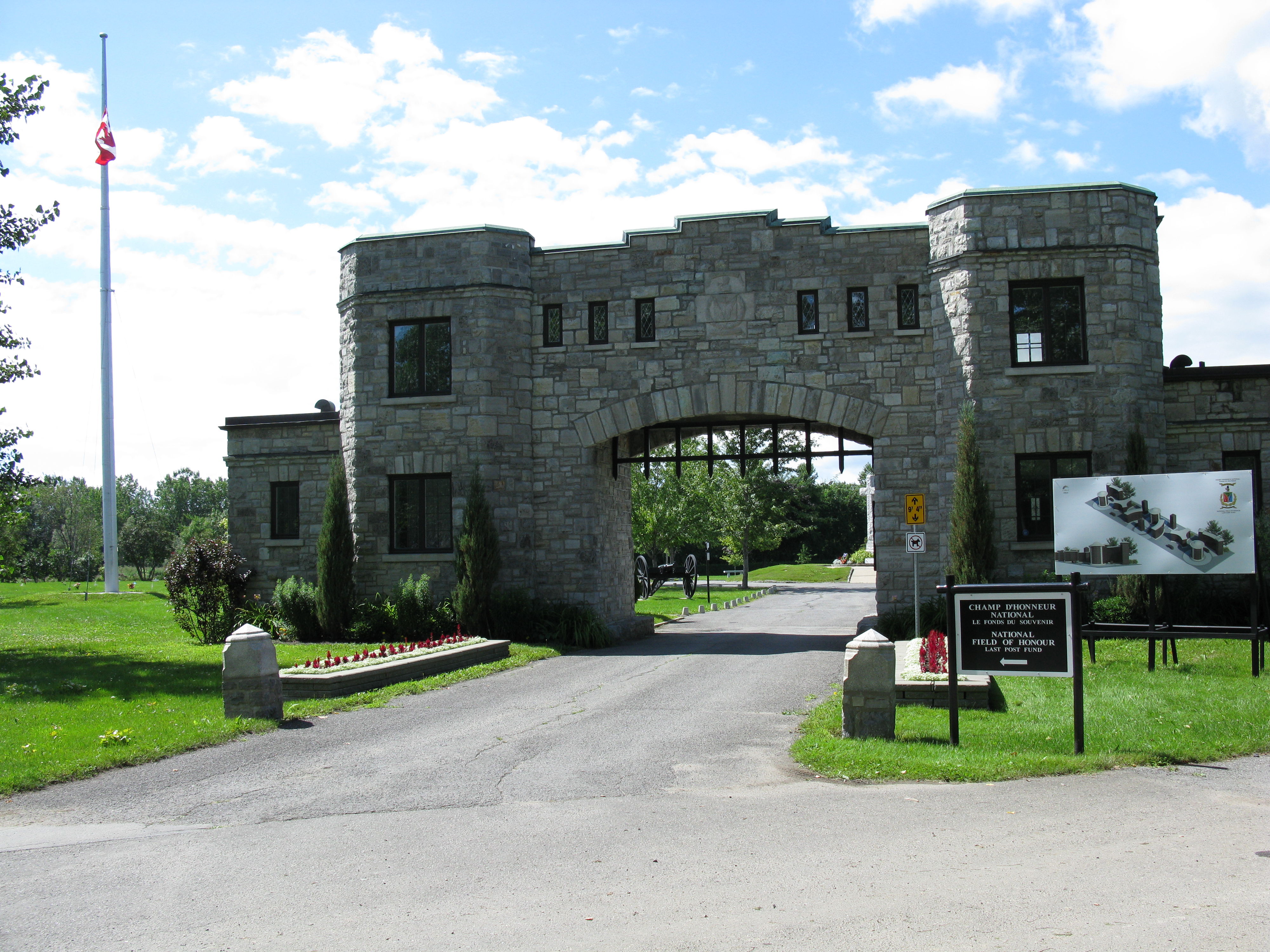
National Field of Honour
Every headstone is flush with the ground. That single design choice tells you everything about this place. At the National Field of Honour in Pointe-Claire, Quebec, a general lies no higher than a private. Consecrated on September 21, 1930, and designated a National Historic Site of Canada in 2007, the cemetery holds more than 22,000 burials -- Canadian and Allied veterans from conflicts stretching back to the eighteenth century. The entrance is a medieval arch flanked by twin towers, one housing an ecumenical chapel. The streets are named for distinguished veterans. The silence is intentional.
Arthur Hair's Promise
The National Field of Honour exists because of a Montreal cigar store owner named Arthur Hair. In 1909, Hair attended the funeral of a destitute veteran and was appalled that the man was buried in an unmarked pauper's grave. He founded the Last Post Fund on a simple principle: no veteran should be denied a dignified funeral and burial because they lacked the money to pay for one. The organization grew into the administrator of the Veterans Affairs Canada Funeral and Burial Program, providing funeral, burial, and grave marking benefits for eligible Canadian and Allied veterans. The Field of Honour became its flagship -- a place where the promise of dignified remembrance took physical form. Hair himself was interred in the grounds surrounding the Cross of Remembrance on June 30, 1947, the first burial in what became the Directors' Circle. His reception center at the entrance now serves as an interpretive space where visitors can search for relatives among the thousands buried here.
The Papineau Rescue
The most remarkable chapter in the Field's history involves graves that were already old when they arrived. D'Urban Circle contains the remains of soldiers who fought in the Napoleonic Wars, the Battle of Waterloo, the War of 1812, and the Fenian Raids. These veterans were originally buried at the Papineau Military Cemetery in downtown Montreal, which British Forces used from 1814 to 1869. By the 1940s, that cemetery sat directly in the path of the planned access road for the Jacques Cartier Bridge. In 1944, the Last Post Fund undertook the most formidable project in its history: exhuming 1,797 burials, some 130 years old, and relocating them with dignity and full military honours. The records were poor, the headstones deteriorating. In May 1944, a volunteer named Sydney Ham transcribed every legible inscription and compiled a comprehensive roster through painstaking research. Over five days, the remains were transferred to the National Field of Honour. The move was completed on July 21, 1944 -- while Canadian soldiers were fighting their way through Normandy.
Three Circles of Memory
The Field is organized around three commemorative circles, each anchoring a different chapter of Canadian military history. Currie Circle honors Sir Arthur Currie, who commanded the Canadian Corps in World War I and later served as principal of McGill University and president of the Last Post Fund from 1924 to 1932. The Cross of Remembrance stands at its center. De Salaberry Circle is named for Lieutenant Colonel Charles-Michel de Salaberry, the French-Canadian nobleman who halted the American advance at the Battle of Chateauguay on October 26, 1813, during the War of 1812. The Veterans' Memorial at its center commemorates all Canadian military men and women who died in World War I, World War II, and the Korean War. D'Urban Circle, holding the relocated Papineau graves, centers on the Field's largest monument -- an obelisk to Sir Benjamin D'Urban, commander of British Forces in North America, who died in Canada in 1849. The city of Durban, South Africa, carries his name.
Memorials in Stone and Steel
Scattered across the grounds are memorials representing each branch of the armed forces. The Air Force Memorial, donated in 2003 by Flight Lieutenant Howard Ripstein, is a metal propeller mounted on a granite plinth. The Army Memorial, a pair of six-inch cannons given by the Canadian Army in 1999, stands in memory of fallen soldiers. The Navy Memorial, an anchor donated by the Canadian Forces' Longue Pointe Garrison in 1998, honors sailors. The Quebec Memorial, erected by the Commonwealth War Graves Commission, consists of two granite blocks listing the names of 49 World War I and 43 World War II service personnel buried in Quebec Province whose graves could no longer be marked or maintained. The Peace Circle, dedicated in 1997, reflects Canada's broadened definition of veterans to include peacekeepers. Its monument, designed by World War II Royal Canadian Air Force veteran Jean Bernard, features a white dove perched on pink granite, inscribed with the words "Paix & Peace."
Who Rests Here
The notable burials read like a cross-section of Canadian public life. Lieutenant Colonel Clarence S. Campbell served in both World Wars before becoming president of the National Hockey League, a position he held from 1946 to 1977. Private Leo Major earned the Distinguished Conduct Medal twice -- once for single-handedly liberating the Dutch city of Zwolle from German occupation in 1945. Lieutenant Colonel Coulson Norman Mitchell received the Victoria Cross, the British Empire's highest military honor. Air Vice Marshal Clifford McEwen was one of Canada's top fighter aces. And among the oldest graves, beneath weathered headstones moved from Papineau, lie soldiers who fought under Wellington. The Gate of Remembrance, built in 1937 for $11,850 with $5,000 donated by the city of Pointe-Claire, frames every visit. Its architect, Harold J. Doran, also designed Benny Farm in NDG -- social housing built for World War II veterans. From entrance to exit, the Field of Honour speaks a single truth: rank dissolves in the ground.
From the Air
Located at 45.44N, 73.84W in Pointe-Claire, a western suburb of Montreal on the island of Montreal. The cemetery is visible from altitude as a large, flat green expanse with organized rows and circular memorial features, distinct from the surrounding suburban development. The Gate of Remembrance entrance and the three commemorative circles are identifiable features. Nearest airports: Montreal-Trudeau International Airport (CYUL) approximately 5nm west; Montreal-Saint-Hubert Airport (CYHU) approximately 20nm east. Best viewed from 2,000-4,000 ft AGL. The Jacques Cartier Bridge, whose construction necessitated the relocation of the Papineau Cemetery burials, is visible to the east spanning the St. Lawrence River.