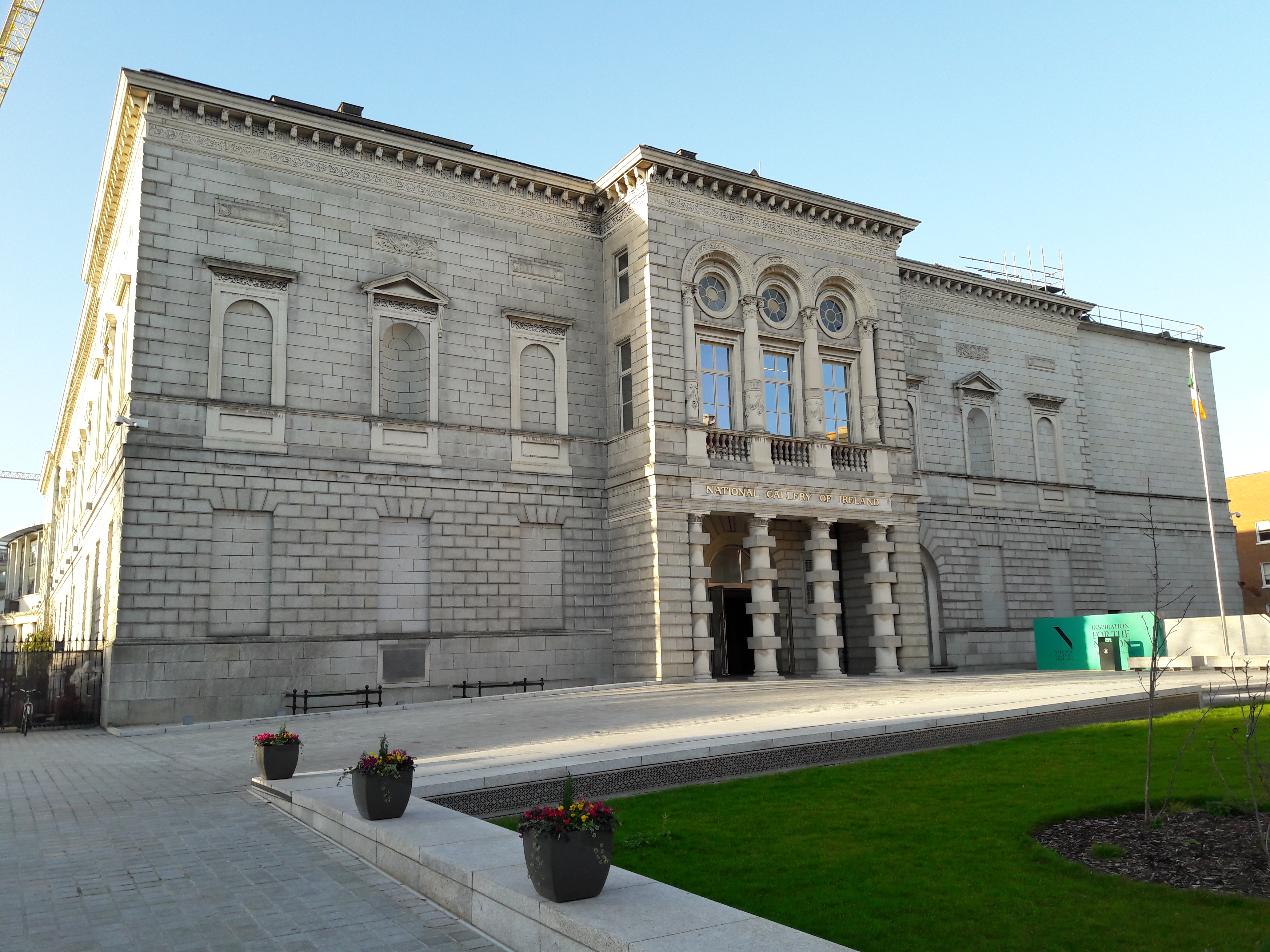
National Gallery of Ireland
When George Bernard Shaw died in 1950, he left a third of his estate to the National Gallery of Ireland -- not out of vague philanthropic sentiment, but out of specific gratitude. Shaw credited the gallery with his education, claiming he had spent more time wandering its rooms as a boy than he ever spent in school. His bequest, swelled by decades of royalties from Pygmalion and My Fair Lady, transformed the gallery's acquisitions budget and funded some of its most significant purchases. A statue of the playwright now stands outside the entrance on Merrion Square, looking toward the institution he called his alma mater.
A Gallery Born from a Railway
The National Gallery of Ireland owes its existence, improbably, to a railway exhibition. The Irish Industrial Exhibition of 1853, mounted on the lawns of Leinster House, generated enough enthusiasm and profit to support the founding of a permanent gallery the following year. The gallery opened its doors in 1864, a decade after its founding, in a purpose-built Dargan Wing named after William Dargan, the railway magnate who had funded the 1853 exhibition and whose portrait by Stephen Catterson Smith hangs prominently in the collection. From the beginning, the gallery occupied a privileged position: its entrance on Merrion Square sits beside Leinster House, now the seat of the Irish parliament, and within steps of the National Museum and the Natural History Museum.
Caravaggio in Dublin
The gallery's most celebrated single work is Caravaggio's The Taking of Christ, a large canvas depicting Judas's betrayal in the Garden of Gethsemane. The painting had been hanging, unrecognized, in a Jesuit house of studies in Dublin before being identified in 1990 by Sergio Benedetti, the gallery's head of conservation. It is on indefinite loan from the Jesuits and has become the gallery's most popular attraction -- a Baroque masterpiece rediscovered in a Dublin dining room. The Italian collection also includes works by Fra Angelico, Titian, and Tintoretto, giving the gallery a depth in Italian painting that belies its relatively modest size.
An Irish Eye
The gallery's Irish collection is the most comprehensive in existence, tracing the country's artistic traditions from the 18th century to the present. Jack B. Yeats, brother of the poet W.B. Yeats, is represented with particular depth -- his expressionist paintings of Irish life, from tinkers and circus performers to the landscape of the West, form one of the collection's emotional centers. The gallery also holds significant works by Walter Osborne, William Orpen, Roderic O'Conor, and a growing collection of contemporary Irish art. Beyond the Irish schools, the Dutch and Flemish rooms include works attributed to Vermeer and Rembrandt, while a substantial Spanish collection features El Greco and Goya.
Expansion and Renewal
The gallery has grown through several building campaigns since its original Dargan Wing. The Milltown Wing, added in 1903, was funded by the Countess of Milltown, who donated over 200 paintings from the Russborough House collection. The most recent major addition, the Millennium Wing on Clare Street, opened in 2002 and gave the gallery its second public entrance as well as modern exhibition spaces. A significant refurbishment completed in 2017 reorganized the permanent collection and restored many of the Victorian-era galleries to their original proportions, allowing natural light to flood rooms that had been partitioned and dimmed over the decades.
Free to All
The National Gallery of Ireland charges no admission for its permanent collection -- a policy that reflects the founding principle that art should be accessible to everyone, not just those who can afford it. Shaw's boyhood experience, wandering the galleries without cost or permission, was not an accident of generosity but a deliberate institutional choice. The gallery sits at the heart of Dublin's cultural district, sharing Merrion Square with the National Museum of Ireland and the Natural History Museum, all free to enter. On any given afternoon, the rooms hold a mix of schoolchildren, tourists, art students copying Old Masters, and Dubliners who, like Shaw, have simply come to look. The gallery's collection of over 16,300 works spans seven centuries, but its most valuable asset may be the open door.
From the Air
The National Gallery of Ireland is located at 53.3408N, 6.2525W in central Dublin, on the west side of Merrion Square beside Leinster House (the Irish parliament). From altitude, look for the distinctive Millennium Wing's modern glass and limestone facade on Clare Street. Nearest airport: Dublin Airport (EIDW) approximately 10km north.