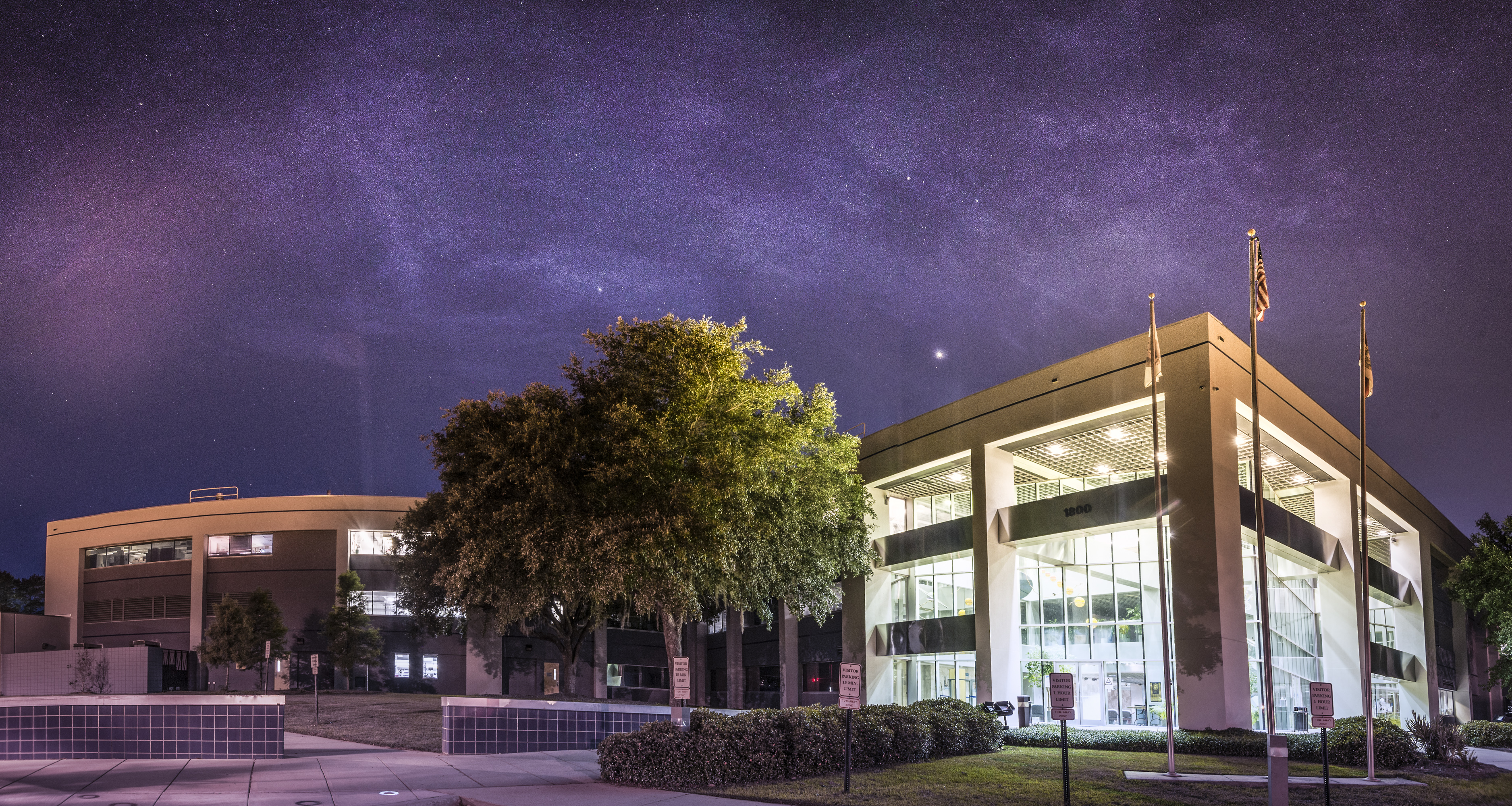
National High Magnetic Field Laboratory
Tallahassee residents have a running joke: the reason hurricanes seem to swerve around the city is the giant magnets at the MagLab. It is scientifically nonsense, of course -- magnetic fields have no effect on weather systems. But the folk legend persists, and it captures something real about how the National High Magnetic Field Laboratory has settled into the imagination of a small Southern capital that happens to host the most powerful magnets on Earth. Tucked into the campus of Florida State University, the MagLab is the only national laboratory of its kind in the United States, one of just twelve high-magnetic-field facilities worldwide, and the holder of multiple world records, including the strongest continuous magnetic field ever produced: 45.5 tesla, roughly a million times stronger than Earth's own magnetic field.
The $60 Million Fight
The MagLab exists because of a high-stakes academic rivalry. In 1989, Florida State University, the University of Florida, and Los Alamos National Laboratory submitted a joint proposal to the National Science Foundation for a new national laboratory dedicated to high-magnetic-field research. The competition was fierce. MIT, backed by the University of Iowa, the University of Wisconsin-Madison, Brookhaven National Laboratory, and Argonne National Laboratory, countered with a proposal to expand its already world-class Francis Bitter Magnet Laboratory. With $60 million in federal funding on the line, the NSF chose the FSU-led consortium. MIT did not accept the decision gracefully. On September 5, 1990, MIT researchers petitioned the 21-member National Science Board to "review and reconsider" -- the first appeal of its kind in NSF history. The board denied the request on September 18, 1990. MIT followed through on its warning and phased out the Francis Bitter Lab. The magnets would go to Tallahassee.
The 1,200-Ton Heart of the Lab
The Tallahassee complex was dedicated on October 1, 1994, with Vice President Al Gore delivering the keynote address. What grew on the FSU campus over the following decades is a facility that defies casual description. The DC Field program alone operates 14 resistive magnet cells connected to a 48-megawatt power supply -- enough electricity to power a small city -- along with vast cooling systems to absorb the tremendous heat the magnets generate. The pulsed-field facility at Los Alamos runs on an even more dramatic scale: a 1.43-gigawatt motor generator weighing 1,200 tons sits on a 4,800-ton inertia block supported by 60 springs designed to minimize earth tremors. This single machine, the centerpiece of the Pulsed Field Laboratory, can produce experimental capabilities up to 100 tesla in short bursts. The numbers sound abstract until you consider that an ordinary refrigerator magnet produces about 0.005 tesla. The MagLab routinely operates in a realm nearly 10,000 times more powerful.
Breaking Records, One Tesla at a Time
The MagLab's reputation rests on a relentless accumulation of world records. The 45.5-tesla hybrid magnet -- which combines resistive and superconducting magnet technologies -- holds the record for the strongest continuous magnetic field ever achieved. The 41.4-tesla resistive magnet is the most powerful continuous-field resistive magnet in the world. On November 15, 2016, the lab's series connected hybrid magnet reached 36 tesla during a series of tests, setting a new record for nuclear magnetic resonance spectroscopy. The facility's 900-MHz NMR magnet, built in-house, features an ultra-wide bore measuring 105 millimeters in diameter and achieves the highest magnetic field for MRI study of living animals. These instruments are not trophies. They are working tools used by scientists from across physics, chemistry, biology, geochemistry, materials science, and engineering to probe the fundamental behavior of matter under extreme conditions.
Potato Launchers and Melting Rocks
For all its esoteric research, the MagLab has cultivated a surprisingly accessible public face. Monthly tours are open to visitors, and an annual open house draws roughly 10,000 attendees. As physicist Scott Hannahs described it: "We have tesla coils shooting sparks and we melt rocks in the geochemistry group and we measure the speed of sound and we have lasers and potato launchers and we just have all sorts of things showing little scientific principles." The lab's Center for Integrating Research and Learning runs mentorship programs for students and teachers, and the Magnet Academy website provides educational content on electricity and magnetism. Today, with approximately 300 faculty, staff, and students at the Tallahassee site alone, the MagLab operates under the direction of physicist Kathleen Amm. The facility remains a partnership between Florida State University, the University of Florida, and Los Alamos National Laboratory, supported by the National Science Foundation and the state of Florida -- a collaboration that began with a bold proposal and a bitter rivalry, and produced the most powerful magnets humanity has ever built.
From the Air
Located at 30.43°N, 84.32°W on the Florida State University campus in Tallahassee, Leon County. The laboratory complex is a large industrial-looking facility on the southwestern edge of campus, distinguishable from surrounding academic buildings by its scale and utilitarian design. Tallahassee Regional Airport (KTLH) lies approximately 4nm to the south-southwest. The Florida State Capitol dome is a prominent landmark approximately 2nm to the east. Best viewed at 2,000-4,000 feet AGL; the facility's large flat-roofed buildings and associated infrastructure stand out against the surrounding campus green spaces.