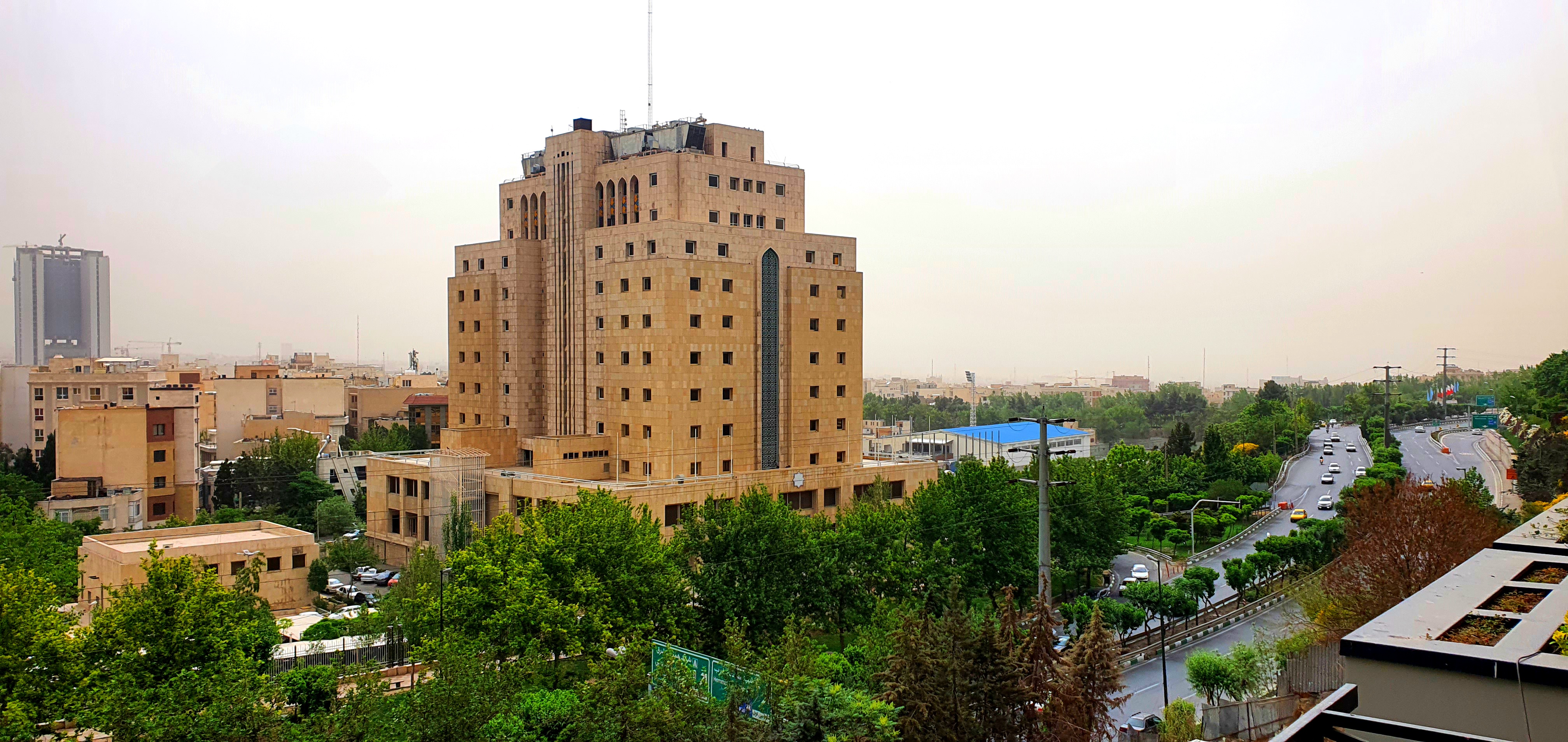
National Library and Archives of Iran
In March 2024, an eyewitness reported that some ten thousand publications held by the National Library and Archives of Iran had been destroyed. The government said the materials were damaged, contaminated, and redundant. Critics saw something else entirely: a country's relationship with its own past being quietly renegotiated, one truckload at a time. Whether the truth lies closer to housekeeping or erasure, the incident revealed how much weight a national library carries in a country where memory and power have always been intertwined.
From Military Academy to National Institution
Iran's first modern library opened in 1863 at the Dar ul-Funun, the military and engineering academy established in Tehran. Under Mozaffar ad-Din Shah, as Iran's diplomatic ties with the West expanded, a scientific society formed in Tehran in 1897 to promote Western educational values. That society created the National Scientific Library in 1898, and the small collection became the seed of something much larger. In 1934, Mehdi Bayani, the library's first director, proposed to Minister of Science Ali-Asghar Hekmat that Iran establish a true national library. Hekmat noticed unused land on an old military base in central Tehran, secured Reza Shah's approval, and commissioned the French architect Andre Godard to design the building. Records suggest that Maxime Siroux, working under Godard's direction, actually drew the plans. The library opened on August 25, 1937, with 30,000 publications drawn from the National Scientific Library, the Royal Library, the Aziz Khan Library, and the Russian Credit Bank.
Two Institutions Become One
Iran's national library and national archives grew separately for most of their histories. The archives trace their origins to the Qajar court, where documents were kept in the Biotat Office under Fath Ali Shah in the early 1800s. Under Nasser al-Din Shah, political documents moved to the Ministry of Foreign Affairs; financial records went to a separate office. In 1899, the Foreign Ministry began following European archival methods. A bill to create a national archive organization was introduced in 1966, and the National Assembly approved it in 1970. For decades, the two institutions operated independently. In 2002, they merged into the National Library and Archives of Iran, though they continue to occupy separate buildings.
Fifteen Million Items and Counting
The NLAI is the largest library in the Middle East, with more than fifteen million items in its collections. Twelve branches operate across the country. The institution holds books in dozens of languages, including volumes published over 400 years ago. The Center for Islamic and Iranian Studies, founded within the library in 1963, collects Islam-related publications in every language except Persian and Arabic -- a mandate that reflects both the breadth of Islamic scholarship and the library's ambition to serve as a global resource. The eight-story main building covers 11,695 square meters and includes reading rooms, research halls, and a women's studies hall. Its president is appointed by the President of Iran, underscoring the institution's position as a state priority.
The Architecture of Knowledge
The library's original building was designed to complement the Museum of Ancient Iran next door, and the two structures share a family resemblance that reflects their intertwined origins. A chronogram poem by Habib Yaghmai adorns the building, and Iranian brick patterns decorate the entrance. By the 1950s, the collection had outgrown its home, and additional buildings were constructed. After the 1979 Revolution, the library was reorganized and merged with the Tehran Book Processing Center. In 1994, a national competition was held to design a new main building for the ever-expanding collection. The result is a modern facility that houses one of the region's most important repositories of human knowledge -- a place where Qajar-era documents share shelf space with twenty-first-century dissertations.
From the Air
Located at 35.752N, 51.434E in central-north Tehran. The library's eight-story building stands near the Museum of Ancient Iran and the National Museum complex, south of the Alborz foothills. Nearest airports are Mehrabad International Airport (OIII), approximately 12 km to the west, and Tehran Imam Khomeini International Airport (OIIE), about 50 km to the southwest. The large institutional building is identifiable from medium altitude as part of Tehran's government and cultural district. Best viewed from the north during approach.