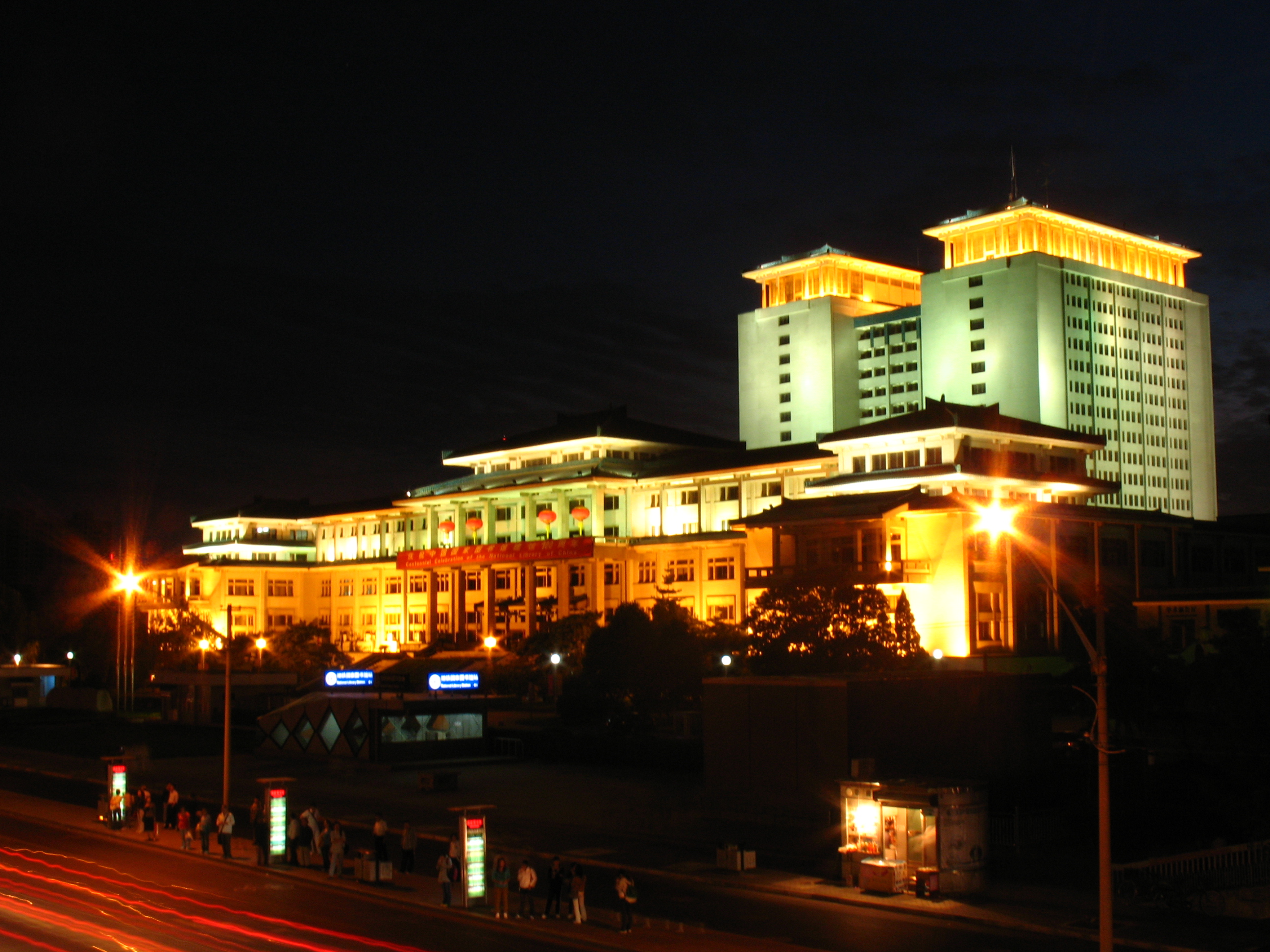
National Library of China
The reading fee was one copper coin. That was the price of admission when the National Peking Library first opened its doors on August 27, 1912, a few months after the last emperor abdicated and the Republic of China began. Borrowing was not allowed -- readers could only consult books on the premises -- and the library was housed in a Buddhist temple that was too damp for proper book storage. From these modest beginnings, the National Library of China has grown into one of the largest libraries on Earth: over 41 million items, materials in 123 languages, and digital resources exceeding one petabyte. Its history is a mirror of China's.
Imperial Origins in a Buddhist Temple
The library was founded on September 9, 1909, when Zhang Zhidong, a leader of the Self-Strengthening Movement, petitioned the Qing court for permission to establish a library in the capital. The imperial edict approving the request was issued the same day. The institution was originally called the Imperial Library of Peking, and its first administrator was the philologist Miao Quansun, who had already overseen the founding of the Jiangnan Library in Nanjing. A site was needed, but funds were short. The ideal location -- the quiet Deshengmen neighborhood inside the northern city wall -- would have required purchasing multiple buildings. Instead, Guanghua Temple near the Shichahai was chosen. It was inconvenient, damp, and too small, but it was available. The library would remain there until 1917.
Inspired by Boston and the Library of Congress
The idea of a Western-style public library was not intuitive in late Qing China. The earliest Chinese references to such institutions appeared in the 1830s and 1840s, in texts by Lin Zexu and Wei Yuan that translated descriptions of Western countries. In the late 19th century, the Qing government sent diplomatic missions abroad to study Western institutions firsthand. Members of these missions were struck by the libraries they visited -- their openness, their organization, the honesty of readers who returned borrowed books. The journalist and intellectual Liang Qichao, exiled after the failed Hundred Days' Reform of 1898, wrote admiringly of the Boston Public Library and the University of Chicago Library. These encounters planted the seeds for what would eventually become China's national library system.
Five Names, One Institution
The library has changed its name five times, each renaming reflecting a shift in political power. Imperial Library of Peking became National Peking Library after the Republic replaced the dynasty in 1912. When the Kuomintang moved the capital to Nanjing in 1928 and renamed Beijing as Beiping, the library became the National Peiping Library. After the People's Republic was established in 1949, it was briefly the National Peking Library, then simply the Peking Library. In 1999, it received its current name: the National Library of China. Through each transformation, the collection grew. In 1931, a new building opened on Wenjin Street near Beihai Park. In 1987, the library moved to a modern complex north of Purple Bamboo Park in Haidian District. Today it operates across multiple buildings, including an Ancient Books Hall and the National Museum of Classic Books.
Forty-One Million Items and Counting
The collection is the largest in Asia. Its holdings include over 270,000 ancient and rare Chinese books, more than 16,000 volumes of Dunhuang manuscripts recovered from the Mogao Caves, the oldest extant printed edition of the Huangdi Neijing -- the foundational text of Chinese medicine -- and the most complete surviving copies of the Yongle Encyclopedia, the massive Ming dynasty compilation. Oracle bones inscribed three thousand years ago share catalog space with digital databases growing at 100 terabytes per year. In 1963, the library began exchanging materials with Columbia University, trading the complete works of James Baldwin for Chinese legal publications in one memorable early transaction. In 1979, it established an exchange program with the Library of Congress. The National Library of China began in a leaky temple with a handful of books and a one-coin reading fee. It now holds more items than most nations produce in a century.
From the Air
Located at 39.94N, 116.32E in Beijing's Haidian District, on Zhongguancun South Road north of Purple Bamboo Park. The modern library complex is a large institutional building accessible by subway at the National Library station. Beijing Capital International Airport (ZBAA) lies approximately 28 km northeast. The building is visible from moderate altitude as a large, low-rise institutional campus.