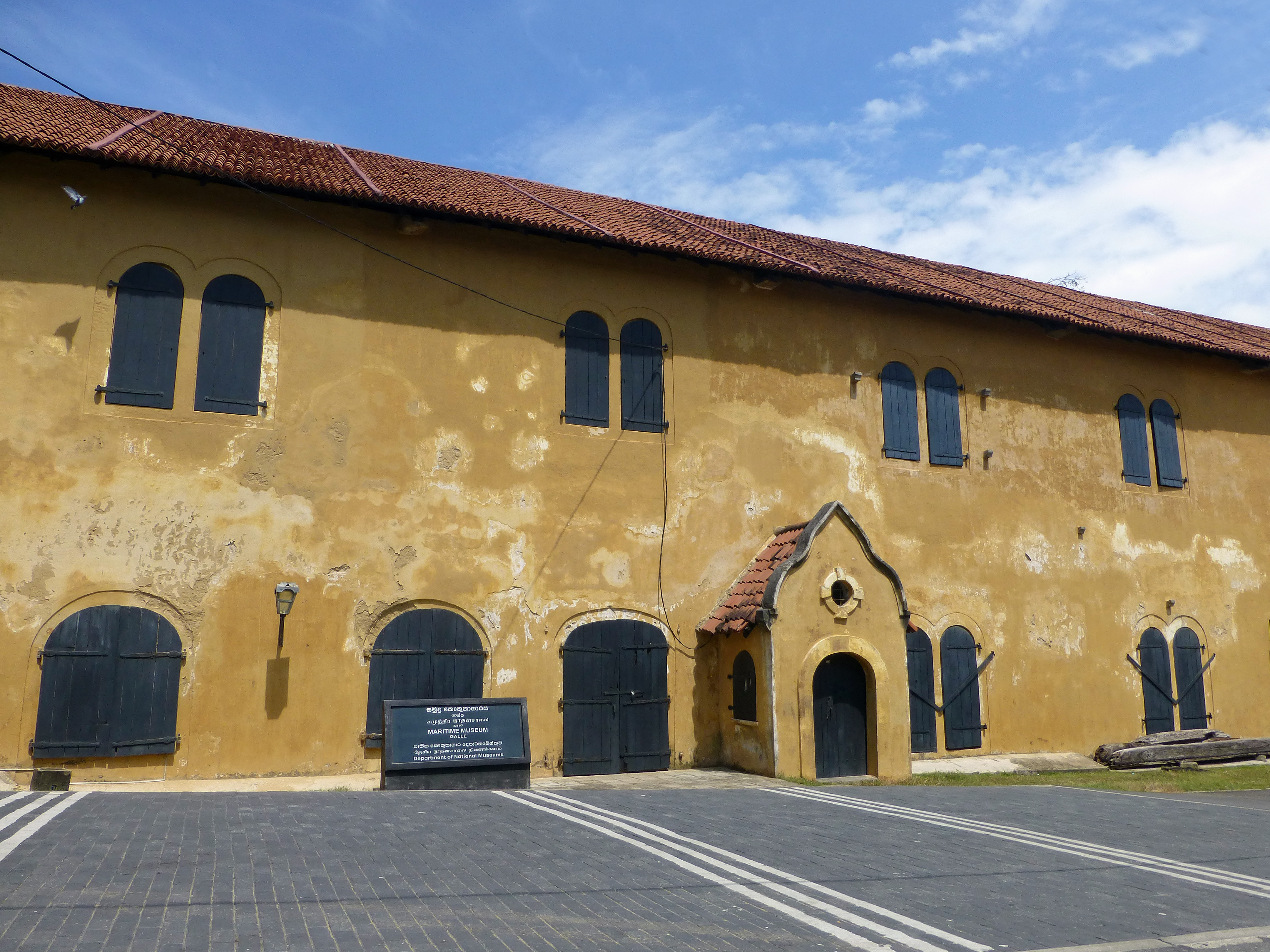
National Maritime Museum (Galle)
The inscription above the Old Gate of Galle Fort reads 1669, flanked by the letters VOC and an insignia of a cock between two lions. Walk through that gate and you pass beneath a building that has served as warehouse, administrative office, derelict shell, and museum -- sometimes more than one of these at once. The National Maritime Museum occupies a Dutch warehouse built in the latter part of the 17th century, a structure unusual even among Dutch colonial fortifications because part of it is embedded directly into the thickness of the rampart wall itself. When the museum first opened on 9 May 1992, it displayed relics pulled from more than twenty maritime archaeological sites scattered across the bay. Twelve years later, the Indian Ocean would send most of those relics back.
A Warehouse Built Into the Wall
Dutch military engineers typically kept their warehouses separate from their fortifications. At Galle, they did something different: they built the warehouse partially into the rampart, so that the structure's lower level doubled as the fort's original gateway. The two-storey building straddles the Old Gate, its ground floor bisected by the entrance passage. For more than three centuries the building shifted purpose with each change of administration. Under the Dutch East India Company, it stored trade goods moving through one of the Indian Ocean's busiest ports. The British added their own coat of arms above the entrance when they took control -- the English lion and Scottish unicorn holding the motto 'Dieu et mon droit' -- but kept using the building. After Sri Lankan independence, it became an administrative office complex. When those offices relocated to a new secretariat building outside the fort, the warehouse fell into disrepair, its coral-stone walls crumbling from neglect and tropical decay.
Twenty Wrecks on the Museum Floor
The decision to convert part of the building into a maritime museum in 1992 was driven by what lay just offshore. Galle Harbour and its surrounding waters contained more than twenty documented shipwreck sites, a concentration of colonial-era maritime disaster that made the bay an archaeologist's treasure trove. The museum's original collection of 3,600 objects included artifacts salvaged from these wrecks -- trade goods, navigational instruments, personal belongings of sailors who never reached port. Beyond shipwreck relics, the museum displayed life-size dioramas of traditional Sri Lankan fishing methods and a 'walk into the sea' exhibit showing coral beds, sea grass meadows, and deep-sea fish. Scaled-down models of whales shared gallery space with displays on coastal erosion and sea pollution. For a small museum in a converted warehouse, it punched well above its weight, drawing researchers and casual visitors alike to one of the Indian Ocean's most artifact-rich coastlines.
The Wave That Took the Collection
On 26 December 2004, the Indian Ocean tsunami entered Galle through the northern gate -- the same gate the British had cut through the rampart in 1873. Water flooded the museum premises to a height of 2.2 meters. The building itself survived, its thick Dutch walls absorbing the impact much as they had absorbed centuries of weather. But the collection did not fare as well. An estimated eighty percent of the 3,600 shipwreck artifacts were lost or damaged beyond recovery. The adjoining UNESCO Maritime Archaeology Unit, a joint Sri Lankan-Dutch project housed on one of the old jetties just outside the northern gate, was completely destroyed. Objects that archaeologists had spent years carefully extracting from the seafloor were returned to the sea in minutes. The museum, already closed for renovations at the time of the tsunami, would remain shuttered for more than five years.
Rebuilt From the Waterline
Reconstruction funding came from the same country that had built the warehouse in the first place. The Kingdom of the Netherlands provided a grant of 177 million rupees to fully renovate the original 40,000-square-foot Dutch warehouse. On 4 March 2010, the building reopened as Sri Lanka's first National Maritime Archaeology Museum, shifting its focus from general marine science to the archaeological heritage of the southern coast. The renovated museum features dual access -- upper-level entry from the present main gate, lower-level entry reinstating the building's original position as the fort's primary gateway. Exhibits now showcase marine artifacts from underwater explorations: maps, naval craft, ropes, earthenware, beer mugs, smoking pipes, barrels, artillery guns, and sailor shoes. Some artifacts recovered from shipwrecks off the southern coast date back nearly eight hundred years. The museum that the ocean nearly erased now exists specifically to tell the story of what the ocean has preserved.
From the Air
The National Maritime Museum is located at 6.028N, 80.218E, inside Galle Fort near the Old Gate on the northeast side of the fortification. The building straddles the original gateway and is identifiable from the air by its long rectangular footprint embedded in the rampart wall. The fort's star-bastion outline is a strong visual reference. From above, the Old Gate area faces the harbor to the north, with the museum building running along the wall. Nearest airports: Koggala Airport (VCCO) approximately 15 km southeast; Mattala Rajapaksa International (VCRI) roughly 150 km east-southeast; Colombo Bandaranaike International (VCBI) 150 km north. Recommended viewing altitude: 1,500-3,000 ft to distinguish individual fort buildings.