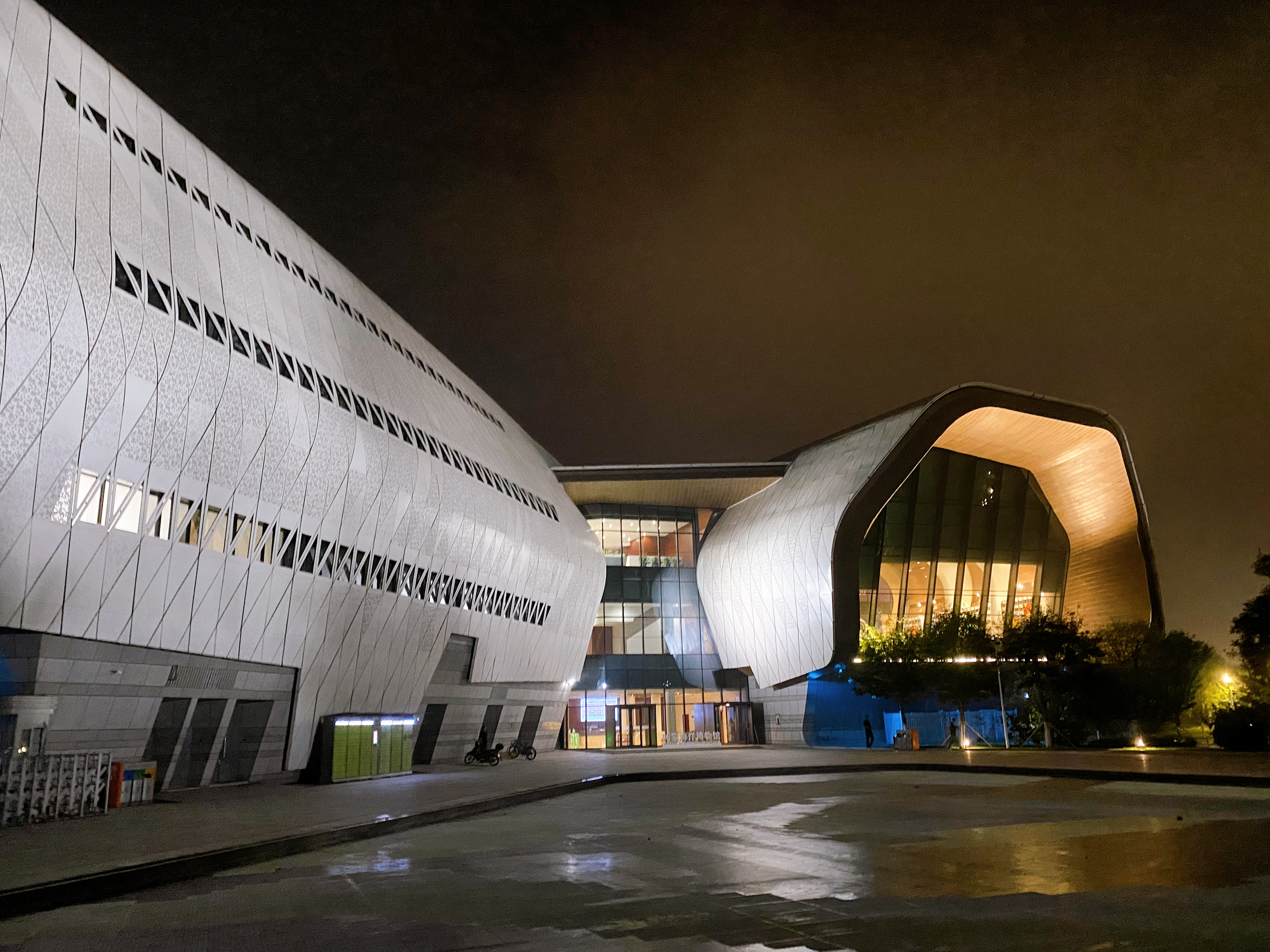
National Maritime Museum of China
From the air, the National Maritime Museum of China looks like something that belongs to the sea -- its flowing, interlocking structures suggest shells or breaking waves, depending on the angle and the light. This is by design. Australian architect Philip Cox, who also designed the Sydney Football Stadium and multiple venues for the 2000 Sydney Olympics, conceived the building as a dialogue between land and ocean, and when his plan was selected from a global competition in 2013, it swept three awards at the World Architecture Festival in Singapore. The museum opened for trial operation on May 1, 2019, and it is the largest maritime museum in the world.
An Idea Born from Academicians
The museum's origins trace to September 2007, when more than thirty academicians from the Chinese Academy of Sciences and the Chinese Academy of Engineering jointly wrote to the State Council, arguing that China's status as a major maritime nation demanded a comprehensive national museum devoted to the sea. The State Council agreed, and a lengthy selection process began. The State Oceanic Administration evaluated sites for years before the National Development and Reform Commission approved the Binhai New Area location in April 2010, citing its coastal proximity to Beijing and favorable transportation links. It was an intentional choice: the museum would sit where the Bohai Bay meets the reclaimed landscape of the Sino-Singapore Tianjin Eco-city, a setting where architecture and environment could reinforce each other.
A Global Competition for a National Vision
Between November 2012 and February 2013, two rounds of global solicitation drew designs from six leading international firms, including GMP from Germany, Preston Scott Cohen from the United States, and EMBT from Spain. Philip Cox's winning design drew on his experience with large-scale public buildings to create a structure that is both monumental and organic. Liu Jingliang, Honorary President of the Tianjin Institute of Architectural Design, served as the chief designer on the Chinese side, ensuring the building's grand gestures worked within the specific conditions of the Binhai coast. Construction of the main building began in October 2014, and the project passed its final acceptance inspection in December 2018.
What Lies Inside
The museum integrates collection, display, research, and education across an institution jointly managed by the Ministry of Natural Resources and the Tianjin Municipal Government. Its exhibitions explore China's relationship with the ocean across millennia, from ancient maritime trade routes to modern naval development. Among its outdoor exhibits, the Type 037IG missile boat Yuqing sits preserved as a tangible link to China's naval history -- a warship retired from service and given a second life as a museum piece. The juxtaposition of the sleek vessel against Cox's flowing architecture captures the museum's ambition: to present China's maritime identity not as a single narrative but as an evolving relationship between a civilization and its coastline.
Architecture as Statement
Standing on the edge of reclaimed land, the museum makes a statement about intention. The Binhai New Area was once saltpans and barren ground; the Eco-city that surrounds it is an experiment in building livable spaces from degraded landscapes. The museum anchors this transformation culturally, giving the planned community a landmark that draws visitors from across China. Its scale and ambition reflect a broader pattern in Chinese museum-building -- the use of architecture not merely to house collections but to declare a city's or a nation's aspirations. For the Binhai district, the National Maritime Museum performs both functions, serving as repository and symbol in equal measure.
From the Air
Located at 39.11°N, 117.79°E in the Binhai Tourism Zone of the Sino-Singapore Tianjin Eco-city. The museum's distinctive flowing architecture is visible from altitude as a large, organic-shaped structure on the coast. Nearest airport: Tianjin Binhai International (ZBTJ/TSN), approximately 20 km to the southwest. At 3,000-5,000 feet AGL, the museum, adjacent Eco-city development, and Bohai Bay coastline provide excellent visual context.