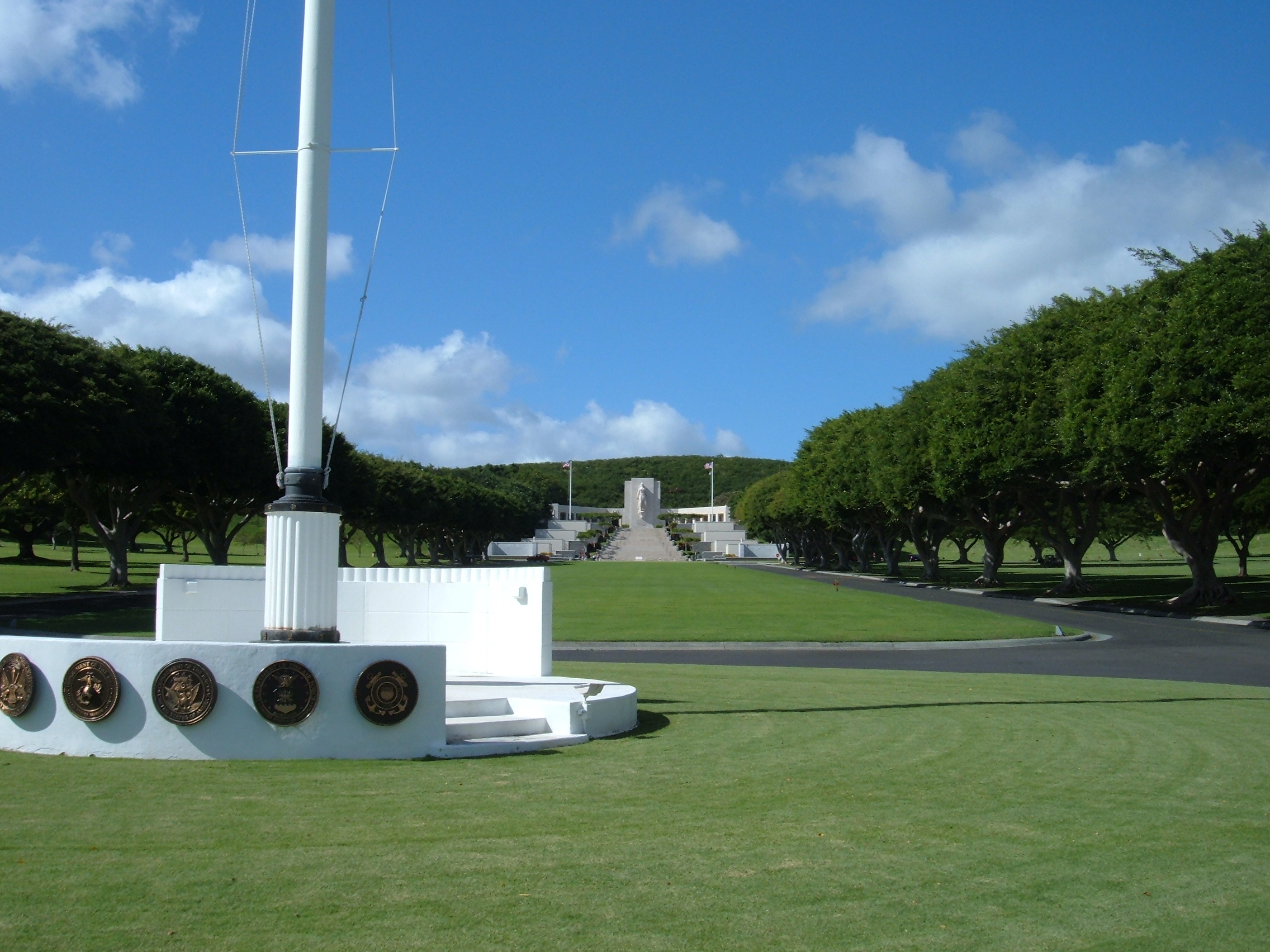
National Memorial Cemetery of the Pacific
Ernie Pyle was one of the first five people buried here. The Pulitzer Prize-winning war correspondent, who had survived the beaches of Normandy only to be killed by a Japanese sniper on Ie Shima in April 1945, was laid to rest on July 19, 1949, alongside an unknown serviceman, two Marines, and an Army lieutenant. They were the inaugural interments at a cemetery that would grow to hold more than 53,000 souls inside the bowl of an extinct volcano overlooking the city of Honolulu.
A City of the Dead Above a City of the Living
The idea of putting a cemetery in Punchbowl Crater was first proposed in the 1890s and promptly rejected. Critics recoiled at the notion of building a necropolis on a hill above Honolulu, and practical concerns about water contamination sealed the argument. Half a century later, World War II changed the calculus. By 1947, thousands of American servicemen lay in temporary graves on Guam, Wake Island, and across the Pacific, awaiting permanent burial. Congress approved funding in February 1948, and the governor of Hawaii offered the crater. The Hawaiian name for the place is Puowaina, most commonly translated as "Hill of Sacrifice" -- a name that predates the cemetery by centuries. Ancient Hawaiians used the crater rim as a site for rituals and offerings, and during the reign of Kamehameha the Great, cannons were mounted there to salute arriving dignitaries.
Bringing Them Home
Before the cemetery even opened to the public, remains began arriving from across the Pacific Theater. The logistics were staggering. Bodies were exhumed from temporary burial sites on tropical islands, identified where possible, and transported to Hawaii for permanent interment. Over 13,000 World War II dead eventually came to rest in the Punchbowl. The process did not end with that war. During Operation Glory in 1954, the remains of 4,167 American soldiers were exchanged with North Korea and China for 13,528 of their dead. Of the returned Americans, 416 could not be identified by name and were buried as unknowns in the Punchbowl. Decades later, forensic advances and persistent detective work began putting names to those markers. In 2007, two unknowns were identified as Marines from the 1st Marine Division, killed in December 1950 during the brutal retreat from the Chosin Reservoir.
Twenty-Eight Thousand Names on Stone
At the top of the cemetery, past rows of flat granite headstones that replaced the original white wooden crosses in 1951 -- a change that provoked public outcry despite the Army's warnings -- stands the Honolulu Memorial. Erected in 1964 by the American Battle Monuments Commission, it lists the names of 28,788 military personnel who were lost at sea, missing in action, or buried in unknown graves across the Pacific during World War II, Korea, and Vietnam. Ten Courts of the Missing flank a grand stone staircase. At its summit, a statue of Lady Columbia stands on the prow of a ship, holding a laurel branch. Below her, an inscription borrowed from Lincoln's letter to Mrs. Bixby reads: "The solemn pride that must be yours to have laid so costly a sacrifice upon the altar of freedom." The memorial is one of only three war memorials in the United States administered by the ABMC.
The People Who Rest Here
The Punchbowl holds Medal of Honor recipients from three wars, 34 in all. Many came from Hawaii's own communities -- men like Barney Hajiro, Shizuya Hayashi, and Yeiki Kobashigawa of the legendary 442nd Regimental Combat Team, the Japanese-American unit that became the most decorated in Army history while their families sat in internment camps on the mainland. Senator Daniel Inouye, who lost his arm fighting with the 442nd in Italy and went on to serve Hawaii in Congress for 53 years, rests here beside them. So does Ellison Onizuka, Hawaii's first astronaut, killed in the Challenger disaster in 1986. And Patsy Mink, the congresswoman who co-authored Title IX. Among the more unexpected graves: Donn Beach, the inventor of the tiki bar, and Stanley Armour Dunham, grandfather of President Barack Obama.
The View from the Rim
Millions of visitors come to the Punchbowl each year, making it one of Hawaii's most visited sites. The crater rim offers panoramic views of Honolulu, Diamond Head, and the Pacific. A 25-bell carillon nicknamed "Coronation," dedicated in 1956, sounds across the grounds. Sixty memorial boulders bearing bronze plaques line a pathway through the cemetery, placed by organizations and governments honoring America's veterans. The cemetery now primarily accepts cremated remains in above-ground columbaria, a reflection of both space constraints and changing customs. A $25 million expansion in 2015 added Columbarium Court 13 with 6,860 new niches. Construction continues. The Punchbowl is still making room for the people who served.
From the Air
Located at 21.312N, 157.846W inside Punchbowl Crater in Honolulu. The crater is a distinctive circular formation clearly visible from the air at altitudes above 1,500 feet. Diamond Head crater is visible 3 miles to the southeast. Honolulu International Airport (PHNL) lies 4 miles to the west. Best viewed in morning light from the south or east approach.