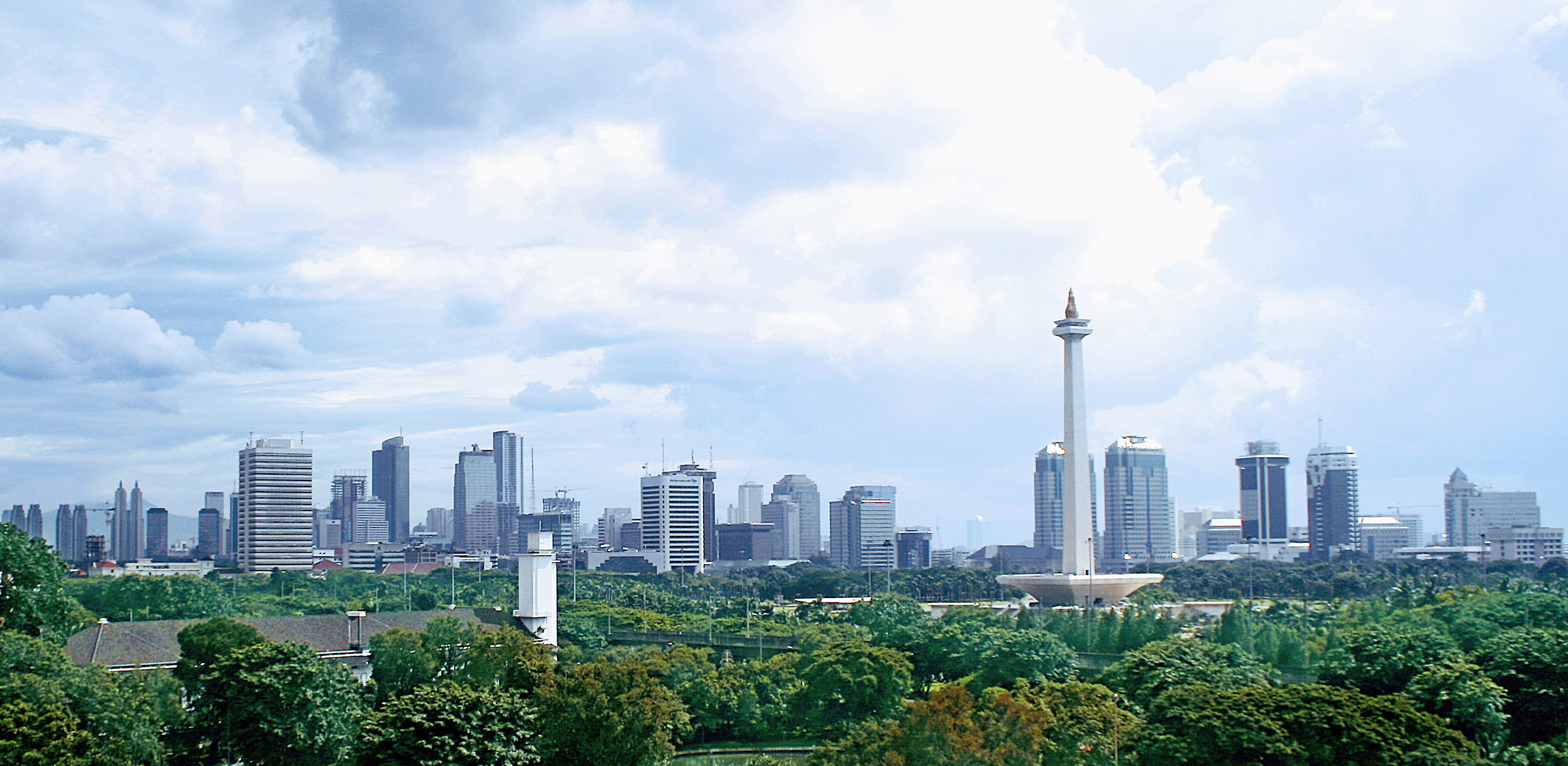
National Monument (Indonesia)
Sukarno wanted something to rival the Eiffel Tower. What Indonesia got instead was a 132-meter obelisk sheathed in Italian marble and topped with a bronze flame gilded in gold -- a monument that encodes the date of national independence into its physical dimensions. The numbers 17, 8, and 45 appear throughout the structure, a reference to 17 August 1945, the day Sukarno read the Proclamation of Indonesian Independence. Architect R.M. Soedarsono wove them into the platform height, the obelisk proportions, and the flame above. Standing at the center of Jakarta's Merdeka Square, the National Monument -- universally called Monas -- is part national symbol, part history museum, and part observation tower. It took fourteen years to build, survived a coup attempt and a funding crisis, and now anchors one of the largest public squares in the world.
Two Competitions and a Presidential Vision
The story of Monas begins with frustration. After Indonesia's government returned to Jakarta from Yogyakarta in 1950, Sukarno wanted a national monument on the great square facing his presidential palace. A design competition in 1955 drew 51 entries; only one, by the prominent architect Friedrich Silaban, met the committee's criteria of reflecting Indonesian character in a building meant to last centuries. A second competition in 1960 attracted 136 entries -- and again, none satisfied the judges. Sukarno had a specific vision: the monument should take the form of a lingga and yoni, ancient symbols of harmony and fertility rooted in Hindu-Javanese tradition. Silaban was asked to design such a monument but produced plans so ambitious they were unaffordable. When he refused to scale them down, Sukarno turned to Soedarsono, who delivered the design that stands today.
Building Through Turmoil
Construction began on 17 August 1961 -- independence day, naturally -- with Sukarno driving in the first concrete pile. The foundation alone required 284 piles, with another 360 for the underground museum. By August 1963, the obelisk structure was complete. Then everything stalled. The aftermath of the 30 September Movement, a failed coup attempt in 1965, plunged Indonesia into political upheaval and economic hardship. Funding dried up, and the second phase of construction dragged from 1966 to 1968 with little progress. Work resumed in earnest during the final phase, from 1969 to 1976, when dioramas were installed in the underground museum and persistent water-leaking problems were addressed. Monas finally opened to the public on 12 July 1975 -- fourteen years after groundbreaking, under a different president, in a very different Indonesia.
Symbols in Stone and Gold
The monument's design draws on the philosophy of lingga and yoni -- forms that evoke the traditional rice pestle and mortar, tools central to Indonesian daily life for centuries. The 117.7-meter obelisk rises from a 45-meter square platform at a height of 17 meters, creating the stepped silhouette visible across Jakarta. Italian marble clads the shaft. At the summit, a 14.5-ton bronze flame structure -- 14 meters high, 6 meters in diameter, assembled from 77 sections -- is covered in gold leaf. Originally 35 kilograms of gold were applied; for the 50th anniversary of independence in 1995, the coating was refreshed and increased to 50 kilograms. Below ground, the National History Museum houses 51 dioramas tracing Indonesian history from the prehistoric era through the Sriwijaya and Majapahit empires, European colonization, the Japanese occupation, and independence. The Hall of Independence, inside the goblet-shaped platform, holds the original Proclamation text behind mechanized bronze doors that weigh four tons and open to a recording of Sukarno's voice.
The View from 115 Meters
An elevator on the southern side carries visitors to the observation platform at 115 meters, where roughly 50 people can stand and survey the sprawl of Jakarta in every direction. On clear days the city stretches to the haze-blurred horizon -- a metropolis of more than ten million people radiating outward from the green expanse of Merdeka Square below. The surrounding reliefs in the outer courtyard tell Indonesia's story in molded cement: Singhasari and Majapahit, Dutch colonization, local uprisings, Japanese occupation, the proclamation, and the turbulent decades that followed. A statue of Prince Diponegoro, the 19th-century Javanese national hero, stands to the north. Around the base, a pond originally designed to cool the air conditioning system reflects the obelisk on still mornings. Monas appears on the coat of arms of Jakarta -- fitting for a monument that has become inseparable from the city's identity.
From the Air
Located at 6.18S, 106.83E at the center of Merdeka Square in Central Jakarta. At 132 meters, Monas is easily the most prominent vertical structure in the area and is topped by a gold-leaf flame that can catch sunlight visibly from altitude. Merdeka Square itself is one of the largest urban squares in the world, providing a massive green reference point. The Merdeka Palace sits on the north side of the square. Nearest major airport is Soekarno-Hatta International Airport (WIII), approximately 25 km to the northwest. Halim Perdanakusuma International Airport (WIIH) is roughly 12 km southeast. The monument is best spotted at lower altitudes when the gold flame reflects sunlight.