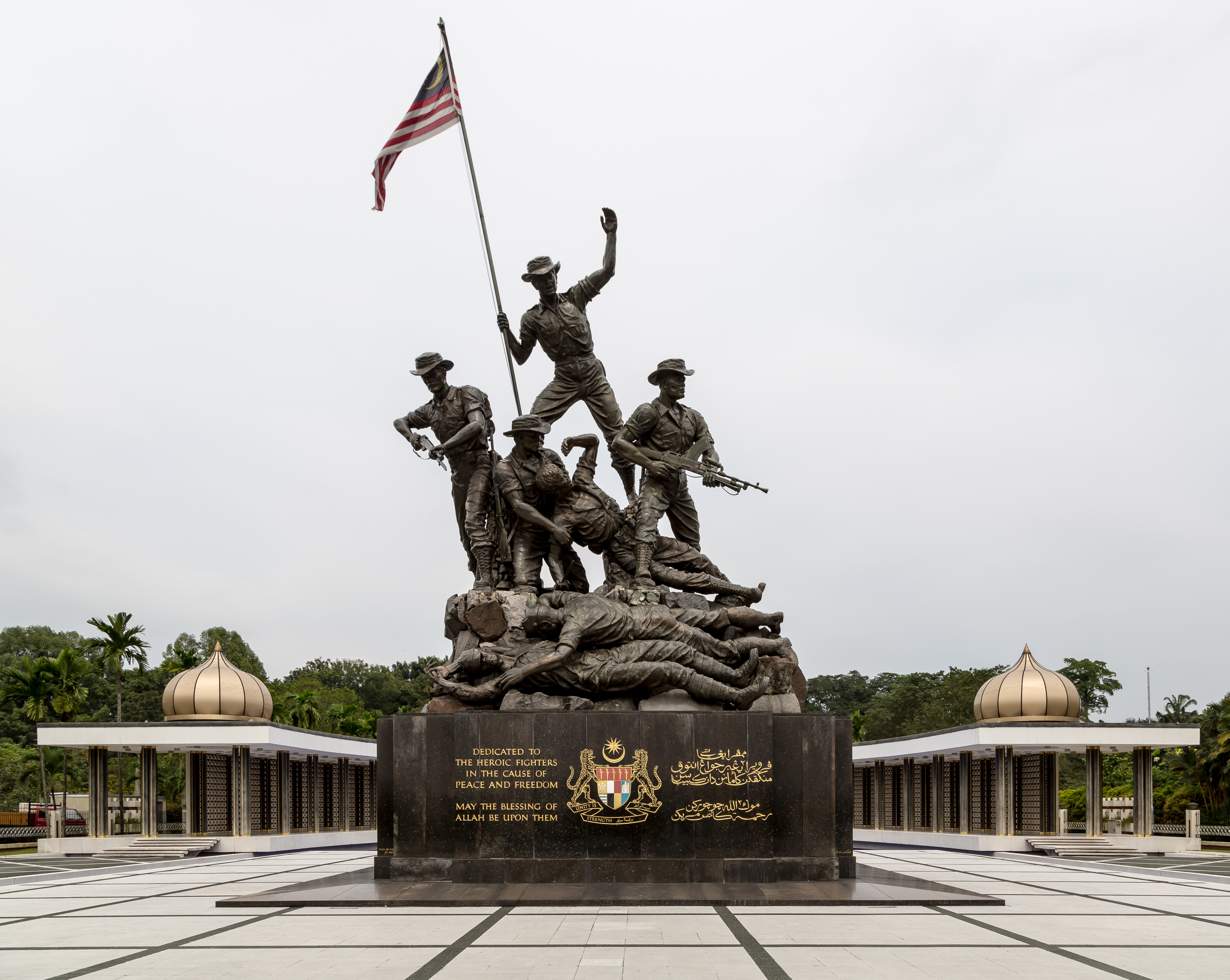
National Monument (Malaysia)
The sculptor who created one of America's most recognizable war memorials also made one of Malaysia's. Felix de Weldon, the Austrian-born artist behind the Marine Corps War Memorial in Arlington, Virginia, was personally recruited by Tunku Abdul Rahman, Malaysia's first prime minister, after a visit to Washington in October 1960. The result, the Tugu Negara, stands 15 meters tall in Kuala Lumpur's Lake Gardens, depicting seven bronze soldiers in a tableau of victory. It is the world's tallest freestanding bronze sculpture grouping, and since its unveiling in 1966, it has served as both a solemn memorial to 11,000 war dead and a lightning rod for religious and political controversy.
From Cenotaph to Colossus
Before the Tugu Negara existed, a more modest structure honored Malaysia's fallen. An interwar-era cenotaph, erected by the British colonial administration on a roundabout near Victory Avenue, originally commemorated soldiers from British Malaya killed in World War I. After the Second World War, inscriptions were added for that conflict's dead as well. In 1964, when a planned flyover threatened its location near the Kuala Lumpur Railway Station, the cenotaph was dismantled into catalogued parts and reassembled at the site of the future national monument in Lake Gardens. New inscriptions honored soldiers from the Malayan Emergency, the twelve-year communist insurgency that claimed roughly 11,000 lives between 1948 and 1960. The cenotaph still stands beside the larger monument, bearing its bilingual inscription: "To Our Glorious Dead."
Bronze Cast in Rome
De Weldon was commissioned in 1963, and the sculpture was cast at a foundry in Rome at a cost of RM600,000. Seven figures make up the composition. Five represent the victorious allied forces: one holds the Malaysian flag, two are armed with a rifle and machine gun, and two tend to a wounded comrade. The remaining two figures lie on the ground, representing defeated communist forces. The symbolism is explicit: democracy, peace, and freedom triumph over communism. The granite base bears the Malayan Coat of Arms flanked by inscriptions in English and Malay, rendered in both Latin and Jawi script. Even the stone beneath the soldiers' feet was imported, quarried from the Swedish coastal city of Karlshamn. De Weldon was later conferred the title Tan Sri, the Malaysian equivalent of a high-ranking knighthood.
A Bomb and a Restoration
The monument was officially opened on 8 February 1966. For nearly a decade it stood undisturbed, the site of annual wreath-laying ceremonies on Warriors' Day, 31 July. Then, on 26 August 1975, a communist guerrilla detonated an explosive that caused extensive damage to the sculpture. Restoration fell to a four-person team led by Christopher Carney, an Australian sculptor and lecturer at Universiti Teknologi MARA. The rebuilt statues were unveiled on 11 May 1977. A fence was erected and the complex declared a protected area between sunset and dawn. Every morning since, a soldier has raised the national flag at the monument; every evening, another has lowered it.
Sacred or Idolatrous?
In 2010, the monument became the center of a religious controversy that revealed fault lines in Malaysian society. Religious Affairs Minister Jamil Khir Baharom announced that Warriors' Day commemorations would be moved elsewhere, after the National Fatwa Council declared the human-shaped statues potentially idolatrous under Islamic guidelines. Defence Minister Zahid Hamidi added that a new Warrior's Square would be built in Putrajaya, the administrative capital. The controversy deepened in September 2016 when Harussani Zakaria, the mufti of Perak, declared that the monument's construction had been a "big sin" because depicting humans in sculpture was haram. The debate placed the Tugu Negara at the intersection of national identity, religious authority, and the legacy of a multicultural founding generation that saw no contradiction in honoring its dead with figurative art.
Standing in the Garden
Despite the political disputes, the Tugu Negara remains in place. Remembrance Day ceremonies still occur at the cenotaph beside it. Tourists and school groups visit year-round, walking the grounds of the memorial park that Tunku Abdul Rahman envisioned more than six decades ago. The monument appears on Malaysian banknotes issued between 1982 and 1989. Nearby, the Malaysian Houses of Parliament rise above the tree line. The Lake Gardens, one of Kuala Lumpur's largest green spaces, spread out in every direction. Whatever the arguments over its form, the seven bronze figures continue to do what they were designed to do: stand watch over the memory of the 11,000 who did not come home from the Emergency.
From the Air
Located at 3.149°N, 101.684°E in the Lake Gardens district of central Kuala Lumpur, near the Malaysian Houses of Parliament. The monument sits on elevated ground within a landscaped memorial park. Best viewed at low altitude from the west, with the parliament building visible nearby. Sultan Abdul Aziz Shah Airport (WMSA) lies 25 km west; Kuala Lumpur International Airport (WMKK) is 50 km south.