National Museum of Malaysia
A bronze bust of King Edward VII still stands in the grounds. So does a statue of Sir Frank Swettenham, the British Resident who shaped colonial Malaya. That these monuments survive on the lawn of a museum built to celebrate Malaysian independence says something about the institution's relationship with its own past -- not erasure, but accumulation, layer upon layer, the colonial period folded into a longer story that stretches back to the Stone Age and forward to a 1.3-liter Proton Saga parked out front.
Before the Nation Had a Name
The museum's ground floor begins where the peninsula's human story begins: with stone tools, bronze vessels, and iron implements that predate every kingdom and sultanate. The ancient Hindu-Buddhist states of Gangga Negara, Srivijaya, and Majapahit left behind artifacts that now sit in glass cases -- a stone makara statue, a bronze Avalokiteshvara from Bidor, a model of the Bujang Valley temple in Kedah. These are not minor footnotes. They represent centuries when the Malay world was woven into a vast maritime network linking India, China, and the Indonesian archipelago. The exhibit continues through the Muslim Sultanate of Malacca, the pivot point around which Malaysian national identity still turns, before climbing to the second floor and the colonial era that followed.
The Selangor Museum's Long Shadow
Long before the National Museum existed, the Selangor Museum served as the peninsula's de facto repository of knowledge. Established in 1887 by colonial civil servants with more enthusiasm than expertise, it grew into something serious under curator Herbert Christopher Robinson, whose collectors ranged across the central highlands -- Fraser's Hill, Genting, Cameron Highlands -- cataloging birds, mammals, and insects with obsessive thoroughness. Their fieldwork, published in the Journal of the Federated Malay States Museums, laid the scientific foundation for the hill stations that became Malaysia's most popular retreats. When Japanese bombers destroyed the Selangor Museum during World War II, surviving collections were moved to the Perak Museum in Taiping. The loss made the case for a new, purpose-built national museum impossible to ignore.
Independence Day, Opening Day
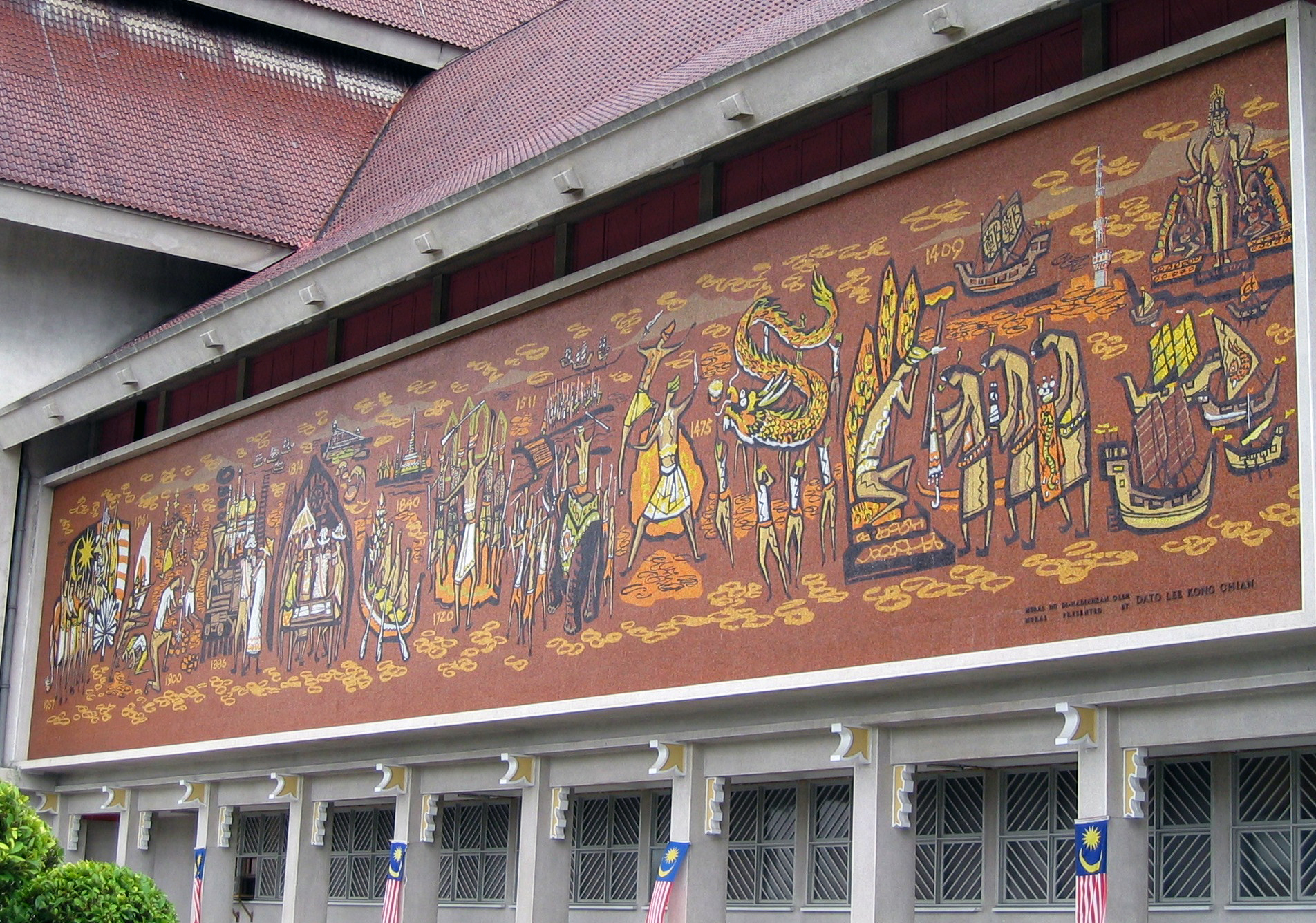
Prime Minister Tunku Abdul Rahman conceived the National Museum as a home for the cultural and historical treasures of a nation about to be born. The three-story building that resulted -- 109.7 meters long, 15.1 meters wide, rising 37.6 meters at its central point -- blends traditional Malay architectural elements with modernist lines. Its facade features large mosaic murals depicting scenes from Malaysian history, while inside, four main galleries span ethnology and natural history. The museum was inaugurated on 31 August 1963, the sixth anniversary of Malaysian independence, tying the building's identity to the nation's birthday. Blue geometric mosaic tiles from Pakistan adorn the Central Hall floor, and intricate carved panels cover the ceiling -- a space that has since hosted exhibitions ranging from 'The Islamic Civilization' to 'Durian King of Fruits.'
A Palace on Stilts
Among the museum's most arresting exhibits is Istana Satu, an original-size Terengganu timber palace built in 1884 by Sultan Zainal Abidin III. Relocated to the museum compound in April 1974, the wooden palace sits on stilts that allow air to circulate beneath, its steep thatch roof engineered to cool the interior in the tropical heat. Intricate wood carvings ornament every door and window, each cut from cengal hardwood. Beside it stand two keliriengs, Borneo burial poles carved from massive tree trunks -- hollowed at the top to hold a jar containing a chief's bones, with niches along the sides for followers. These poles, with their frank physicality, offer a counterpoint to the museum's more polished galleries: a reminder that Malaysia's cultural heritage extends far beyond the peninsula's western coast.
Locomotives, Bullock Carts, and the First National Car
Step outside the main building and the museum becomes an open-air transport gallery. A steam locomotive built by Kitson & Co. of England sits on a stretch of track, its service record spanning 1921 to 1969 and 1.5 million rail miles. Nearby, a Melaka bullock cart echoes the horse-drawn wagons of the American frontier, and a tin dredge resembles a floating factory -- a nod to the industry that once drove the Malay economy. Most poignant, perhaps, is the early Proton Saga, Malaysia's first national car, launched on 9 July 1985. It is a modest vehicle by any standard, but its presence here carries weight: a country that once moved by bullock cart and colonial rail now manufactured its own automobiles. The progression from steam to Saga, arranged casually across a museum lawn, compresses a century of transformation into a single stroll.
From the Air
Located at 3.138N, 101.687E on Jalan Damansara in central Kuala Lumpur, adjacent to the Perdana Botanical Gardens and near KL Sentral station. The museum's distinctive traditional-modern facade and surrounding gardens are visible from low altitude. Sultan Abdul Aziz Shah Airport (WMSA/SZB) at Subang is 18nm west; Kuala Lumpur International Airport (WMKK/KUL) is 30nm south. The KL Tower and Petronas Twin Towers provide useful visual references to the northeast. Best viewed at 2,000-3,000 feet AGL.