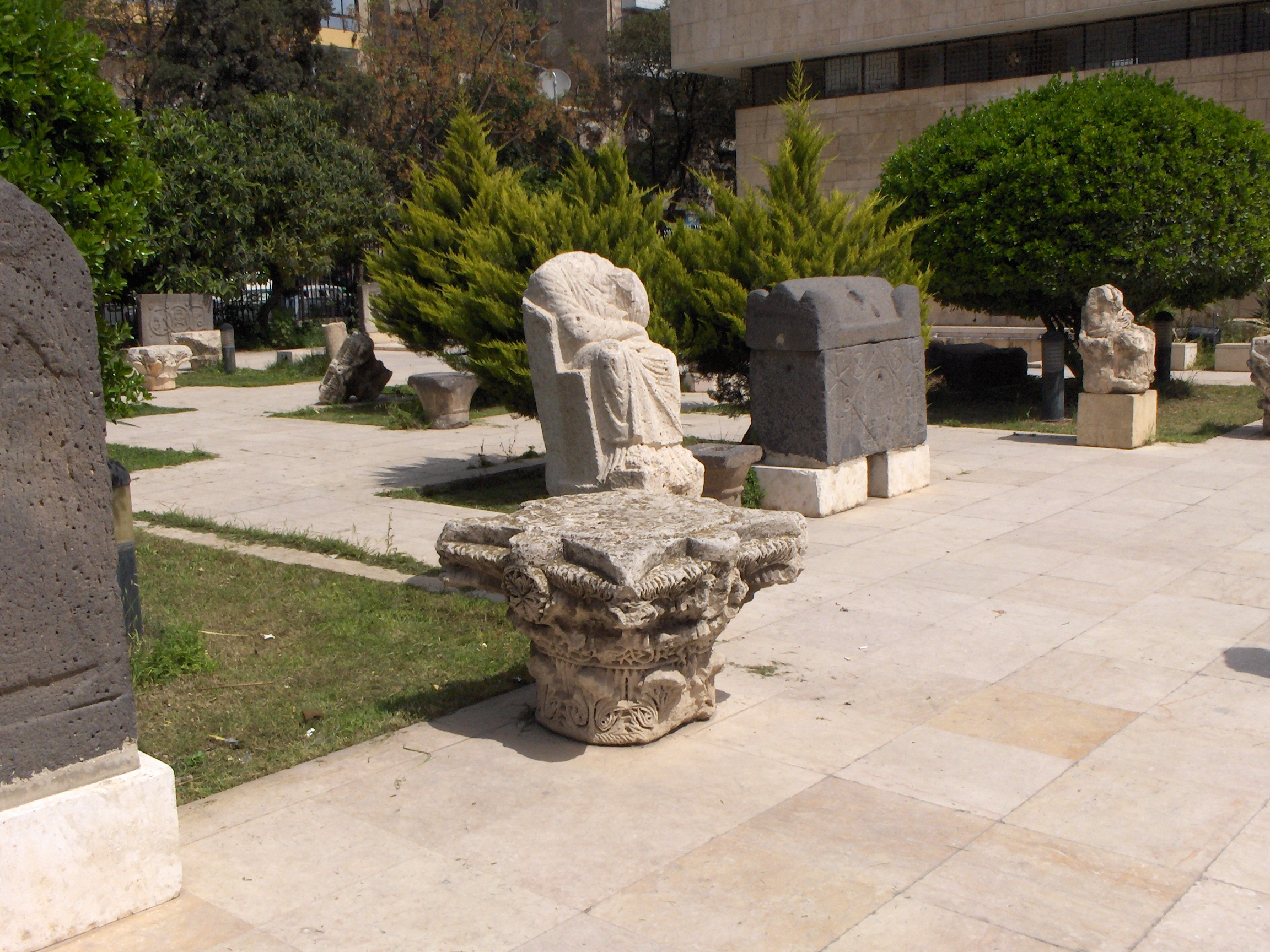
National Museum of Aleppo
A stone sphinx stares out from the museum's entrance, her expression unchanged in three thousand years. She was carved by Neo-Hittite sculptors at Tell Halaf in the 9th century BC, and she has outlasted every empire that claimed her. The National Museum of Aleppo sits on Baron Street in the heart of one of the world's oldest continuously inhabited cities, a repository that compresses ten thousand years of Syrian civilization into a single building. From Stone Age shelters to Islamic astrolabes, from Bronze Age cuneiform tablets to Roman mosaics, the collection maps the entire arc of human settlement in the Fertile Crescent. That it still stands at all, after a decade of civil war and a catastrophic earthquake, is itself a story worth telling.
From Ottoman Palace to Yugoslav Concrete
The museum began modestly in 1931, when Syrian authorities designated a small Ottoman palace as Aleppo's national collection. For three decades the palace sufficed, but the artifacts kept coming -- from excavations at Ebla, Mari, Ugarit, and dozens of lesser-known tells scattered across northern Syria. By the 1960s the collection had outgrown its home. In 1966, the old palace was demolished and replaced with a purpose-built modern structure designed by Yugoslav architects Zdravko Bregovac and Vjenceslav Richter, whose competition entry had won first prize. The result was a clean-lined building that let the artifacts speak for themselves, organized geographically across halls dedicated to specific regions: the Euphrates, Al-Jazeera, Hama, and the ancient trading city of Ugarit, where the world's first alphabet was devised.
Layers Beneath the Surface
Walking the ground floor is a lesson in deep time. The Prehistoric Culture section opens with stone tools from the regions around Aleppo, Ain Dara, and Ebla, then presents what may be the oldest known civilized human shelter, dating to 8500 BC and brought from Mureybet on the Euphrates. Beyond this, the Ancient Syrian Civilizations halls unfold in geographic order. Statues and cuneiform scripts from Mari share space with Bronze Age objects from Hama and pieces excavated by Max Mallowan at Tell Brak. Iron Age materials include Assyrian-style statues from the Al-Jazeera region and reliefs from Arslan Tash and Tell Ahmar. The Hall of Ebla alone contains treasures from a city that rivaled the great Mesopotamian capitals four thousand years ago. Upstairs, Greek coins sit alongside Byzantine mosaics, a 12th-century Islamic astrolabe gleams under glass, and a detailed scale model of Aleppo's old city reveals the labyrinth of souks and alleyways that made this one of the great trading crossroads of the medieval world.
Under Fire
In July 2016, during the Syrian Civil War, missiles and mortar shells struck the museum, tearing through the roof and damaging the structure. Most of the collection had already been evacuated by staff who understood what was at stake, but concerns persisted for items too large or too fragile to move -- the basaltic Hittite statues in the courtyard, the massive Roman mosaics. The building that Bregovac and Richter had designed to house civilization's record became, for a time, a casualty of its destruction. Then, on February 6, 2023, the Turkey-Syria earthquakes struck. The museum's facade cracked. Artifacts inside sustained further damage. Each blow was a reminder that the museum guards something irreplaceable: the physical evidence of how humans first learned to farm, write, trade, and build cities in this very landscape.
The Courtyard's Silent Assembly
In the museum's internal courtyard, huge basaltic statues of Hittite and Roman mythological figures stand in the open air alongside a third-century mosaic. The external courtyard extends the timeline further, with monuments representing Assyrian, Aramaic, Byzantine, and Arabic civilizations arranged as though in conversation with one another. It is a gathering of cultures that once competed for dominance across this region, now reduced to silent stone witnesses. The effect is cumulative rather than dramatic -- not one showstopping artifact but rather the sheer weight of millennia pressing down. Aleppo itself, one of the longest-inhabited cities on the planet, seems to have produced a museum in its own image: layered, resilient, and bearing the marks of every age that passed through it.
From the Air
Located at 36.205N, 37.15E in the heart of Aleppo, Syria. Aleppo International Airport (OSAP) lies approximately 10 km east of the city. The museum is on Baron Street near the Citadel of Aleppo, which serves as the primary visual landmark from altitude -- a massive fortified hill in the city center. Best viewed at 3,000-5,000 ft AGL. The old city and its souks spread outward from the Citadel in a visible pattern of dense urban fabric.