National Museum of Anthropology (Mexico)
A single concrete column, slender as a tree trunk, holds up a canopy the size of a city block. Water cascades down its shaft into a courtyard pool below, and around this engineered waterfall, twenty-three exhibition halls radiate outward like the spokes of a wheel. The National Museum of Anthropology in Mexico City is not subtle about its ambitions. Opened in 1964, it was designed to be a temple -- and Nobel laureate Octavio Paz used exactly that word, though not entirely as a compliment.
The Umbrella
Architect Pedro Ramirez Vazquez, working with Jorge Campuzano and Rafael Mijares Alcérreca, conceived a building that would itself feel monumental. The centerpiece is "el paraguas" -- the umbrella -- a vast square concrete canopy supported by that lone column, sheltering the central courtyard. Construction began in February 1963 and lasted just 19 months. When President Adolfo Lopez Mateos inaugurated it on September 17, 1964, he declared that Mexico was lifting "this monument in honor of the admirable cultures that flourished during the Pre-Columbian period." The building covers nearly 80,000 square meters -- almost 20 acres -- with halls ringed by gardens that double as outdoor exhibit space. It received 3.7 million visitors in 2024, making it the most-visited museum in Mexico and the 17th most-visited art museum in the world.
Centuries of Collecting
The museum's roots reach back to the late 18th century, when the Viceroy of Bucareli ordered the sculptures of Coatlicue and the Sun Stone placed in the Royal and Pontifical University of Mexico. In 1790, botanist Jose Longinos Martinez established Mexico's first Cabinet of Curiosities. Alexander von Humboldt visited during the 19th century. The first Mexican president, Guadalupe Victoria, formalized the collection as the National Mexican Museum in 1825, and Emperor Maximilian relocated it to Calle de Moneda 13 in 1865. By 1924 the holdings had grown to 52,000 objects. The collection was divided twice -- natural history splitting off in 1906, and historical artifacts moving to Chapultepec Castle in 1940 -- before finding its permanent home in the purpose-built structure in Chapultepec Park.
The Stone at the Center
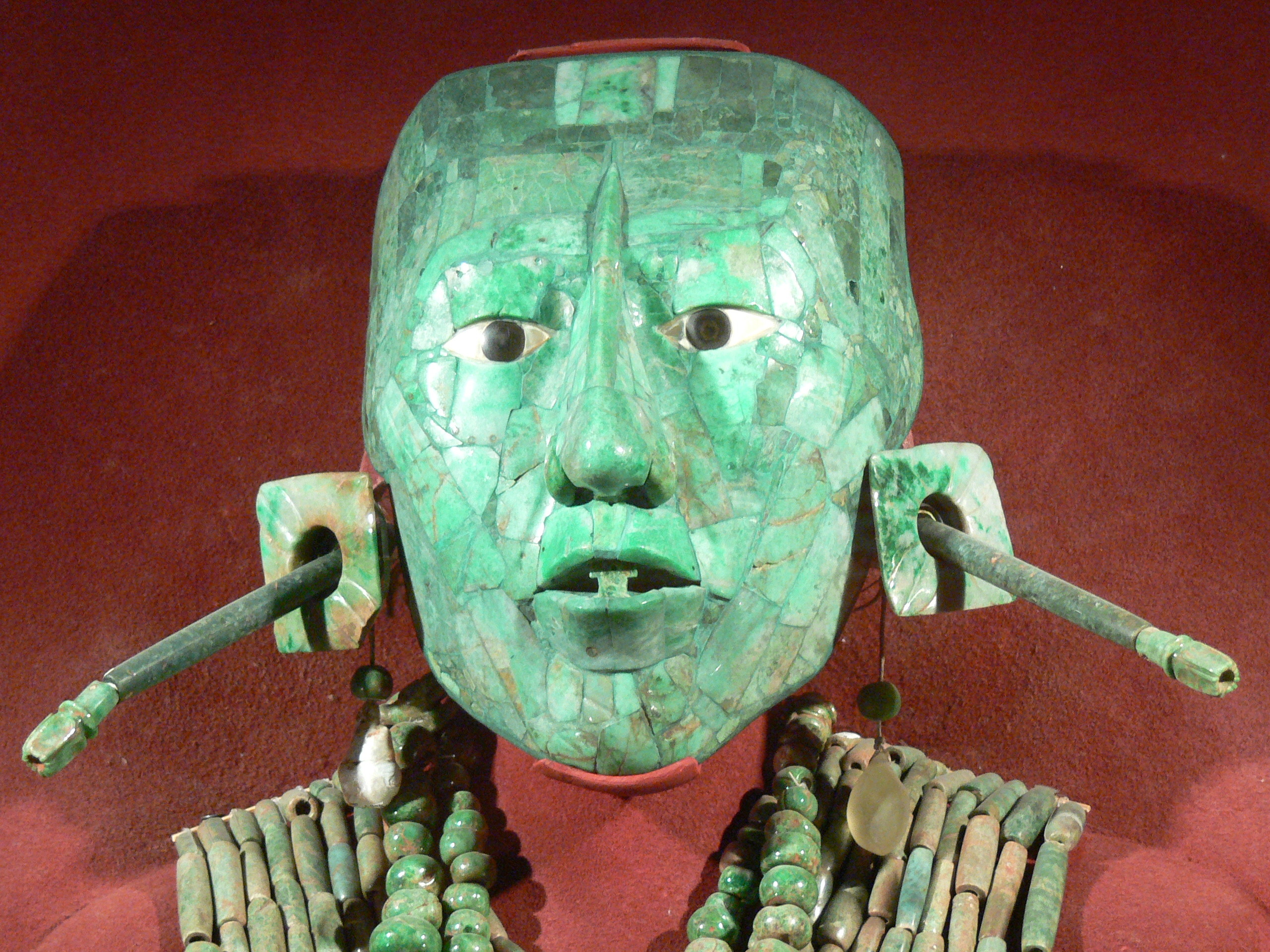
The Aztec Sun Stone anchors the Mexica hall, and this placement is itself a statement. Paz argued that making the Aztec gallery central amounted to an "exaltation and glorification of Mexico-Tenochtitlan" that transformed the museum into something more ideological than scientific. Whether you agree or not, the effect is undeniable. The stone -- a massive basalt disc carved with the face of the sun god Tonatiuh and the symbols of previous cosmic eras -- commands attention the way an altar commands a cathedral. Around it, the ground-floor galleries unfold the full sweep of pre-Columbian Mexico: colossal Olmec stone heads from the jungles of Tabasco and Veracruz, Maya treasures recovered from the Sacred Cenote at Chichen Itza, a replica of the sarcophagal lid from Pacal's tomb at Palenque, and a scale model of the Aztec capital Tenochtitlan.
The Christmas Heist
On December 25, 1985, two veterinary students broke into the museum and stole 124 artifacts. Their motives remain unclear. The theft was one of the most brazen museum robberies in history, and the missing pieces included irreplaceable pre-Columbian objects. Most were recovered in 1989, though four remain missing. One of the thieves was arrested; the other was never found. The story became the basis for the 2018 Mexican film Museo, a darkly comic retelling that treated the heist as an improbable, almost absurd act -- which, given the scale of the museum's security and the thieves' utter lack of a plan, it essentially was.
Living Cultures Upstairs
Visitors who make it past the pre-Columbian galleries on the ground floor -- and many do not, exhausted by the sheer density of the collection -- find a different museum upstairs. The first-floor halls are devoted to ethnography, documenting the living cultures of Mexico's indigenous peoples from the Spanish colonization to the present. The museum also hosts rotating international exhibitions, having featured collections from Iran, Greece, China, Egypt, Russia, and Spain. Managed by the Instituto Nacional de Antropologia e Historia, the museum functions as both a scholarly institution and a declaration of national identity. Its address, between Paseo de la Reforma and Mahatma Gandhi Street, places it at the intersection of Mexico City's grandest boulevard and one of its most contemplative green spaces.
From the Air
Located at 19.4261N, 99.1861W within Chapultepec Park on the west side of Mexico City. The museum's distinctive rectangular footprint and central courtyard are visible from altitude within the large green expanse of the park, south of Paseo de la Reforma. Nearest major airport is Mexico City International (MMMX/MEX), approximately 13 km east. The Chapultepec Castle hilltop is a nearby visual landmark. Best viewed at 2,000-4,000 ft AGL.