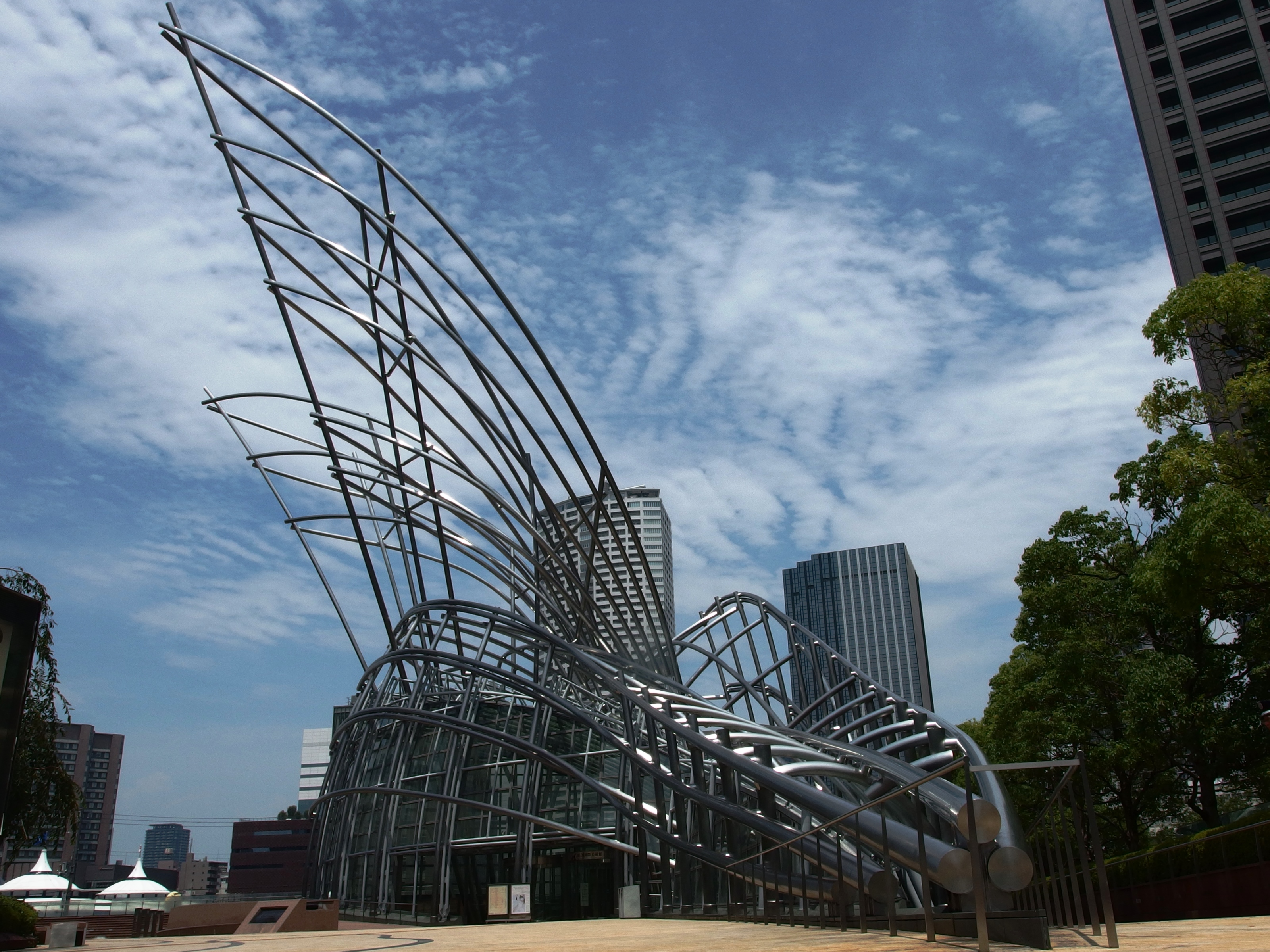
National Museum of Art, Osaka
The building is almost entirely invisible. What visitors see from street level on the narrow island of Nakanoshima -- wedged between the Dojima and Tosabori rivers in central Osaka -- is a towering sculpture of stainless steel and glass tubes rising in two peaks, 52 and 34 meters high, evoking bamboo swaying in the wind. Beneath it, three floors of galleries descend into the earth, holding approximately 8,200 works of contemporary art. The National Museum of Art, Osaka is one of the world's rare completely underground museums, a space where the architecture itself argues that the most extraordinary things can exist just below the surface.
Born from a World's Fair
The museum traces its origins to Expo '70, the first World Exposition held in Asia. That landmark event, themed "Progress and Harmony for Mankind," drew over 64 million visitors to Suita on the outskirts of Osaka between March and September 1970. Among its many pavilions stood the Expo Museum of Fine Arts, designed by architect Kiyoshi Kawasaki. After the fair closed, the site became Expo Commemoration Park, but the art gallery was preserved and reopened in 1977 as the National Museum of Art. For nearly three decades the collection grew within that aging Expo-era structure, until space constraints and the building's deterioration forced a rethinking. The old museum closed in January 2004, was demolished, and its contents migrated to an entirely new home in the heart of the city.
Pelli's Subterranean Vision
Argentine-American architect Cesar Pelli designed the new museum, which opened in November 2004 on Nakanoshima, next door to the Osaka Science Museum. Pelli chose to place nearly all functional space underground, leaving the surface free for his dramatic entrance sculpture -- a framework of steel tubes he described as representing reeds waving in the wind, though the structure also evokes the bamboo groves native to the Kansai region. The entrance level, just below the surface, houses an auditorium, restaurant, and museum shop. The second basement level holds the permanent collection galleries, while the third basement level is reserved for special and co-organized exhibitions. The design achieves something remarkable: a museum that occupies minimal footprint on the crowded island while offering expansive, climate-controlled gallery space below.
Eight Thousand Works and Counting
The NMAO collection focuses on Japanese and international art from 1945 onward, making it Japan's largest repository of contemporary art. The holdings span painting, sculpture, photography, video, and installation, with works by artists from Picasso and Yasuo Kuniyoshi to contemporary figures like Leiko Ikemura and Miyako Ishiuchi. Thematic exhibitions rotate several times a year, each one drawing different threads from the collection to trace movements, ideas, or conversations across decades and continents. The museum is one of seven institutions under Japan's National Museum of Art system, which also includes the National Museum of Modern Art in Tokyo and Kyoto, the National Crafts Museum, the National Film Archive, the National Museum of Western Art in Tokyo, and the National Art Center, Tokyo. Together, they maintain a union catalog that links their combined holdings into a single searchable resource.
An Island Between Rivers
Nakanoshima itself adds context to the museum experience. This slender sandbar between two branches of the old Yodo River has been Osaka's civic and cultural spine for centuries, home to government buildings, concert halls, and research institutions. Walking east from the museum along the tree-lined riverbanks, visitors pass the neoclassical Osaka City Central Public Hall and the prefectural library before reaching the commercial bustle of Kitahama. The museum's location places contemporary art at the center of this cultural corridor, making it easy to pair a gallery visit with the broader Nakanoshima experience -- riverside cafes, cherry blossoms in spring, and illuminated bridges at night.
From the Air
Located at 34.6918°N, 135.4920°E on Nakanoshima, a narrow island in the Dojima and Tosabori river channels running through central Osaka. The island's linear shape is visible from moderate altitude, and the museum's distinctive steel entrance sculpture catches light near the western end. Adjacent to the domed Osaka Science Museum. Nearest airports: Osaka Itami (RJOO) approximately 12 km north, Kansai International (RJBB) approximately 42 km south on its reclaimed island. Best viewed when following the Nakanoshima river corridor at lower altitudes.