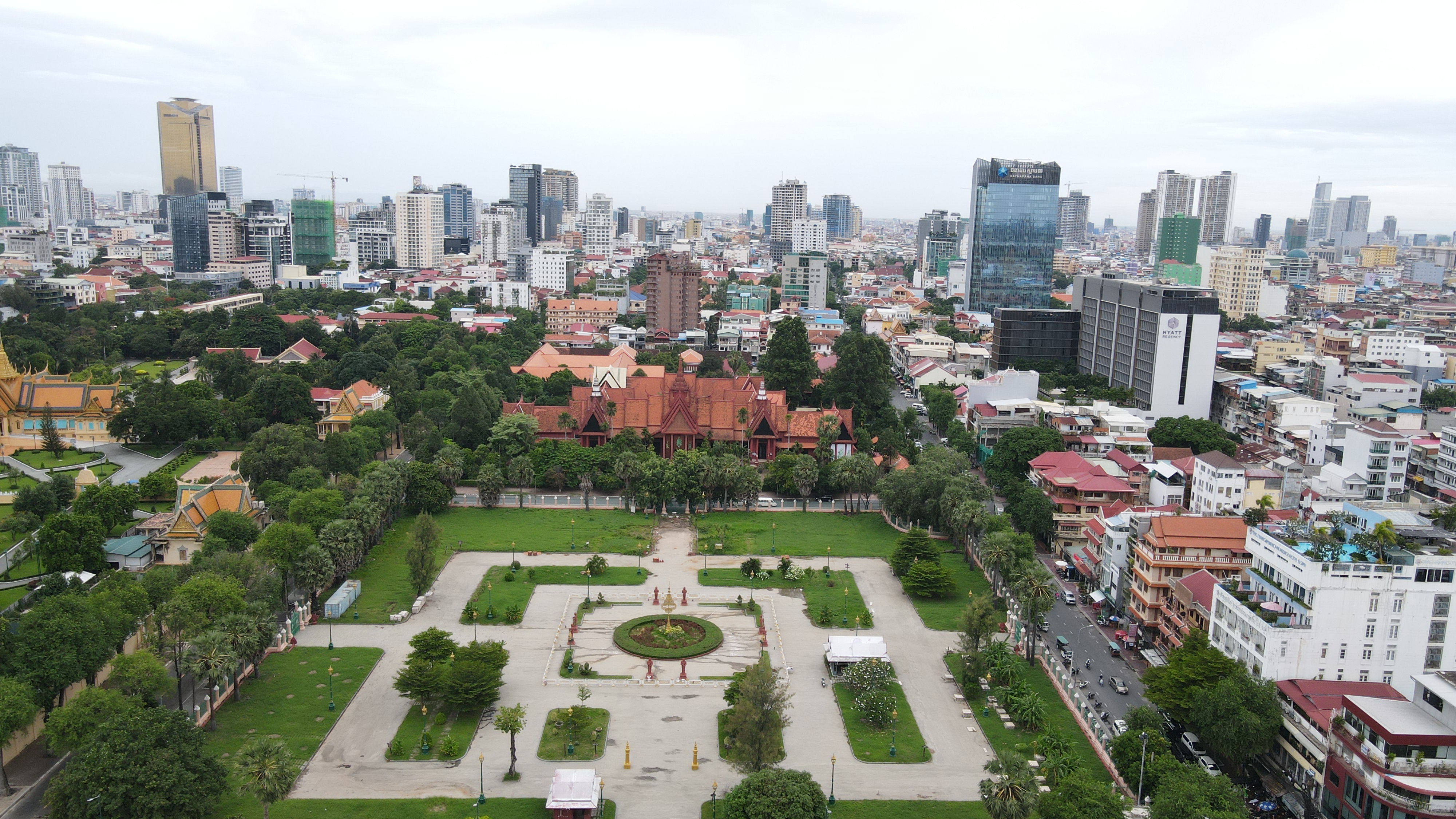
National Museum of Cambodia
When the museum was found in 1979, its roof was rotting, bats had colonized the galleries, the garden had gone wild, and many objects in its collection of Khmer art had been damaged or stolen. The Khmer Rouge had emptied Phnom Penh four years earlier, and the National Museum of Cambodia -- like everything else in the capital -- had simply been abandoned. That it reopened on 13 April 1979, the same Khmer New Year date on which it had originally been inaugurated in 1920, was either coincidence or a quiet act of defiance. The museum had survived before. It would survive again.
A Frenchman's Vision of Khmer Architecture
George Groslier was a historian, curator, and the driving force behind the museum's creation. Born in 1887, he spent years studying Cambodian temple architecture -- not to replicate it, but to enlarge it. The building he designed drew from prototypes found on ancient bas-reliefs, reinterpreted through colonial eyes to meet the scale a museum required. The foundation stone was laid on 15 August 1917. Two and a half years later, King Sisowath himself attended the inauguration on 13 April 1920. Wings were added to the eastern facade in 1924, making the terra-cotta structure more imposing still. What Groslier created was something genuinely new: a building that felt ancient but had never existed before, a colonial-era invention that would come to define what Cambodians themselves recognized as traditional Khmer architecture.
From Colony to Independence
For decades, the museum operated under French colonial authority, its collections growing as archaeological expeditions unearthed treasures from Angkor and other Khmer Empire sites. The relationship between the museum and the Royal University of Fine Arts, founded in 1920 as the Ecole des Arts Cambodgiens, was intimate from the start -- students, artisans, and teachers worked together to preserve cultural traditions, with the university still occupying grounds behind the museum. Control of the institution passed from French to Cambodian hands on 9 August 1951. Following independence in 1953, bilateral accords governed the then Musee National de Phnom Penh. In 1966, Chea Thay Seng became the first Cambodian director, also serving as dean of the newly created Department of Archaeology. The museum was becoming what Groslier had perhaps always intended but could not, as a colonial administrator, have fully realized: a Cambodian institution serving Cambodian identity.
Emptied and Reclaimed
The Khmer Rouge took Phnom Penh on 17 April 1975 and emptied the entire city. The museum was closed, its staff scattered. Many employees lost their lives during the regime's four years in power. When the Vietnamese-backed government reclaimed the capital in January 1979, the museum was found in ruins -- waterlogged, infested, its collection in disarray. The speed of its reopening, just months later, spoke to something urgent: Cambodia needed its past back. The museum could not undo what had happened, but it could reassert that Khmer culture had not been erased. The collection that visitors encountered was diminished and damaged, but it was there. Restoration would take years. The act of opening the doors took will.
Fourteen Thousand Objects and a Living Faith
Today, the museum holds over 14,000 items spanning from prehistoric times through the height of the Khmer Empire -- which at its peak stretched from present-day Thailand across Cambodia to southern Vietnam -- and into the post-Angkorian period. The collection includes sculpture, Khmer ceramics, bronzes, and ethnographic objects, making it one of the world's largest repositories of Khmer art. But the museum is more than an archive. Its Buddhist and Hindu sculptures serve an active religious function; visitors come not only to study but to pray. A permanent exhibition of post-Angkorian Buddha images, supported by UNESCO, opened in 2000 to formalize this role. The museum sits on Street 10 in central Phnom Penh, just north of the Royal Palace and west of Veal Preah Man square -- a location that places it at the physical and symbolic center of Cambodian cultural life.
The Long Work of Bringing Things Home
Looting and illicit export of Cambodian cultural material remain persistent problems, and repatriation has become a central mission. In July 2024, fourteen sculptures were returned from the United States and put on display, including a 10th-century stone sculpture of the goddess Uma from the ancient royal capital of Koh Ker. The museum lends objects for international exhibitions -- a practice that began before Cambodia's decades of upheaval and was revived in 1992 with a show at the National Gallery of Australia. Subsequent exhibitions have traveled to France, the United States, Japan, South Korea, and Germany. Each loan carries a dual purpose: promoting global appreciation of Khmer art while reminding the world that these objects have a home, and that home wants them back.
From the Air
Located at 11.57°N, 104.93°E in central Phnom Penh, the museum's distinctive terracotta-red roofline is visible just north of the Royal Palace complex along the Tonle Sap riverfront. Phnom Penh International Airport (VDPP) lies approximately 9 km to the west. The confluence of the Tonle Sap, Mekong, and Bassac rivers provides a striking navigational reference point immediately east of the museum district.