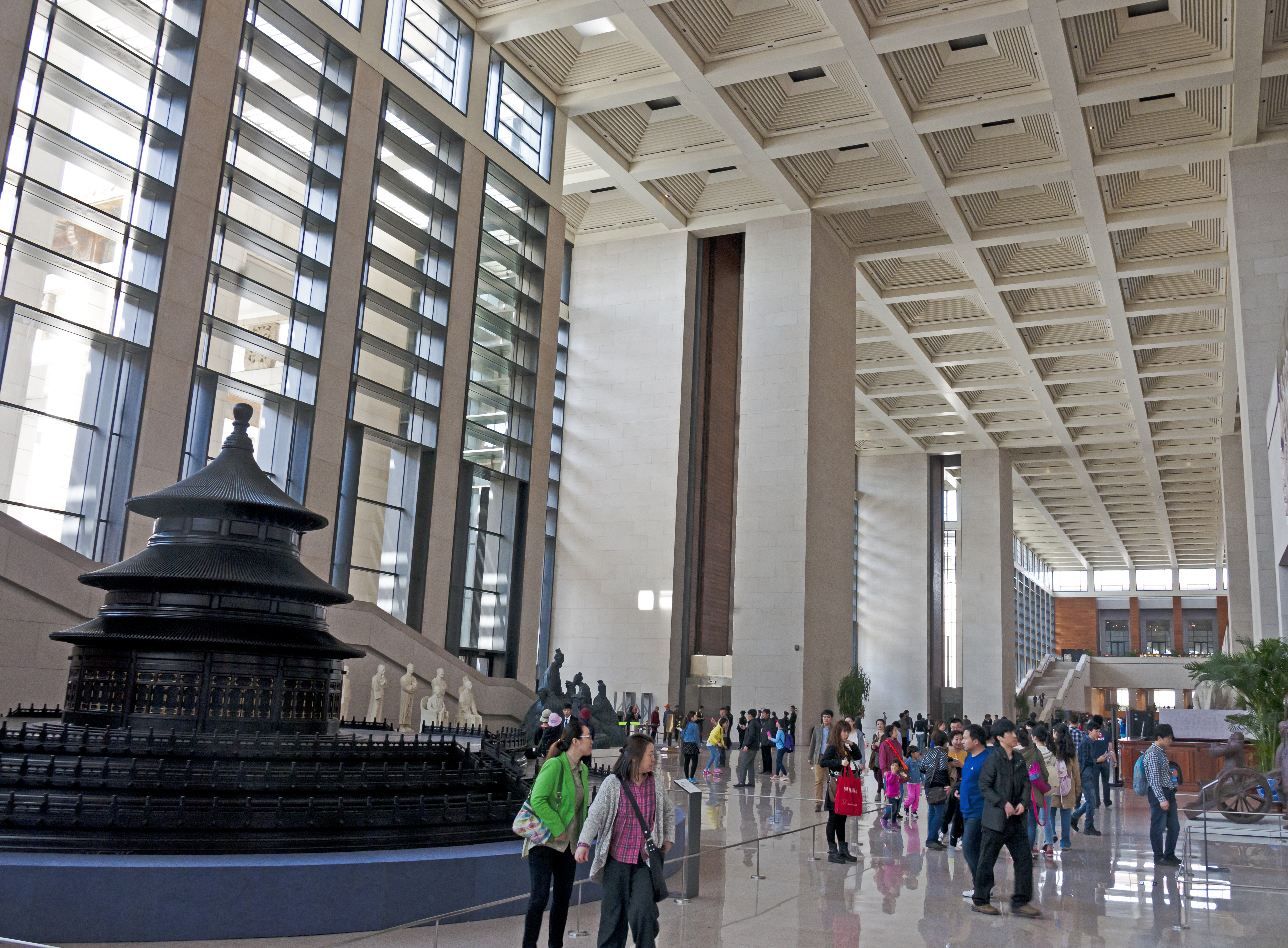
National Museum of China
The Houmuwu Ding weighs 832.84 kilograms. Cast during the Shang dynasty more than three thousand years ago, it is the heaviest piece of ancient bronzeware ever found, and it sits inside the National Museum of China on the eastern side of Tiananmen Square. The museum that houses it is itself a superlative: the largest single-building museum in the world, with nearly 200,000 square meters of floor space, 48 exhibition halls, and a permanent collection of more than 1.4 million items. It is a building designed to contain the entirety of Chinese civilization, from the earliest human remains found on Chinese soil to the establishment of the People's Republic.
Two Museums Become One
The National Museum of China was born from a merger. In 1959, two institutions were established in the same building on Tiananmen Square: the Museum of the Chinese Revolution in the northern wing, preserving the legacy of the 1949 communist victory, and the National Museum of Chinese History in the southern wing, tasked with safeguarding China's broader historical heritage. The building itself was one of the Ten Great Buildings constructed to celebrate the tenth anniversary of the People's Republic, positioned to face the Great Hall of the People across the square. In 2003, the two museums merged into a single institution. After four years of renovation led by the German firm Gerkan, Marg and Partners, the museum reopened on March 17, 2011, with 28 new exhibition halls and more than triple its previous exhibition space. The building stretches 313 meters along its front facade, rises four stories to a height of 40 meters, and sits on 6.5 hectares of land. Ten square pillars mark its center, a monumental entrance designed to match the scale of the square it overlooks.
Artifacts Across Millennia
The permanent collection spans an almost incomprehensible range. The oldest materials relate to the Yuanmou Man, whose remains date to 1.7 million years ago, making them among the earliest evidence of human habitation in China. From there, the collection moves through the Neolithic period, including painted pottery of the Yangshao culture depicting storks catching fish, through the bronze age with its elaborate ritual vessels, and on through every dynasty to the end of the Qing. A Han dynasty jade burial suit laced with gold thread demonstrates the lengths to which elites went to preserve their bodies for eternity. A copperplate for printing the Great Ming banknote speaks to China's early leadership in paper currency. A bronze cannon from 1332 records the Yuan dynasty's military technology. The Li gui, the earliest Zhou dynasty bronze vessel ever discovered, provides the only epigraphic evidence for the day the Zhou conquered the Shang, making it one of the most historically significant objects in any museum anywhere.
The Road to Rejuvenation
The museum's signature permanent exhibition, The Road to Rejuvenation, presents Chinese history from the First Opium War of 1839 to the present, with particular emphasis on the role of the Chinese Communist Party. The exhibition was the site where Xi Jinping articulated the concept of the Chinese Dream in November 2012. Its first half documents what Chinese historians call the century of humiliation, the period from the Opium Wars through the Japanese occupation when foreign powers imposed unequal treaties on China. The exhibition frames the Communist Party's rise as the resolution of that humiliation, a narrative arc that connects the Houmuwu Ding and the Yangshao pottery upstairs to the political achievements celebrated in the galleries below. Whether visitors accept this framing or not, the exhibition demonstrates how a museum can serve simultaneously as a repository of artifacts and an instrument of political narrative.
Countdown and Controversy
The museum's central location on Tiananmen Square has made its front facade a site for national milestone markers. Since the 1990s, countdown clocks have been mounted there for events including the 1997 handover of Hong Kong, the 1999 handover of Macau, the 2008 Beijing Olympics, and the 2010 Shanghai World Expo. The building itself has not been immune to controversy. A three-month Louis Vuitton exhibition in 2011 drew complaints from critics who argued that a state-level public museum should not host commercial luxury brands. A Peking University professor called for the museum to dedicate itself exclusively to non-profit cultural promotion. The brand's CEO defended the show by arguing that 157 years of craftsmanship constituted history worth exhibiting. The debate touched on a broader question that hovers over many of the world's great museums: who decides what counts as culture, and whose purposes does a public institution ultimately serve.
From the Air
Located at 39.90°N, 116.39°E, on the east side of Tiananmen Square. The long rectangular building with ten pillars at its center faces the Great Hall of the People across the square. Visible from altitude as part of the square's symmetrical layout. Best viewed at 3,000-5,000 feet. Nearest airport: Beijing Capital International (ZBAA), approximately 25 km northeast.