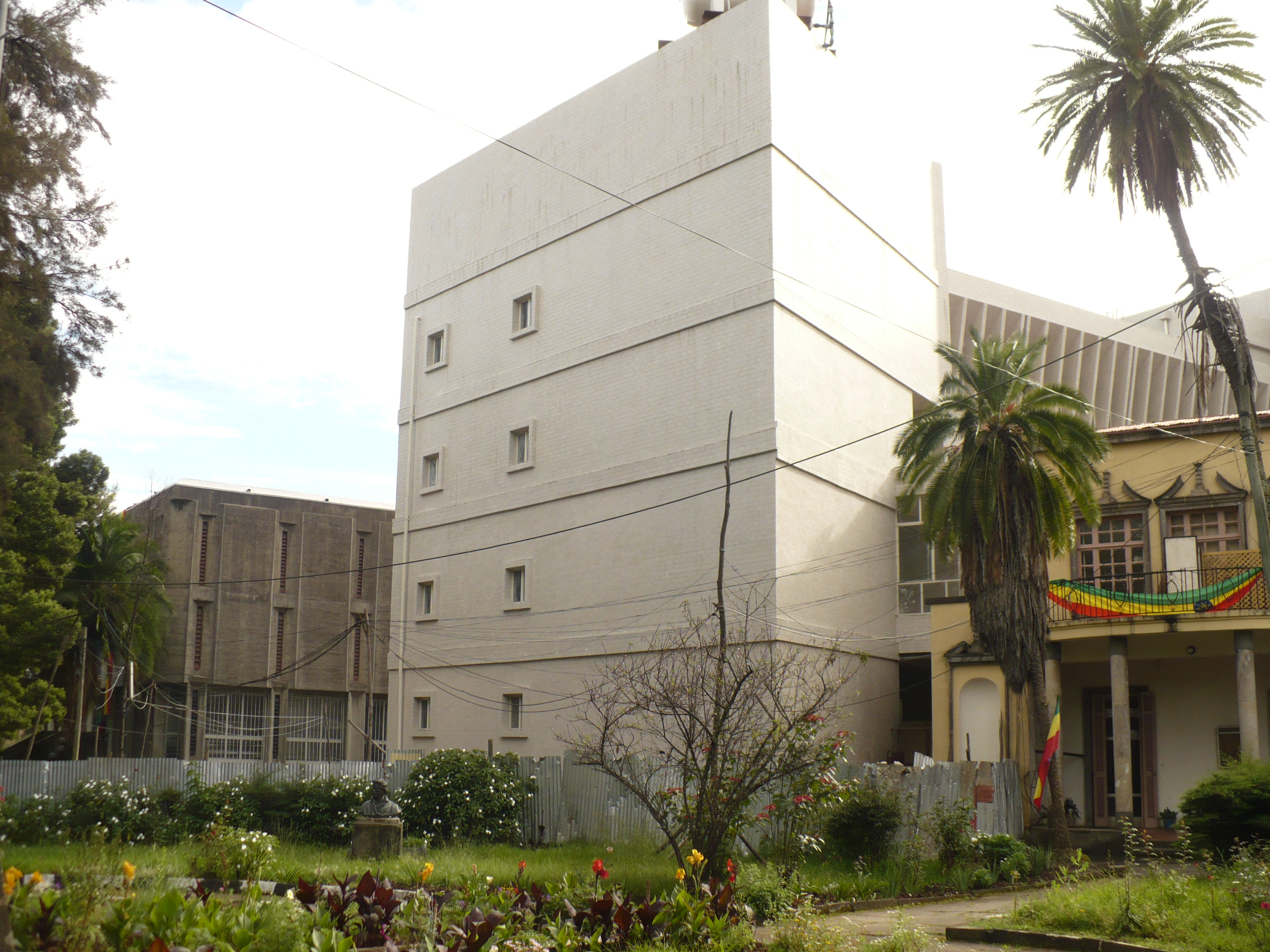
National Museum of Ethiopia
She is 3.2 million years old, stands about a meter tall, and draws more visitors to Addis Ababa than any living resident. Lucy -- or Dinkinesh, as Ethiopians call her, meaning 'you are marvelous' -- rests in the basement of the National Museum of Ethiopia, her partial skeleton arranged in a glass case that has become a pilgrimage site for anyone who wants to stand in the presence of deep time. Found in 1974 in the Afar region, this Australopithecus afarensis specimen rewrote the story of human evolution. The museum built around her tells a different but equally sweeping story: Ethiopia's own journey from the ancient kingdoms of Axum through the Solomonic dynasty to the modern nation.
Three Million Years in Four Floors
The museum's layout reads like a timeline in reverse. The basement belongs to the deep past -- the paleoanthropological collection where Lucy shares space with Selam, a more recently discovered fossil (a child specimen of the same species, dating to 3.3 million years ago -- actually 100,000 years older than Lucy -- first found in 2000). These are not casts or replicas; these are the original bones, housed in the country where they were found. The first floor jumps forward to the ancient and medieval periods. Here are objects from the Aksumite civilization, regalia from the Solomonic dynasty, and memorabilia from Ethiopia's emperors, including Haile Selassie. The transition from fossilized bone to gold crowns and imperial robes covers an almost incomprehensible span of time, condensed into a single flight of stairs.
Art, Craft, and the Meeting of Kings
The second floor shifts from history to aesthetics. Ethiopian art is displayed chronologically, from traditional religious painting through contemporary work. Afewerk Tekle's massive painting African Heritage dominates the gallery -- a sweeping composition that captures the cultural complexity of the continent. Another notable work depicts the legendary meeting of King Solomon and the Queen of Sheba, the foundational myth of Ethiopia's Solomonic dynasty, which claimed unbroken descent from their union. Alongside the paintings, the floor houses secular arts and crafts: traditional weapons with intricately worked hilts, silver and gold jewelry, household utensils, ceremonial clothing, and musical instruments. These objects ground the museum's narrative in daily life, reminding visitors that civilizations are built not just by emperors but by the people who made, wore, and played these things.
A Museum Born of Empire and Excavation
The National Museum grew from unlikely roots. In 1936, during the Italian occupation, the first exhibition in Ethiopian history opened with ceremonial costumes donated by the Solomonic dynasty and their associates -- an act of cultural preservation during a period of foreign domination. The institution's modern form took shape in 1958 with the founding of the Institute of Archaeology, established to support French archaeological expeditions in northern Ethiopia. Those early excavations produced the artifacts that formed the museum's first collections. In 1976, the Ethiopian Cultural Heritage Administration created the framework for a true national museum, and the government provided the legislative authority to protect sites and monuments throughout the country. What began as a display of royal costumes evolved into a four-department institution -- conservation, documentation, exhibition, and research -- responsible for safeguarding Ethiopia's material heritage.
The Peoples of Ethiopia
The third floor takes the broadest view, offering an ethnographic survey of Ethiopia's diverse populations. With over 80 distinct ethnic groups and languages, the country's cultural landscape defies simple summary, and the museum does not attempt one. Instead, it assembles clothing, tools, ritual objects, and domestic items from communities across the highlands and lowlands, the Christian north and the Muslim east, the pastoral Afar and the farming Oromo. The effect is cumulative rather than encyclopedic -- a reminder that the nation below is far more varied than any single narrative can contain. Standing in this gallery after ascending from Lucy's bones in the basement, the full arc becomes visible: from the first upright steps of a proto-human in the Afar desert to the intricate social fabric of a modern African nation. No other museum on Earth compresses that journey so completely under one roof.
From the Air
Located at 9.038N, 38.762E in central Addis Ababa near Addis Ababa University, at approximately 2,350 meters (7,710 feet) elevation. The museum building is a modest structure not easily distinguished from altitude, but it lies in the university district north of the palace area. Addis Ababa Bole International Airport (HAAB) is approximately 7 km southeast. High-altitude conditions; reduced engine performance on departure.