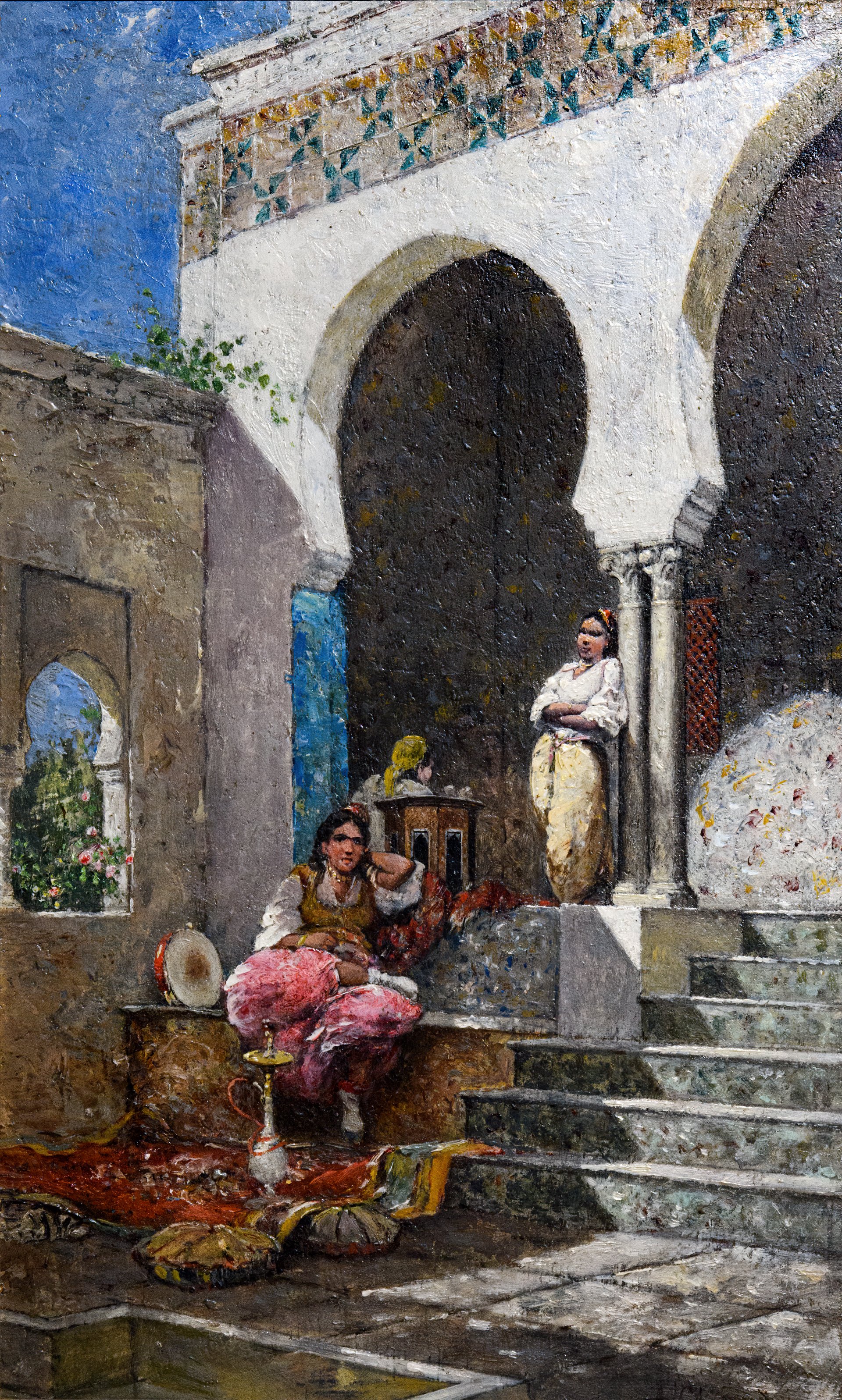
National Museum of Fine Arts of Algiers
On a spring night in 1962, French soldiers loaded over 300 paintings into trucks under military escort. The frames they left behind in the National Museum of Fine Arts of Algiers were discovered empty the next morning by staff who had not been told a thing. The works -- Monets, Delacroix oils, Renoir landscapes, Rodin bronzes -- were spirited to Marseille and then to the Louvre, their removal justified by fears of post-independence looting that never materialized. It took eight years of negotiations to bring them home.
A Collection Born of Empire
The museum opened to the public on 5 May 1930, timed to coincide with the centenary of France's colonization of Algeria. Its architect, Paul Guion, built it in the Hamma district overlooking the Jardin d'Essai, designing a symmetrical monument that blended Mediterranean influences with modern scale: thirty-five painting rooms, a sculpture gallery, a casting gallery, and a library. The collection was assembled with care and considerable funds allocated for the centenary celebrations. Jean Alazard, dean of the Faculty of Letters, oversaw the acquisition of 498 works in two years, drawing from European masters spanning six centuries. But this was always a museum built to project French cultural power -- its early catalogs emphasized the dissemination of French art, and a historical section with deposits from Versailles underscored the patriotic intent.
Eight Thousand Works, Two Continents
Today the collection holds some 8,000 works: paintings, drawings, engravings, sculptures, decorative arts, ceramics, and a numismatic collection. The European holdings stretch from a 1367 Baptism of Christ by Barnaba da Modena -- the oldest piece -- through Dutch Golden Age works by Brugghen and Van Goyen, to French Impressionists including Monet's Rochers de Belle-Isle, Renoir's Paysage de printemps, and Pissarro's Femme a sa fenetre. Rodin is represented by eight bronzes and six plasters, including the grand Age d'airain and L'Eternel Printemps. But the museum is far more than a colonial inheritance. Algerian artists fill its galleries: the miniaturist Mohamed Racim, the painter Baya whose vivid women and palms became icons of post-independence art, and the abstract compositions of Mohammed Khadda, whose Alphabet libre hangs as a statement of cultural self-determination.
The Secret Transfer and the Empty Frames
As Algerian independence approached, the Organisation Armee Secrete bombed a Bourdelle statue in the museum courtyard on 26 November 1961, damaging the first floor. French cultural authorities, fearing further destruction, arranged the covert transfer of over 300 works to Paris in April 1962 without informing museum staff or Algerian representatives. When curator Jean de Maisonseul discovered the empty frames, he launched what became one of the most significant cultural restitution cases of the postcolonial era. The Algerian argument was clear: these institutions had been financed from Algerian resources and, under the Evian Agreements, belonged to the Algerian state. Even Andre Malraux, then France's Minister of Culture, acknowledged the works belonged to Algeria. Negotiations began in May 1967, and by 1970, 157 paintings and 136 drawings were returned -- a rare instance where both sides found the political will to do the right thing.
Where Civilizations Meet on Canvas
Walking the museum today is an experience of layered identities. Italian primitives hang near Ottoman-era miniatures. Delacroix's North African subjects share space with Dinet's intimate portraits of Algerian life. The contemporary collection, enriched after independence by donations from newly sympathetic nations, includes works by Roberto Matta, Wifredo Lam, and Eduardo Arroyo. Maisonseul, who served as curator until 1970, deliberately expanded the Algerian art holdings, introducing works by Baya, Benanteur, Guermaz, and Khadda. The building itself, perched on the hill of the wild boars above the Hamma gardens, offers views across Algiers that frame the collection in its geographic truth: this is African art, European art, and Mediterranean art, gathered in a city where all three currents have always converged.
From the Air
Located at 36.75N, 3.08E in the Hamma district of Algiers, adjacent to the Jardin d'Essai. The museum sits on a hillside visible from approaches over the Bay of Algiers. Nearest airport: DAAG (Houari Boumediene Airport), approximately 14 km southeast. Best viewed at 2,000-3,000 feet on approach from the north.