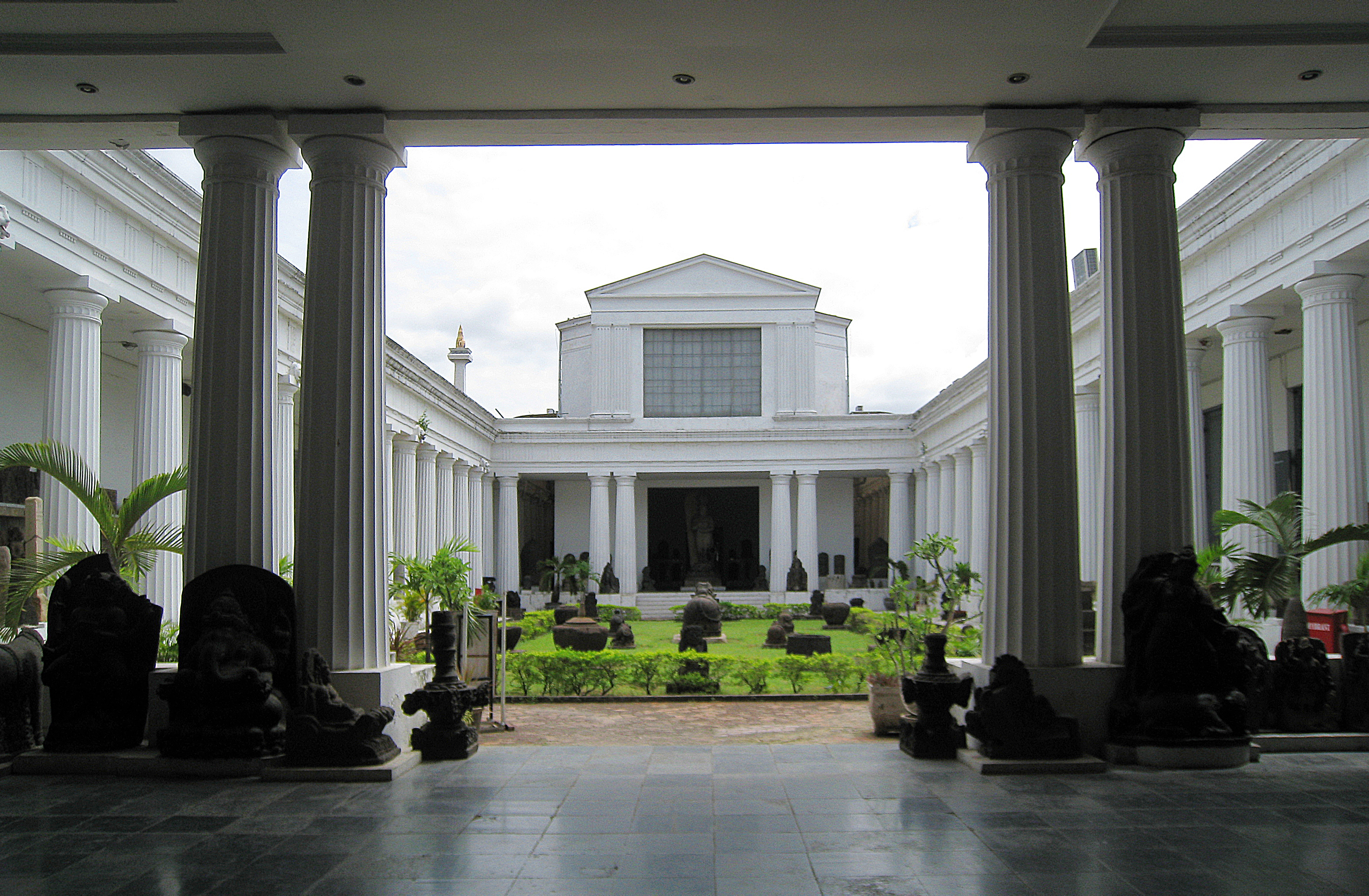
National Museum of Indonesia
Jakartans call it the Elephant Museum. The nickname comes not from any zoological exhibit but from a bronze elephant statue standing in the forecourt -- a gift from King Chulalongkorn of Siam, presented in 1871 during a state visit to the Dutch East Indies. The elephant has outlasted the colony, the kingdom that gave it, and most of the political systems that have governed Indonesia since. Behind it stands one of the oldest and most comprehensive museums in Southeast Asia, housing roughly 141,000 objects that trace the archipelago's story from Stone Age skull fragments to the proclamation of independence.
A Society of Curious Dutchmen
The museum's origins predate Indonesia itself by more than a century and a half. On 24 April 1778, a group of Dutch intellectuals in Batavia founded the Bataviaasch Genootschap van Kunsten en Wetenschappen -- the Royal Batavian Society of Arts and Sciences. Their aim was to study the cultural and scientific aspects of the East Indies: its archaeology, ethnography, natural environment, and languages. The society's first significant benefactor was J.C.M. Radermacher, who donated a building and a collection of cultural objects and books that formed the institution's nucleus. Thomas Stamford Raffles, the British lieutenant-governor who would later found Singapore, served as the society's director during the brief British interregnum from 1811 to 1816. Under Raffles, the collection grew and the society's scholarly ambitions sharpened.
From Colonial Showpiece to National Treasure
As the collection expanded, it outgrew its original home in Old Batavia. The Dutch colonial government commissioned a new neoclassical building on the western edge of Koningsplein -- now Merdeka Square -- which opened in 1868. The institution earned its second nickname, Gedung Arca, the House of Statues, for the classical Hindu-Buddhist stone sculptures that filled its galleries. In 1931, selections from the collection traveled to the World Colonial Exposition in Paris, introducing the archipelago's material heritage to a European audience. After Indonesian independence, the museum and its collections were transferred to the new republic's government. The scholarly society was dissolved, and the institution became the National Museum of Indonesia -- no longer a curiosity cabinet for colonial administrators but a repository of national identity.
141,000 Windows into the Archipelago
The museum's holdings span an almost absurd range. Prehistoric artifacts include fossilized skulls of Homo erectus and Homo floresiensis -- the so-called 'hobbit' of Flores -- alongside stone tools, menhirs, and bronze drums. The Hindu-Buddhist collection features stone statues from the classical periods of Java and Sumatra, including the celebrated Prajnyaparamita sculpture from the Singhasari kingdom and the imposing Bhairawa Buddha from Sumatra's Padang Lawas temple complex. Asian ceramics constitute another strength: Chinese, Vietnamese, Thai, and Japanese pieces accumulated over centuries of maritime trade. Ethnographic galleries display textiles, weapons, tools, and ritual objects from across the archipelago's hundreds of ethnic groups. A colonial-era room preserves Dutch furniture and administrative artifacts. Together these collections tell the story of a nation defined by diversity -- thousands of islands, hundreds of languages, layers of religion and empire stacked atop one another.
Fire and Renewal
On 16 September 2023, fire swept through portions of the old building, damaging rooms and threatening collections that had survived wars, revolutions, and decades of tropical humidity. The museum closed for renovation and did not reopen until October 2024. The disaster was a painful reminder of the fragility of cultural heritage in a country where earthquakes, floods, and fires pose constant threats. But the museum had faced loss before -- artifacts were stolen in a notable theft, and collections had been dispersed to other institutions over the years. The new wing, Gedung Arca, inaugurated in 2007 by President Susilo Bambang Yudhoyono, had expanded the museum's capacity with modern exhibition spaces across seven floors. Recovery from the fire continued that trajectory of reinvention. The elephant in the forecourt, undamaged, continued to stand watch -- as it has for more than 150 years.
From the Air
Located at 6.18S, 106.82E on the west side of Merdeka Square in Central Jakarta. The museum's neoclassical building sits directly west of the Monas obelisk, which serves as the primary visual reference point at 132 meters. The museum grounds include the newer Gedung Arca wing to the north of the original building. Nearest major airport is Soekarno-Hatta International Airport (WIII), approximately 25 km northwest. Halim Perdanakusuma International Airport (WIIH) is roughly 12 km southeast. The museum is best identified by its proximity to the unmistakable Merdeka Square and Monas tower.