National Museum of Ireland -- Archaeology
Without George Petrie and a handful of stubborn antiquarians, the greatest treasures of medieval Ireland would have been melted for their gold. In the 19th century, as agricultural expansion disturbed land untouched since the Middle Ages, laborers across Ireland turned up exquisite metalwork -- brooches, chalices, crosiers, reliquaries -- buried for centuries in bogs and fields. Most of it was destined for the smelter. Petrie and his colleagues at the Royal Irish Academy intervened, purchasing and cataloguing artifacts that would otherwise have been reduced to bullion. Those rescues form the core of the National Museum of Ireland -- Archaeology on Kildare Street, which today holds the world's largest collection of post-Roman Irish medieval art.
A Building Fit for Treasure
The museum building itself is a Victorian statement of intent. Designed by the father-and-son architects Thomas Newenham Deane and Thomas Manly Deane, the Kildare Street building opened in 1890 as the Dublin Museum of Science and Art. Its rotunda entrance, with a domed ceiling and mosaic floors, announces that what lies within deserves reverence. The building stands beside Leinster House, now the seat of the Irish parliament, and until 1922 the museum complex included Leinster House itself. The collections that filled this grand space had been assembled over more than a century, drawn from the holdings of the Royal Dublin Society and the Royal Irish Academy, whose combined efforts had preserved Irish material culture through periods of colonial indifference and outright destruction.
Gold from the Bog
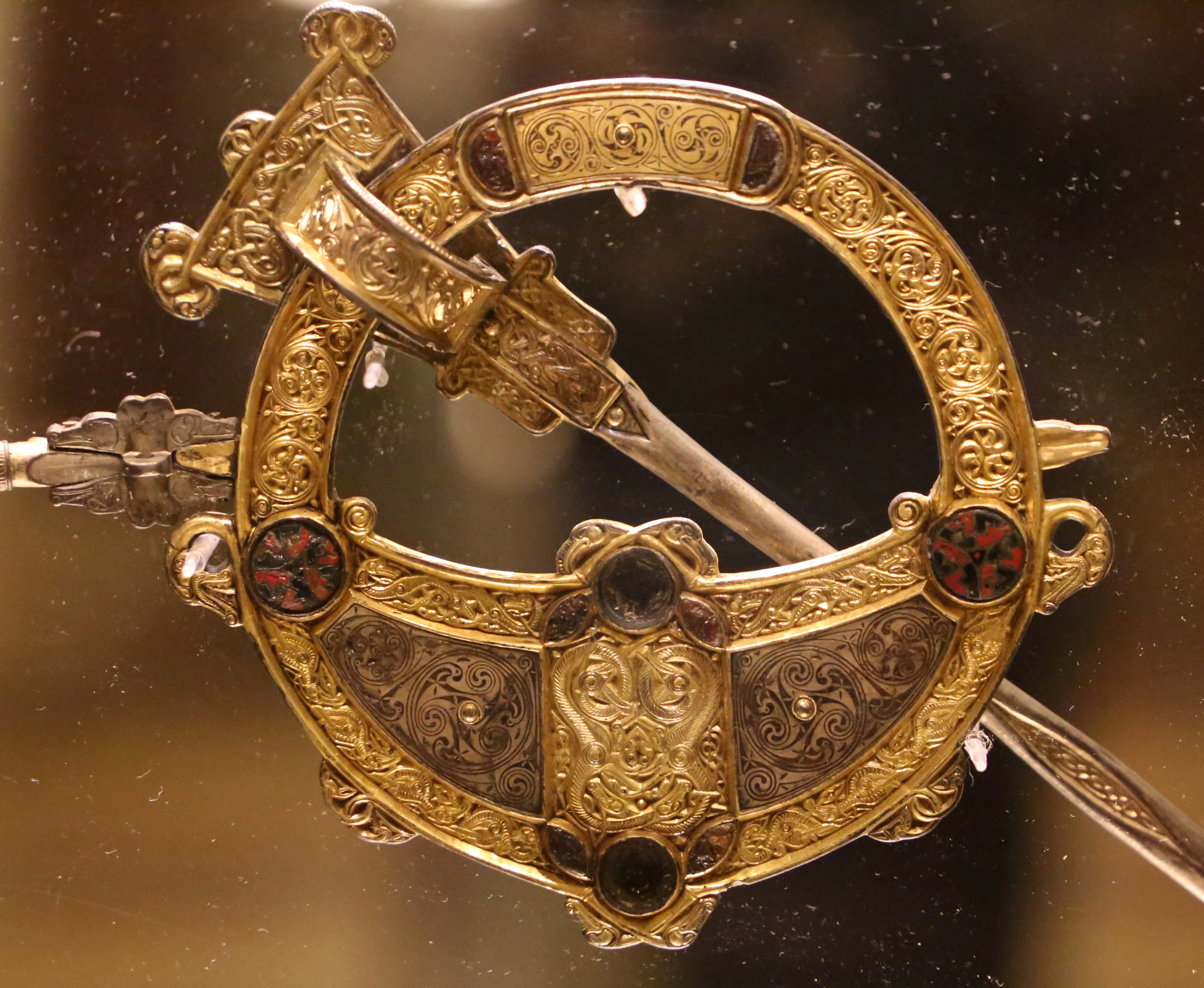
The museum's prehistoric Irish gold collection is one of the most important in Europe. Lunulae -- crescent-shaped neck ornaments hammered from sheet gold -- date to the Early Bronze Age, around 2000 BC. Torcs, bracelets, and dress fasteners trace the sophistication of Irish metalworking through the Bronze and Iron Ages. The earliest artifacts in the collection date to approximately 7000 BC, reaching back to the first communities that settled Ireland after the last Ice Age. But it is the medieval metalwork that draws the most attention. The Tara Brooch, dating to the 7th or early 8th century AD, is a masterwork of Insular art: a penannular brooch decorated with gold filigree, amber, and glass, its intricate patterns condensing an entire artistic tradition into an object smaller than a human hand.
The Bog Bodies
Perhaps the museum's most unsettling exhibits are its bog bodies -- human remains preserved for millennia in the acidic, oxygen-free conditions of Irish peat bogs. Gallagh Man, dating to between 470 and 120 BC, was found in County Galway with a willow rope still around his neck. Old Croghan Man, discovered in County Offaly in 2003, stands over six feet tall and bears wounds consistent with ritual killing -- his nipples had been sliced, a detail that archaeologists interpret as a form of symbolic deposition, since in ancient Ireland the act of suckling a king's nipples was a gesture of submission. These are not simply preserved corpses. They are evidence of a society whose rituals of power and sacrifice were inscribed on the bodies of its victims.
Chalices and Crosses
The Ardagh Chalice, discovered by a boy digging potatoes in County Limerick in 1868, is among the finest examples of 8th-century metalwork anywhere in the world. Crafted from silver, gold, bronze, brass, copper, and lead, decorated with glass and enamel, it was likely used for the distribution of wine during the Eucharist. The Cross of Cong, commissioned around 1123 AD to enshrine a fragment believed to be from the True Cross, represents the last flowering of the Irish metalworking tradition before the Norman invasion reshaped Irish culture. The Derrynaflan Chalice, found by an amateur treasure hunter with a metal detector in County Tipperary in 1980, triggered a landmark legal case that established the Irish state's ownership of archaeological finds -- a ruling with consequences for treasure hunters and archaeologists alike.
Nine Thousand Years in One Building
What makes the Kildare Street museum extraordinary is not any single object but the depth of the timeline it covers. From Mesolithic flint tools to Viking swords, from Iron Age gold torcs to medieval church treasures, the collection traces an unbroken thread of human presence on the island of Ireland across nine millennia. The museum also holds classical objects from ancient Egypt, Cyprus, and the Roman world, broadening the context beyond insular traditions. Admission is free, a policy consistent with the museum's founding purpose of making Ireland's heritage accessible to all. In a country whose archaeological record was nearly destroyed by indifference and the gold market, the Kildare Street museum stands as proof that what was saved was worth saving.
From the Air
The National Museum of Ireland -- Archaeology is located at 53.3403N, 6.2547W on Kildare Street in central Dublin, adjacent to Leinster House (Irish parliament). From altitude, the Victorian building with its distinctive rotunda is visible along Kildare Street, one block east of St. Stephen's Green. Nearest airport: Dublin Airport (EIDW) approximately 10km north.