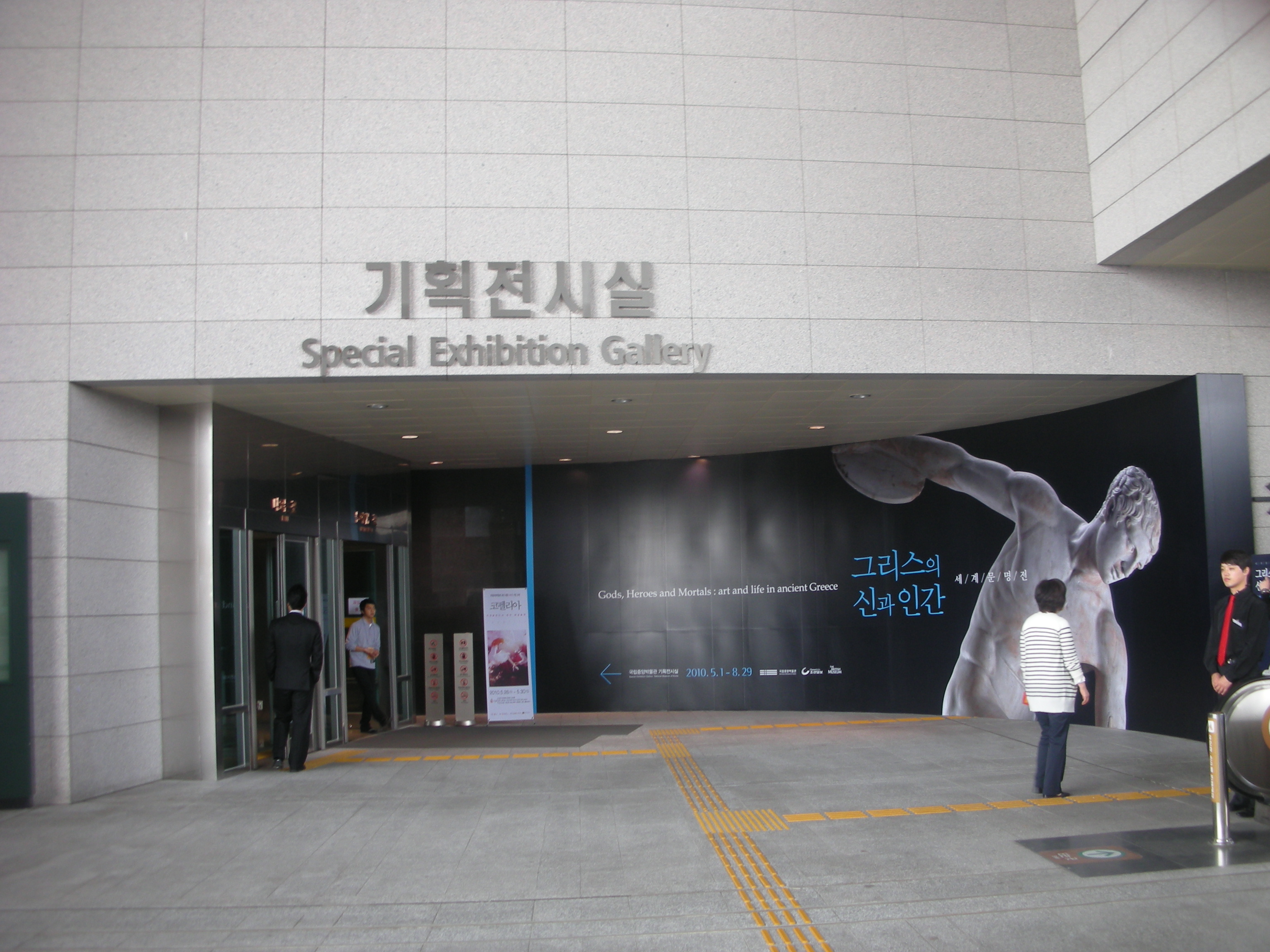
National Museum of Korea
A seventh-century bronze figure sits with one leg crossed over the other, fingers resting gently against its cheek. The Pensive Bodhisattva has been contemplating the human condition for fourteen hundred years, and it does so now from a climate-controlled case in the National Museum of Korea, the sixth largest museum in the world by floor space. The statue survived the fall of kingdoms, Japanese colonial rule, and a desperate wartime evacuation to Busan. That it sits here at all, in Yongsan's sprawling park on land that once served as a U.S. military golf course, is itself a story of endurance.
A Collection in Exile
Korea's first museum was established in 1909 by Emperor Sunjong, housed within the grounds of Changgyeonggung Palace. When Japan annexed Korea the following year, those collections became the nucleus of the Japanese Government General Museum. Independence in 1945 restored Korean stewardship, but peace did not last. When war broke out in 1950, staff moved 20,000 artifacts south to Busan, saving the collection from destruction as Seoul changed hands multiple times. After the armistice, the museum returned to the capital, shuffling between Gyeongbokgung and Deoksugung palaces before settling controversially into the former Japanese General Government Building in 1986. That building was demolished in 1995 as a symbol of colonial erasure, and the museum spent another decade in temporary quarters before finally opening its permanent home in Yongsan Family Park on October 28, 2005.
From Handaxes to Gold Crowns
The museum's first floor traces Korean civilization from its earliest traces. Paleolithic handaxes give way to Neolithic pottery, Bronze Age daggers, and the ornate treasures of the Three Kingdoms period. A fifth-century Silla gold crown, excavated from the North tomb of Hwangnamdaechong in Gyeongju, gleams in its case. The tomb yielded more ornaments than its companion burial, including a silver belt inscribed with characters meaning 'Madame's belt,' suggesting the crown belonged to a queen. Upstairs, Goryeo celadon wares display the jade-green glaze that made Korean ceramics famous across Asia. A twelfth-century openwork incense burner, National Treasure No. 95, exemplifies the craft at its peak. On the third floor, the Asian Arts Gallery traces the cultural threads of the Silk Road through 970 pieces spanning India, Southeast Asia, Central Asia, China, and Japan.
The Pagoda That Came Home
Among the museum's most storied objects is the Ten-Story Pagoda from Gyeongcheonsa Temple, originally erected in 1348 during the Goryeo dynasty. In 1907, a Japanese court official illegally smuggled it to Japan. British journalist E. Bethell and American writer H. Hulbert campaigned for its return, and by 1918 it was back in Korea. But the pagoda's journey was not over. Restored to Gyeongbokgung Palace in 1960, it began deteriorating from acid rain and weathering. In 1995, it was carefully dismantled and moved indoors, where it now stands along the museum's 'Path to History.' The story of looted and returned art runs deep here: 297 volumes of the Oegyujanggak Uigwe, royal protocol documents seized by French forces in 1866, were only repatriated in 2011 after 145 years of diplomatic negotiations.
Danwon's Candid Eye
Not everything in the museum speaks of royalty and ritual. The eighteenth-century painter Kim Hong-do, known by his pen name Danwon, filled his Album of Genre Painting with scenes of ordinary Korean life: wrestlers grappling, blacksmiths hammering, scholars napping. His twenty-five paintings strip away background scenery entirely, focusing on the human figures with expressive, seemingly spontaneous brushstrokes. Art historians believe he completed the album around age forty, at the height of his powers. Designated Treasure No. 527, the paintings offer something rare in a museum dominated by courtly artifacts: a window into the daily rhythms of common people, their humor and physicality captured with a warmth that feels contemporary despite the centuries.
Built to Endure
The museum building itself reflects hard-won lessons about preservation. Constructed to withstand a magnitude 6.0 earthquake, it features shock-absorbent display platforms, a natural lighting system that uses sunlight instead of artificial illumination, and fire-resistant materials throughout. The design is symbolic as well as functional: the left side of the building represents the past, the right side the future. Outside, gardens of indigenous plants surround waterfalls, pools, and a collection of stone pagodas and steles, including the Great Bell of Bosingak, National Treasure No. 2, the definitive example of Joseon-period Korean bells. With about 15,000 of its 310,000 artifacts on display at any given time, the museum is less a single visit than an ongoing relationship, a place where fourteen centuries of contemplation continue.
From the Air
Located at 37.524N, 126.980E in Seoul's Yongsan District. The museum complex sits within Yongsan Family Park, identifiable from the air as a large green space south of the Han River. Nearest major airport is Gimpo International (RKSS), approximately 14 km west. Incheon International Airport (RKSI) is about 52 km to the west. Best viewed at altitudes of 3,000-5,000 feet in clear conditions.