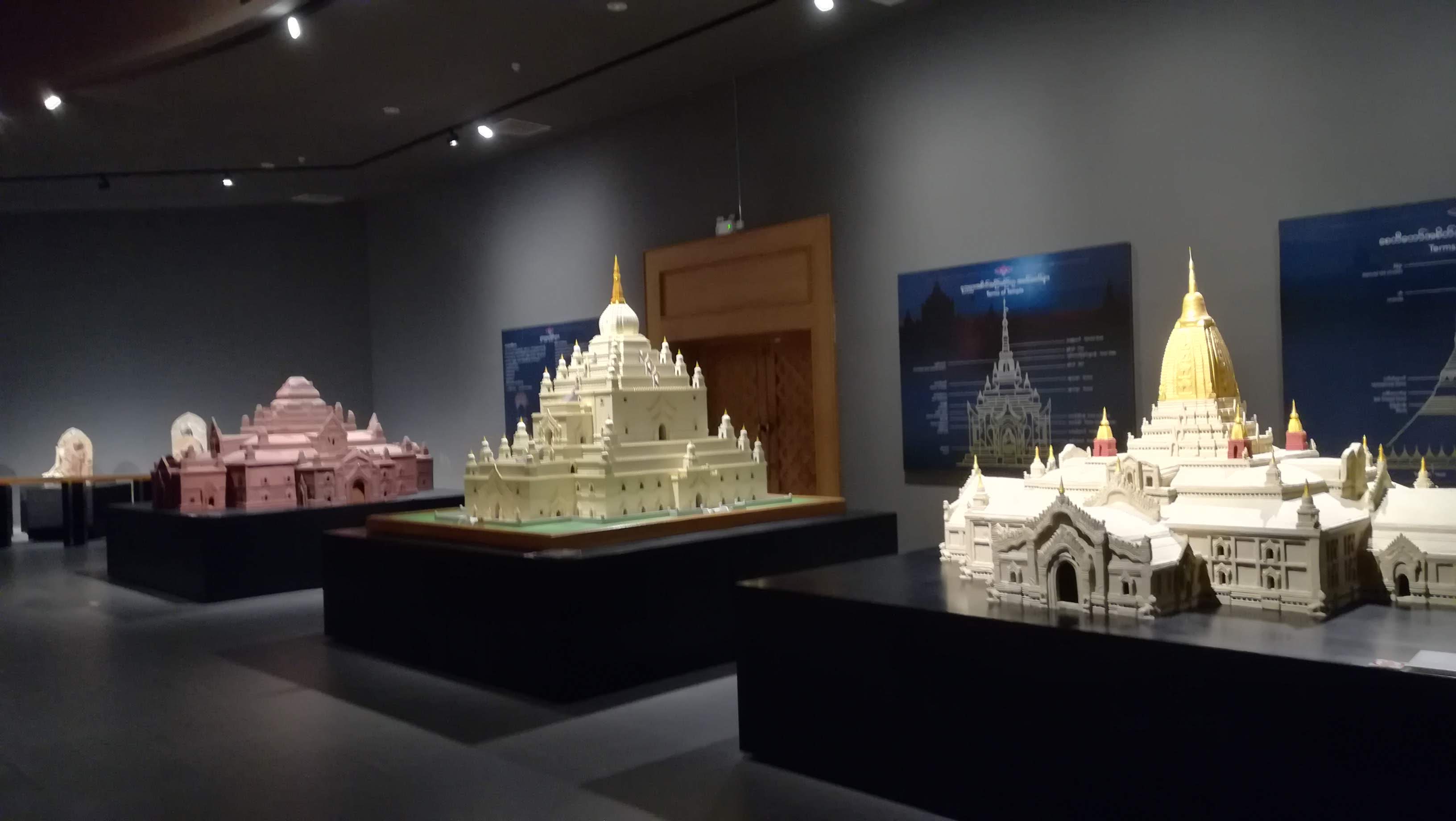
National Museum of Myanmar (Naypyidaw)
Inside the Lion Throne Exhibition Room, a full-scale replica of the only surviving royal throne of Burma's kings dominates a cavernous hall, flanked by royal regalia that once signified absolute power over a domain stretching from the Irrawaddy Delta to the Shan Plateau. It is a fitting centerpiece for a museum built in a capital that was itself conjured from nothing by military decree. The National Museum of Myanmar in Naypyidaw opened on 15 July 2015, five years after construction began, and it serves as the country's second national museum alongside the older institution in Yangon. Spread across 35 acres and five interconnected wings, it attempts something ambitious: to narrate Myanmar's entire civilizational arc, from 40-million-year-old primate fossils to contemporary painting, within the eerily quiet streets of a city most of the world considers a ghost town.
Forty Million Years in Five Wings
The museum's journey through time begins before humanity itself. The Primates and Fossils Exhibition Room displays fossils from the Pondaung formation, a geological layer in central Myanmar that has yielded some of the world's most significant anthropoid primate specimens -- creatures that lived roughly 37 to 40 million years ago. Petrified plants from the Pondaung and Irrawaddy sedimentary formations round out the collection. From there, visitors move into the Prehistoric Period Exhibition Room, where Stone Age, Bronze Age, and Iron Age tools, weapons, and pottery document Myanmar's earliest human inhabitants. A miniature replica of the Padah-Lin Caves, illuminated with atmospheric lighting, recreates one of Southeast Asia's most important prehistoric sites. The centerpiece is a scale model of a Bronze Age excavation, surrounded by the actual objects it represents -- clay pots, glass beads, and bronze weapons pulled from the earth.
Cities Before Bagan
Most visitors to Myanmar know Bagan, with its thousands of temples silhouetted against dusty sunsets. Fewer know what came before. The Protohistoric Period Exhibition Room corrects that gap by showcasing the Pyu city-states -- Halin, Beikthano, and Sri Ksetra -- which flourished from the second century BCE through the ninth century CE and earned UNESCO World Heritage status in 2014. Small-scale architectural models recreate these ancient urban centers, while five Pyu figurines and artifacts in gold, silver, bronze, and earthenware provide tangible evidence of a sophisticated civilization that traded with India and China centuries before the Bagan dynasty rose to power. The Historic Period Exhibition Room then picks up the story with Bagan itself: miniature replicas of its religious architecture, fragments of wall paintings and frescoes, and examples of the masonry and ceramic techniques that built one of the ancient world's most extraordinary temple cities.
Performing Arts and Living Traditions
Not everything in the museum is behind glass. The Myanmar Performing Arts Exhibition Room brings the country's dramatic traditions to life through displays of the hsaing waing -- Myanmar's traditional orchestra of drums, gongs, and oboes -- alongside a miniature theatre stage set up in the traditional manner. Musical instruments from each of Myanmar's major ethnic groups are represented: Kachin, Kayah, Kayin, Chin, Bama, Mon, Rakhine, and Shan. The diversity on display is a quiet reminder of how many distinct cultures coexist within Myanmar's borders. Nearby, the Arts and Crafts Exhibition Room focuses on the physical skills that have defined Burmese material culture for centuries -- goldsmithing, bronze casting through the lost-wax process, stone and wood sculpture, and the lacquerware for which Myanmar remains famous. The Myanmar Art Gallery traces the evolution of painting from ancient wall murals through Jataka epic illustrations to modern and contemporary works.
Shaken Ground
On 28 March 2025, a powerful earthquake struck central Myanmar, and Naypyidaw was not spared. The National Museum sustained damage, joining a long list of structures and infrastructure affected across the capital. The quake exposed the fragility of a city built rapidly and on a massive scale -- many government buildings, housing complexes, and cultural institutions were damaged. For a museum dedicated to preserving Myanmar's civilizational continuity, the earthquake added a painful new chapter. The Pondaung fossils, the Pyu gold, the replicas of Bagan's temples -- all had survived the upheavals of Myanmar's turbulent modern history only to face the older, more indifferent forces of geology. The museum's fate mirrors that of its city: a monument to ambition, tested by the earth itself.
From the Air
Located at 19.78N, 96.14E in Ottarathiri Township, within the Naypyidaw Union Territory. The museum sits near the Kumudra traffic circle in one of Naypyidaw's many planned zones. From altitude, Naypyidaw's distinctive grid layout and massive, largely empty boulevards are unmistakable -- the museum complex is a sizable footprint within the city's cultural zone. Nearest airport is Naypyidaw International Airport (VYNT), approximately 16 km southeast. Elevation is roughly 115 meters ASL. The city is flanked by the Bago Yoma mountains to the west and the Shan Yoma range to the east.