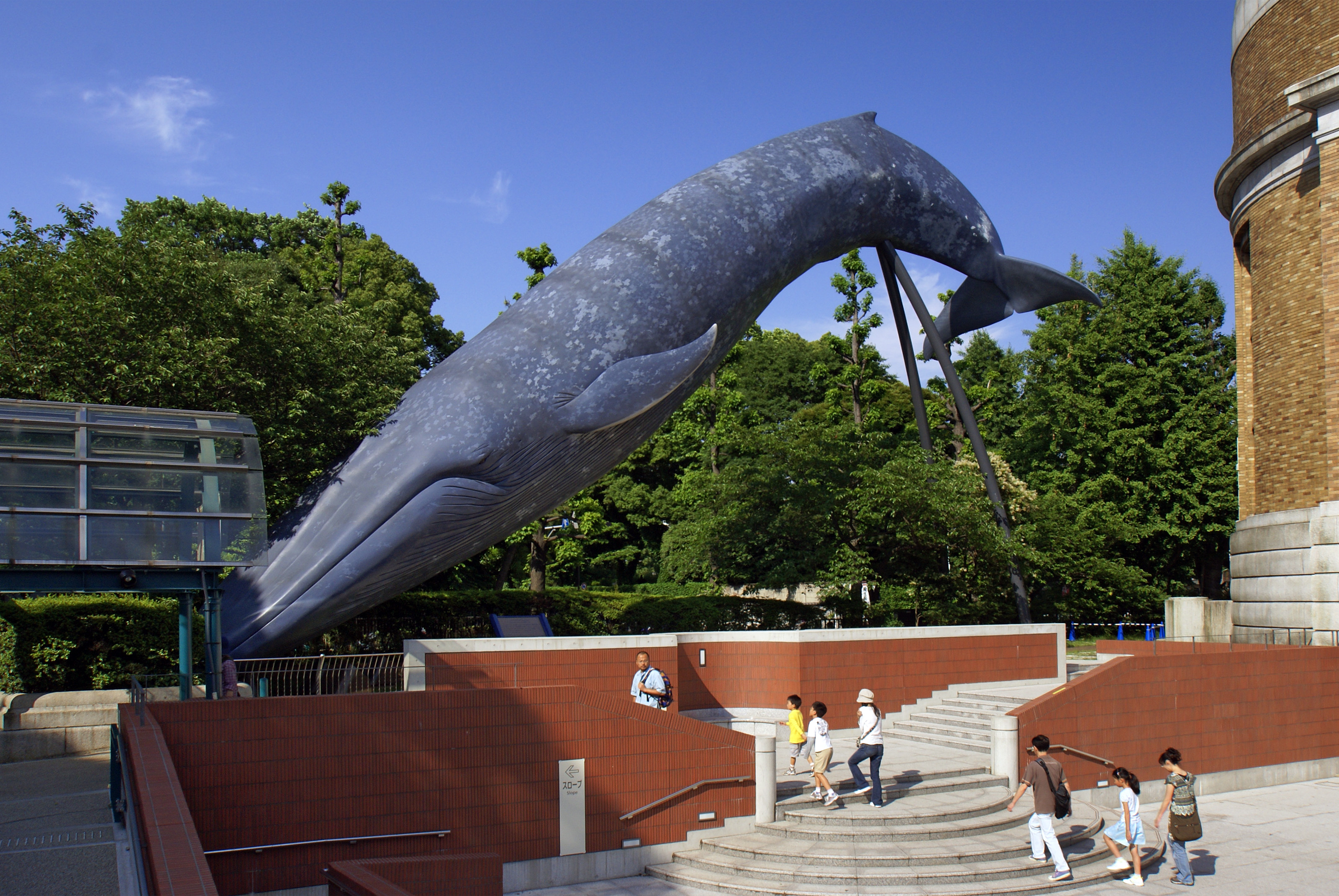
Japan's Cabinet of Wonders in Ueno Park
Somewhere between a stuffed Akita and a chunk of the moon, the National Museum of Nature and Science in Tokyo reveals a country that has always been fascinated by the intersection of nature and invention. The museum sits in the northeast corner of Ueno Park, one of Tokyo's great public spaces, and its main building -- completed in 1931 -- looks like an airplane when viewed from above. That shape was no accident. Designed by Kenzo Akitani as part of Tokyo's reconstruction after the devastating Great Kanto Earthquake of 1923, the Neo-Renaissance structure was built to withstand another earthquake of the same magnitude. Inside, over five million specimens span every department of the natural and scientific world, though only about 14,000 are on permanent display at any time. The rest are stored and studied at a research campus in Tsukuba. About 100,000 new items join the collection every year.
The Dog, the Explorers, and the Extinct
The museum's most emotionally charged exhibit may be the taxidermied body of Hachiko, the Akita dog who waited at Shibuya Station every day for nine years after his owner's death in 1925 -- a story that became a symbol of loyalty across Japan. Nearby stand the preserved forms of Taro and Jiro, the two sled dogs who survived a harsh Antarctic winter alone in 1958 after their Japanese research expedition was forced to evacuate. But the museum reaches far beyond beloved animals. Display cases hold specimens of the extinct Japanese wolf, the Amami rabbit, and the Japanese crested ibis. A skeleton of a Futabasaurus -- a plesiosaur discovered in Fukushima Prefecture -- anchors the paleontology halls, alongside Nipponites ammonites with their impossibly tangled spiral shells and a Triceratops fossil nicknamed Raymond. In the Global Gallery, a full Tyrannosaurus rex skeleton looms over visitors, and the world's largest taxidermied ocean sunfish stares blankly from its case.
Instruments That Shaped a Nation
Several of the museum's holdings are designated as Important Cultural Properties of Japan, and many of them trace the story of how Western science arrived in the country. The Milne horizontal pendulum seismograph, installed in 1899 on the Tokyo Imperial University campus, is the oldest existing seismograph in Japan -- invented by John Milne, an English mining engineer who became one of the founders of modern seismology. An eight-inch astronomical telescope made by Troughton and Sims of England was the first full-scale telescope imported to Japan and served the National Astronomical Observatory until 1967. Perhaps strangest of all is the sogeograph, a tin-foil phonograph made in England and brought to Japan in 1878. On November 16 of that year, at the University of Tokyo's Hitotsubashi laboratory, it made the first sound recording in Japanese history. The museum also holds the Myriad Year Clock, an extraordinary timepiece built in 1851 by inventor Hisashige Tanaka -- later the founder of Toshiba -- that displays both Western and Japanese time systems, the days of the week, moon phases, and zodiac positions.
Two Galleries, Two Worlds
The museum is divided into the Japan Gallery and the Global Gallery, each approaching the natural world from a different angle. The Japan Gallery, housed in the original 1931 airplane-shaped building, focuses on the Japanese archipelago -- its geology, its unique wildlife, and the human cultures that developed alongside them. Shibukawa Shunkai's papier-mache terrestrial globe from 1695 sits alongside Edo-period clockwork mechanisms and a replica of the Elekiter, an electrostatic generator built by the polymath Hiraga Gennai in the 18th century. The Global Gallery, opened in phases between 1999 and 2004 with three floors above and three below ground, takes a planetary view. Here visitors walk among dinosaur skeletons, a specimen of giant squid, the largest fragment of the Nantan meteorite, and a model of the Hayabusa spacecraft that returned asteroid samples to Earth. A Mitsubishi A6M Zero fighter plane hangs overhead, and a piece of moon rock brought back by Apollo astronauts rests in a nearby display.
A Building That Survived Its Own Purpose
The museum's main building tells its own story of resilience. Completed in September 1931 as the Tokyo Science Museum, it was designed specifically to endure the kind of catastrophe that had leveled much of Tokyo eight years earlier. The Great Kanto Earthquake of 1923 killed over 100,000 people and destroyed vast areas of the capital. Kenzo Akitani's Neo-Renaissance design incorporated earthquake-resistant engineering that engineers say still meets modern building code standards nearly a century later. The building was designated an Important Cultural Property on June 9, 2008 -- a museum building recognized as a national treasure in its own right. Since its founding in 1877, the institution has carried at least six different names, cycling through Ministry of Education Museum, Tokyo Museum, Tokyo Science Museum, and the National Science Museum of Japan before settling on the National Museum of Nature and Science in 2007. Through each renaming, the collection only grew.
From the Air
Located at 35.716N, 139.777E in Ueno Park, in Tokyo's Taito ward. From the air, the Japan Gallery building's distinctive airplane shape is visible on clear days. The museum sits within the larger Ueno Park complex, recognizable by its green canopy amid dense urban Tokyo. Nearest major airport is Tokyo Haneda (RJTT), approximately 15 nautical miles south. Tokyo Narita (RJAA) lies about 35 nautical miles east-northeast. The area is within Tokyo's Class B airspace. Best viewed at 3,000-5,000 feet AGL, with Ueno Park's pond and the cluster of museum buildings serving as landmarks.