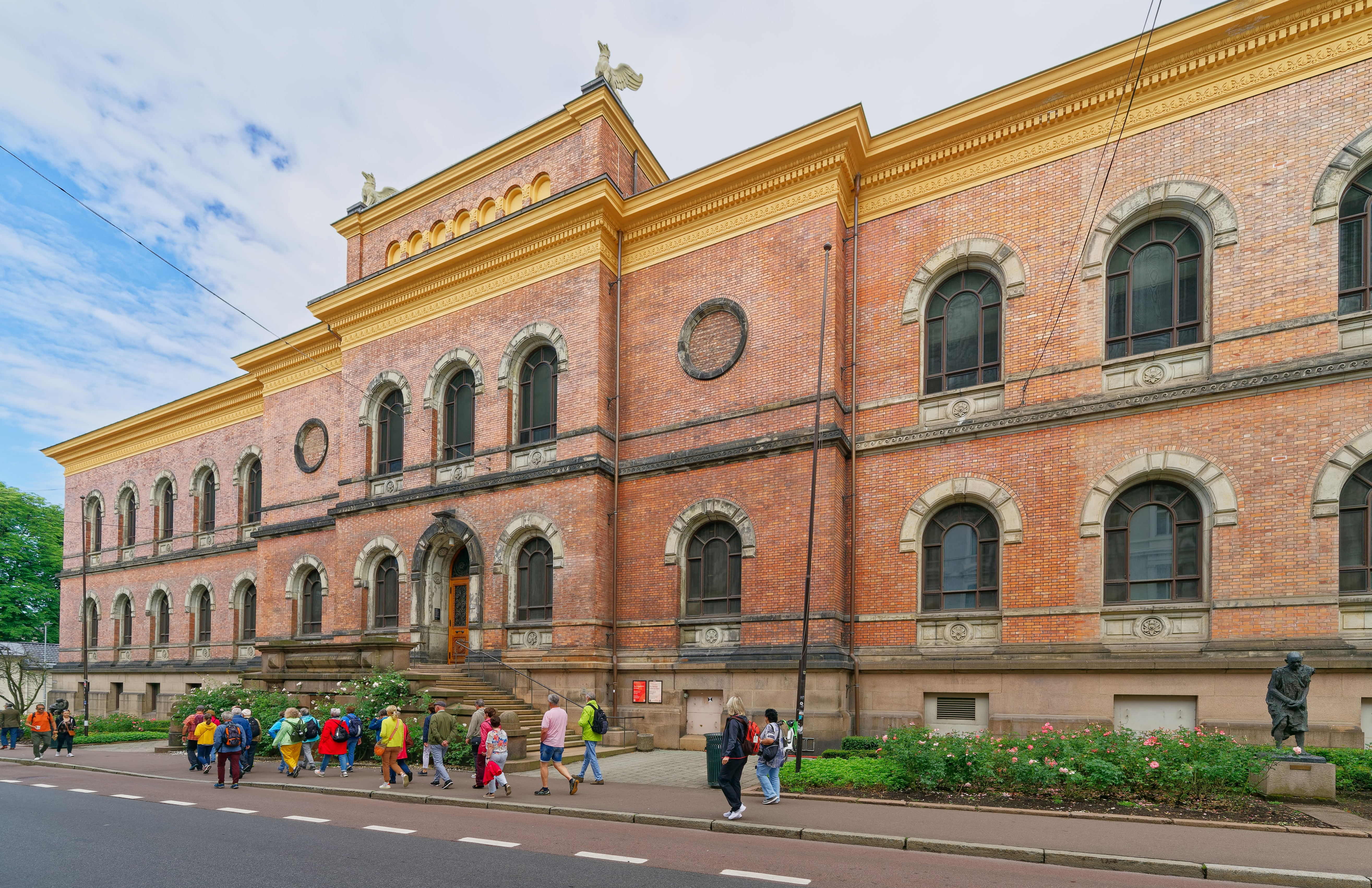
National Museum of Norway
Among the 400,000 objects in the National Museum of Norway, one of the most unexpected is a marble bust of the Roman emperor Trajan. It arrived in Oslo thanks to Christopher Paus, a Norwegian timber heir who became a papal chamberlain in Rome and happened to be the only member of Henrik Ibsen's extended family who ever visited the exiled playwright during his decades abroad. Paus could have sold his collection of Roman antiquities to the Ny Carlsberg Glyptotek in Copenhagen, but he chose instead to donate it to Norway. That decision -- patriotism winning out over profit -- captures the spirit of a museum that exists because Norway insisted on building cultural institutions equal to its national ambitions.
Five Museums Become One
The National Museum was established in 2003 through the merger of five separate institutions: the National Gallery of Norway, the Museum of Contemporary Art, the Museum of Decorative Arts and Design, the Museum of Architecture, and the Museum of Industrial Art. Each had its own building, its own staff, and its own institutional culture. The merger was meant to create a single institution capable of telling the full story of Norwegian art, architecture, and design -- but it also generated years of internal conflict. The museum's first director, the Swedish-born Sune Nordgren, resigned in 2006 after sustained professional criticism and staff disputes. His successor Allis Helleland lasted barely a year. It was not until Audun Eckhoff took over in 2009 that the institution found a measure of stability. The vision, however, remained constant: one collection, one story, one building.
The Vestbanen Gamble
That building opened in June 2022 at Vestbanen, on the site of a former railway terminus in central Oslo. The German architecture firm Kleihues + Schuwerk won the international competition in 2010 with their project Forum Artis. The Norwegian parliament approved a budget of 5.3 billion kroner -- roughly 650 million dollars -- in 2013, making it one of the most expensive museum projects in European history. When the building was finally unveiled, the reviews were savage. Critics called it prison-like, describing it as avvisende (dismissive) and introvert (inward-looking). The stark horizontal mass, stretching along the waterfront without the dramatic gestures of its neighbor the Oslo Opera House, provoked genuine public anger. Whether the architecture ages into respectability or remains a point of contention, the scale is undeniable: the National Museum is now the largest art museum in the Nordic countries.
Romantic Mountains, Existential Screams
The paintings collection traces the full arc of Norwegian visual identity. J.C. Dahl's moonlit landscapes and Adolph Tidemand's scenes of rural life anchor the Romantic Nationalist movement of the 1800s, a period when Norwegian artists used paint to assert a cultural identity distinct from Sweden's and Denmark's. Hans Gude contributed mountain and fjord scenes of luminous precision, while Harriet Backer and Christian Krohg pushed into darker, more psychologically complex territory. Then there is Munch. The National Museum holds the first version of The Scream, painted in 1893 -- a year before the Munch Museum's version. The dedicated Munch Room, reinstated in 2011 after a controversial decision to scatter his works among other contemporaries, has become one of the most visited gallery spaces in Scandinavia.
Beyond the Canvas
The collection extends far beyond painting. The graphics and drawing archive holds nearly 50,000 works spanning from the late 1400s to the present, with names that read like a survey course in Western art: Durer, Rembrandt, Van Gogh, Goya, Picasso, Manet, and Rubens alongside Norwegian masters like Werenskiold and Kittelsen. The design and decorative arts collection ranges from ancient Greek vases and East Asian artefacts to Norwegian silver, Nostetangen glass, and the extraordinary Baldishol tapestry, a 12th-century textile that is one of Norway's most treasured medieval objects. The architecture wing preserves over 300,000 items documenting Norwegian building culture from the 1830s onward, including the archives of Pritzker Prize winner Sverre Fehn. The Paus collection of Roman busts -- Trajan, Galba, Lucius Verus, and a portrait thought to be Cleopatra's grandson Ptolemy of Mauretania -- adds a classical dimension that no one would expect to find in Scandinavia.
Art to the People
Since 1953, the museum has operated under a deceptively simple motto: Kunst til folket -- Art to the People. A dedicated travelling exhibitions program sent 142 shows to communities across Norway over 34 years, carrying original artworks to towns that had no galleries of their own. Though the formal program was disbanded in 2005 and its mission absorbed into a broader national dissemination effort, the underlying idea persists in how the museum presents itself. The permanent exhibition, praised as a condensed version of world art history rather than a self-referential tour of the museum's own holdings, was reorganized in 2011 to restore chronological order after an earlier thematic experiment drew mixed reactions. The result is a collection that moves from ancient to modern, Norwegian to international, painting to architecture -- an institution that took two decades of mergers, conflicts, and billions of kroner to build, now housed in a building that its own country cannot decide whether to love or loathe.
From the Air
Located at 59.912N, 10.729E at Vestbanen in central Oslo, directly adjacent to the harbor. The museum's large rectangular form is visible from the air as a prominent horizontal mass along the waterfront, near Aker Brygge and the Oslo City Hall. Nearest airport is Oslo Gardermoen (ENGM), approximately 47 km northeast. The museum sits between the Nobel Peace Center and Akershus Fortress along the waterfront. Recommended viewing altitude: 2,000-3,000 feet AGL.