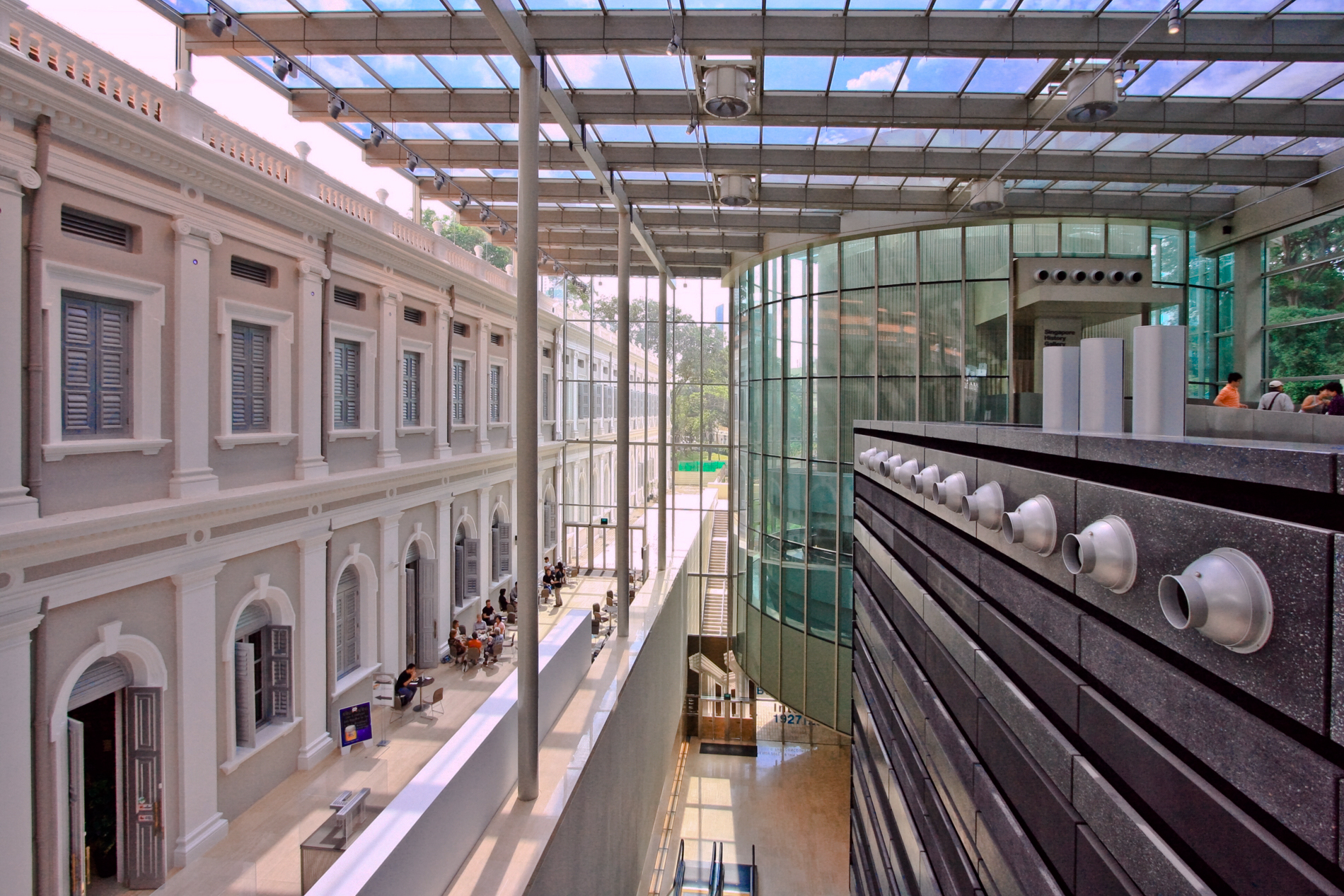
National Museum of Singapore
Somewhere inside the National Museum of Singapore, a split-flap departure board from Changi Airport's Terminal 2 sits alongside seats from Singapore Airlines' first Airbus A380, a 1970s Nanyang coffee roasting machine, and a 1979 Housing and Development Board elevator. These are not antiques in any traditional sense. They are artifacts of a country so young and so rapidly transformed that objects from living memory already feel like relics of another era. The museum itself embodies that compression of time. Founded in 1849 as a corner of the Raffles Library, it is the oldest museum in Singapore, a nation that did not exist as an independent state until 1965. Its nineteenth-century Neo-Palladian dome, crowned with 3,000 zinc fish-scaled tiles and stained glass panels, houses a collection that spans from the enigmatic Singapore Stone to dioramas of early twentieth-century coolie rooms.
From Library Corner to Stamford Road
The museum began in 1849 as a section of a library at the Singapore Institution, the school Raffles had founded to educate the children of the colony's diverse communities. Known then as the Raffles Library and Museum, it bounced between locations for nearly four decades before settling at 93 Stamford Road in 1887, where it has remained ever since. The building that rose there was designed in the Victorian manner appropriate to British colonial confidence, with a rotunda and dome that announced institutional permanence. Between 1993 and 2006, it operated under the name Singapore History Museum before reclaiming the title it had first received upon independence in 1965. That name change and reversion is itself a small chapter in the larger story of a nation working out what to call its relationship with its own past.
What a Nation Chooses to Keep
The museum's collection reveals as much about Singapore's values as about its history. In 2019, Tang Holdings donated the largest private collection of Stamford Raffles memorabilia, including forty-six handwritten letters and his book The History of Java. The following years brought donations that tell a different kind of story: those Singapore Airlines A380 seats in 2022, the Changi Airport Solari board in 2023, and in 2024, parts from a decommissioned Siemens C651 MRT train that had served the North-South and East-West lines since 1995. Train doors, seats, and map displays became museum pieces within months of retirement. When a country preserves its public transit components with the same care other nations reserve for royal carriages, it says something about where that country locates its identity. Singapore finds it in infrastructure, in the systems that made a small island function at a scale that defies its geography.
Galleries of Weight and Silence
Not everything in the museum invites admiration. The World War II galleries confront visitors with the Japanese occupation of 1942 to 1945, including personal items recovered from mass graves left by the Sook Ching massacre, in which the Imperial Japanese Army systematically killed Chinese men and boys across Singapore. These artifacts carry a weight that no interpretive panel can fully convey. Nearby, a reconstructed nineteenth-century shop and coolie room dioramas depict the lives of the laborers who built Singapore's port economy, men who lived in overcrowded conditions and worked under systems that blurred the line between employment and exploitation. The museum does not look away from these histories. Its 2025 maritime exhibition, Once Upon a Tide, traces Singapore's relationship with the sea, connecting ancient trade routes to the modern shipping lanes that still define the island's economy.
Renewal Under the Dome
The museum has been in a state of periodic reinvention throughout its existence. A three-and-a-half-year restoration completed in December 2006 modernized the interior while preserving the colonial-era exterior. President S. R. Nathan and Minister Lee Boon Yang presided over the reopening. Designated a national monument in 1992 by the National Heritage Board, the building carries a double mandate: it must honor its own architectural history while keeping its galleries relevant to a population that is younger, more diverse, and more globally connected than any previous generation. The most recent restoration began in September 2023 with staggered gallery closures, aiming for a full reopening in late 2026. The museum remains partially open throughout, a fitting metaphor for a country that has never stopped building while it was still learning what it had already built. It is one of six national museums in Singapore, and one of the largest museums in Asia. Admission is free for Singaporean citizens and permanent residents.
From the Air
Located at 1.297N, 103.849E on Stamford Road in Singapore's Civic District, near Fort Canning Park. The museum's distinctive white dome with zinc fish-scale tiles is a recognizable landmark. Nearby airports: Singapore Changi (WSSS) approximately 15 km east, Seletar Airport (WSSL) approximately 13 km north. Best viewed below 3,000 feet. Adjacent landmarks include the National Gallery Singapore and the Padang.