The Mighty Eighth: Where Seven Men Without a Single Aircraft Changed the Course of a War
On January 28, 1942, the United States Army Air Forces assigned seven men -- not a single aircraft among them -- to a newly formed unit at Savannah Army Air Base. Within two years, that skeleton crew had grown into the mightiest air armada the world had ever seen: the Eighth Air Force, whose B-17 Flying Fortresses and B-24 Liberators would fly daylight bombing missions deep into Nazi-occupied Europe while fighter squadrons from the Luftwaffe tore at their formations. More than 350,000 Americans served in the Eighth during the war. Over 26,000 never came home. Their story lives on in a museum just miles from where it all began, in the Savannah suburb of Pooler, Georgia.
Born in Savannah, Blooded Over Europe
The Eighth Air Force was activated at Savannah Army Air Base -- now Hunter Army Airfield -- under Colonel Asa N. Duncan. The location was no accident: Savannah's mild climate and open terrain made it ideal for training bomber crews. By February 1942, an advance detachment had already established a presence at RAF Daws Hill near High Wycombe, England. The first heavy bomber mission came on August 17, 1942, when twelve B-17E Flying Fortresses of the 97th Bombardment Group struck the Rouen-Sotteville marshalling yards in France. The concept was controversial: the British had abandoned daylight bombing as suicidal, switching to nighttime area raids. American commanders believed their Norden bombsights could deliver precision strikes in broad daylight. The theory would be tested at a terrible price. Losses mounted catastrophically through 1943, with missions to Schweinfurt and Regensburg costing dozens of bombers in single raids. It was not until long-range P-51 Mustang escorts arrived in early 1944 that the Eighth could sustain its campaign.
Inside the Combat Gallery
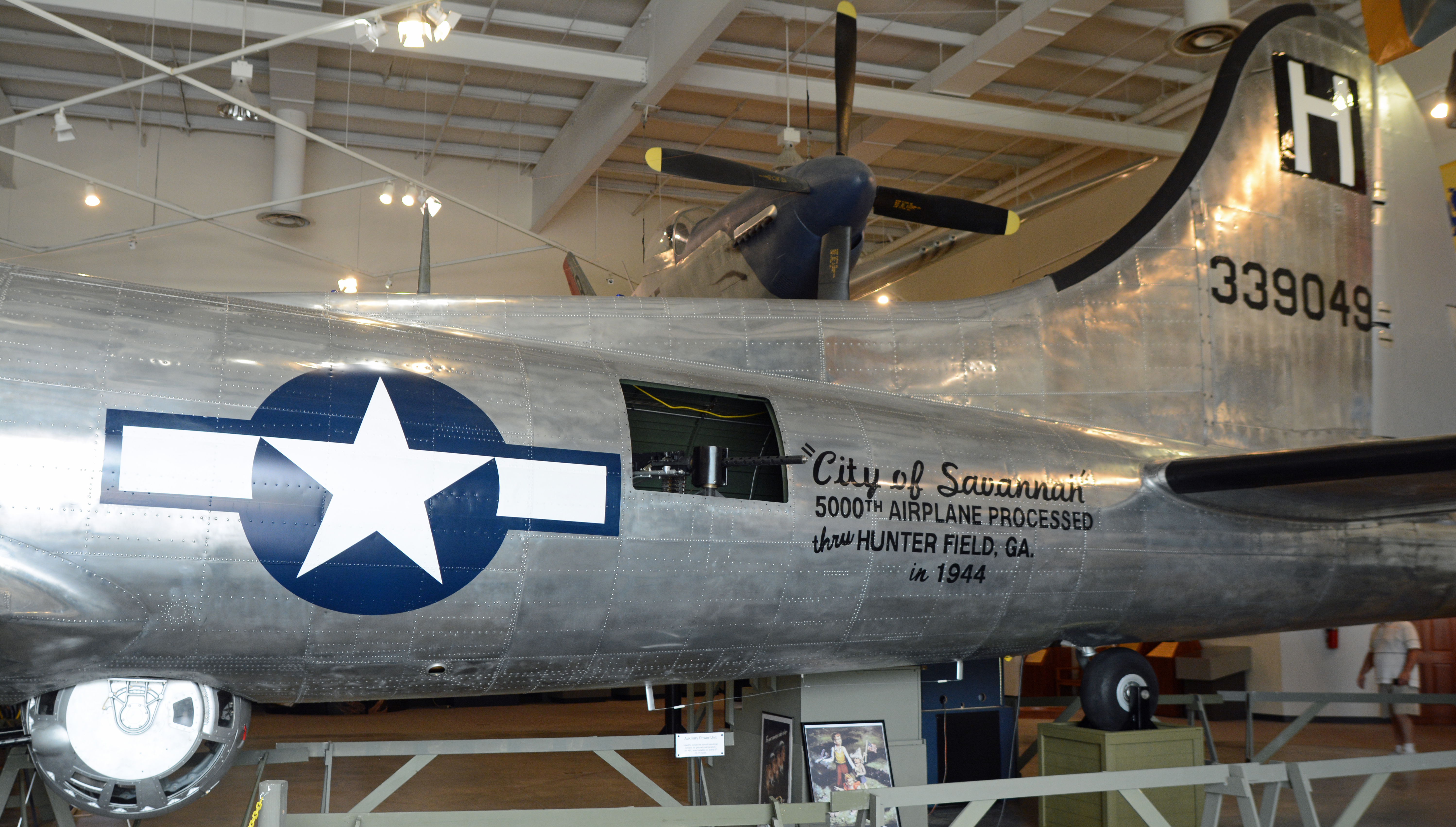
The National Museum of the Mighty Eighth Air Force opened on May 14, 1996, after thirteen years of planning that began in 1983. Its centerpiece is a B-17G Flying Fortress being painstakingly restored as the "City of Savannah" -- named after the original 5,000th aircraft processed through Hunter Army Airfield in 1944. When complete, it will be among the finest static displays of a B-17 in the world. The Combat Gallery houses original aircraft, engines, and scale models alongside a Messerschmitt Bf 109G fighter replica and a three-quarter-scale P-51 Mustang. Outside, Cold War-era aircraft stand guard: a B-47 Stratojet bearing the Strategic Air Command insignia, a Soviet-designed MiG-17, and an F-4 Phantom II. In 2009, the museum received the B-17 restoration project from the National Air and Space Museum. In 2025, it announced the acquisition of a B-24 Liberator from the Barksdale Global Power Museum, along with a 1902 German boxcar of the type used to transport American prisoners of war.
The Weight of 26,000 Names
The museum is more than aircraft and artifacts. Its Memorial Garden holds the names of those who gave their lives flying with the Eighth -- a toll that exceeded the entire United States Marine Corps' losses in the Pacific. The Major General Lewis E. Lyle Rotunda anchors the museum's interior, named for one of the Eighth's distinguished combat leaders. An art gallery showcases aviation paintings that capture moments impossible to photograph: the frozen terror inside a flak-riddled bomber at 25,000 feet, the eerie beauty of contrails drawn across a winter sky by hundreds of aircraft. A 2003 Georgia statute designated the museum as the official state center for character education, recognizing its mission extends beyond military history into broader lessons about courage, sacrifice, and moral responsibility. The museum broke ground on a major expansion in February 2024, ensuring that the story of the Mighty Eighth continues to grow as new artifacts and accounts are discovered.
Hallowed Ground
The museum sits in Pooler, Georgia, just off Interstate 95 in the western suburbs of Savannah. Its proximity to the Eighth Air Force's birthplace at the former Savannah Army Air Base -- now Hunter Army Airfield -- is deliberate and deeply felt. In February 2011, a World War II-era fire truck that had served at Hunter was donated to the collection, a direct physical link between the museum and the airfield where it all started. The museum changed its name to the National Museum of the Mighty Eighth Air Force in March 2013, and in January 2024 received an official national designation. For the pilots, navigators, bombardiers, gunners, and ground crews who passed through Savannah on their way to England's muddy airfields, this flat coastal landscape of marshes and live oaks was the last piece of America they saw. For some, it was the last piece of America they would ever see. The museum exists so that the rest of us remember why.
From the Air
Located at 32.12N, 81.24W in Pooler, Georgia, just south of Interstate 95 and west of downtown Savannah. The museum building sits adjacent to commercial development along US-80. Savannah/Hilton Head International Airport (KSAV) is approximately 4 miles to the south. Hunter Army Airfield (KSVN), the original Savannah Army Air Base where the Eighth Air Force was activated in 1942, lies about 8 miles to the east. The museum's outdoor aircraft displays -- particularly the B-47 Stratojet -- are identifiable from low altitude. Best viewed at 2,000-3,000 feet AGL. The flat coastal plain and marshland surrounding Savannah make this area easy to navigate visually.