National Museum of the Pacific War
The building looks like it ran aground in the Texas Hill Country. With its ship's-bow facade jutting toward the street, the old Nimitz Hotel in Fredericksburg earned the nickname "Steamboat Hotel" from locals who could not miss the resemblance. Charles Henry Nimitz, a German merchant sailor from Bremen, built it in 1852 -- complete with a saloon, brewery, ballroom-turned-theater, smokehouse, and bath-house. In its heyday, the guest book read like a who's who of nineteenth-century America: Horace Greeley, Johnny Ringo, President Rutherford B. Hayes, Generals Robert E. Lee, James Longstreet, Phil Sheridan, Ulysses S. Grant, and the writer William Sydney Porter, better known as O. Henry. But the hotel's greatest legacy would not check in for another three decades. On February 24, 1885, Chester William Nimitz was born upstairs -- the boy who would grow up to command the entire United States Pacific Fleet in the largest naval war in history.
A Sailor Born Landlocked
Chester Nimitz never knew his father. Chester Bernard Nimitz died before his son's birth, and it was grandfather Charles who became the boy's father figure during his first five years. In 1890, Chester's mother married his uncle William Nimitz, and the family moved to Kerrville, where William managed the St. Charles Hotel. The elder Charles Nimitz's seafaring stories and the fantastical steamboat-shaped hotel left their mark on the landlocked boy. Still a teenager, Chester secured enrollment at the United States Naval Academy, where he graduated seventh in a class of 114. His career arc from that Hill Country hotel to Commander-in-Chief of the U.S. Pacific Forces in World War II is one of the most improbable trajectories in American military history. Fleet Admiral Nimitz died on February 20, 1966, having shaped the outcome of a war fought across an ocean he first imagined from the porch of a frontier hotel.
From Memorial to Museum
The Admiral Nimitz Foundation was established in 1964 to honor Fredericksburg's most famous son. Four years later, the Texas legislature restored the old hotel to its original design and renamed it the Admiral Nimitz Museum. At first, the museum focused narrowly on Nimitz himself. But the scope expanded over the decades. In 2000, the complex was renamed the Admiral Nimitz State Historic Site -- National Museum of the Pacific War, dedicating the entire six-acre campus exclusively to the Pacific Theater battles of World War II. The transformation was deliberate: this would not be a shrine to one man but a chronicle of the entire Pacific conflict, from the attack on Pearl Harbor through the Japanese surrender.
Artifacts from Two Oceans
The George H. W. Bush Gallery, opened in 1991 when the former president cut the ribbon on the $3 million addition, houses some of the museum's most striking artifacts. A Ko-hyoteki class midget submarine that participated in the attack on Pearl Harbor sits inside, alongside a Japanese Kawanishi N1K "Rex" floatplane and an American B-25 Mitchell bomber. Outside, the Pacific Combat Zone recreates a Pacific island battlefield, complete with a Quonset Hut, a PT boat and base, Japanese tank, palm trees, and machine gun placements. Living History re-enactments bring the exhibits to life throughout the year. The Center for Pacific War Studies houses thousands of manuscript collections, recordings, photographs, and artwork available to researchers by appointment. Bush himself reflected on the war that shaped his generation: "I have often wondered why me, why was I spared when others died."
A Garden of Reconciliation
On May 8, 1976, the 130th anniversary of Fredericksburg's founding, the Japanese government presented the museum with a remarkable gift: the Japanese Garden of Peace. Designed by Taketora Saita, the garden replicates the private garden of Marquis Togo Heihachiro, the Imperial Japanese Navy commander who won decisive victories in the Russo-Japanese War of 1904-1905. Nimitz himself had personally admired Togo and helped establish a war memorial to the Japanese admiral. The garden stands as a quiet counterpoint to the combat exhibits nearby -- former enemies honoring each other across decades of reconciliation. It is one of the few places in the world where a Pacific War museum and a gift from Japan exist side by side on the same grounds.
Ten Presidents and Five Thousand Witnesses
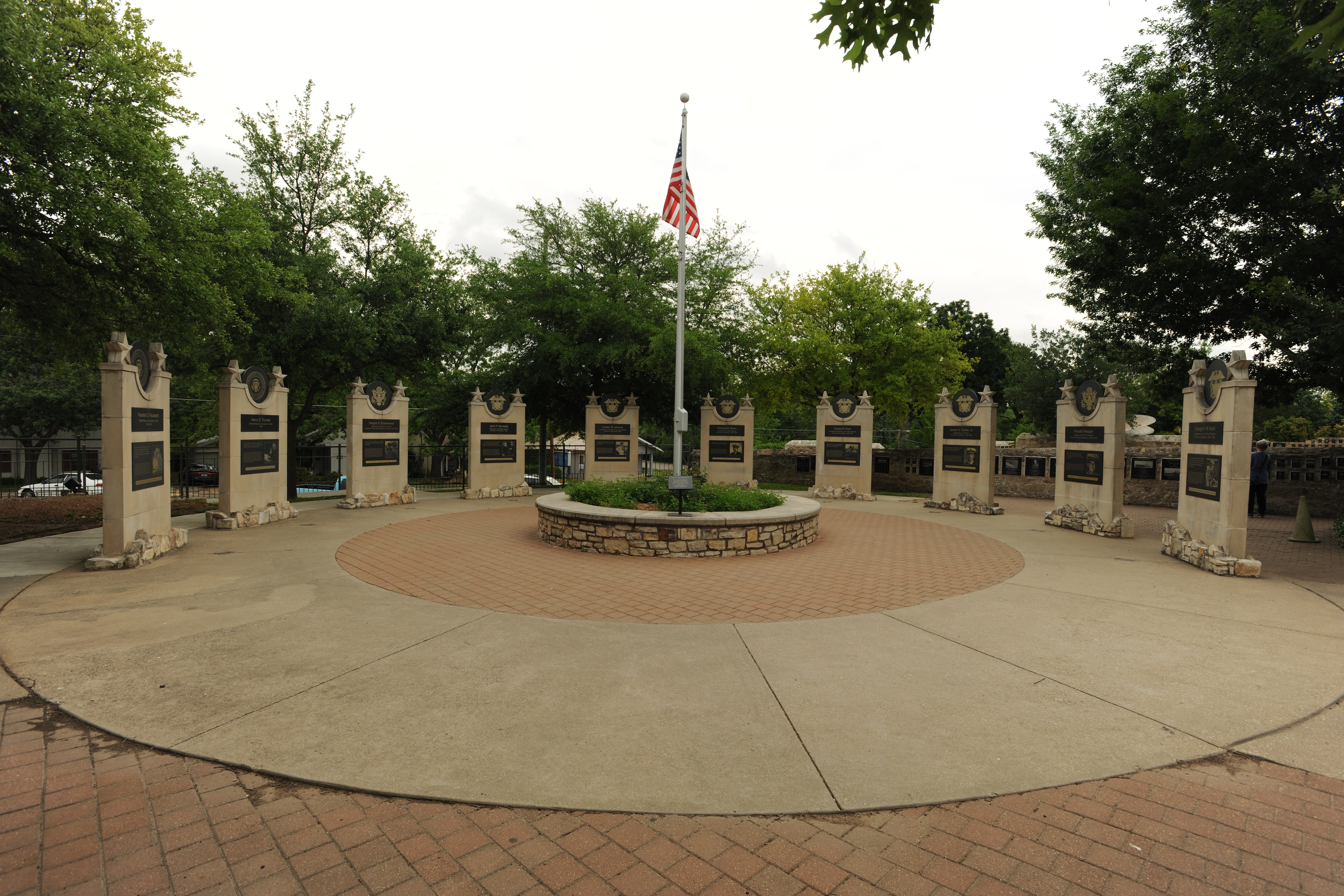
The outdoor Plaza of the Presidents was dedicated on September 2, 1995, the 50th anniversary of Fleet Admiral Nimitz's acceptance of the Japanese Instrument of Surrender. The plaza honors the ten U.S. presidents who served during World War II: Franklin D. Roosevelt and Harry S. Truman as Commanders in Chief, and Eisenhower, Kennedy, Johnson, Nixon, Ford, Carter, Reagan, and George H. W. Bush in uniform. On December 7, 2009, the museum hosted the grand reopening of the expanded Bush Gallery. Former President Bush, his wife Barbara, and Texas Governor Rick Perry cut the ribbon before a crowd of 5,000, including survivors of the attack on Pearl Harbor. The date was chosen deliberately -- the 68th anniversary of the day that pulled a nation, and a boy from Fredericksburg, into war.
From the Air
Located at 30.273N, 98.868W in downtown Fredericksburg, Texas, elevation approximately 1,700 feet MSL. Gillespie County Airport (T82) is the nearest airstrip, about 3 miles south of town. The museum complex occupies six acres along East Main Street (U.S. 290), identifiable from the air by the distinctive steamboat-shaped Nimitz Hotel facade. San Antonio International (KSAT) lies roughly 70 miles southeast; Austin-Bergstrom International (KAUS) is about 80 miles east. Best viewed at 2,000-3,000 feet AGL on approach from the south along the Pedernales River valley.