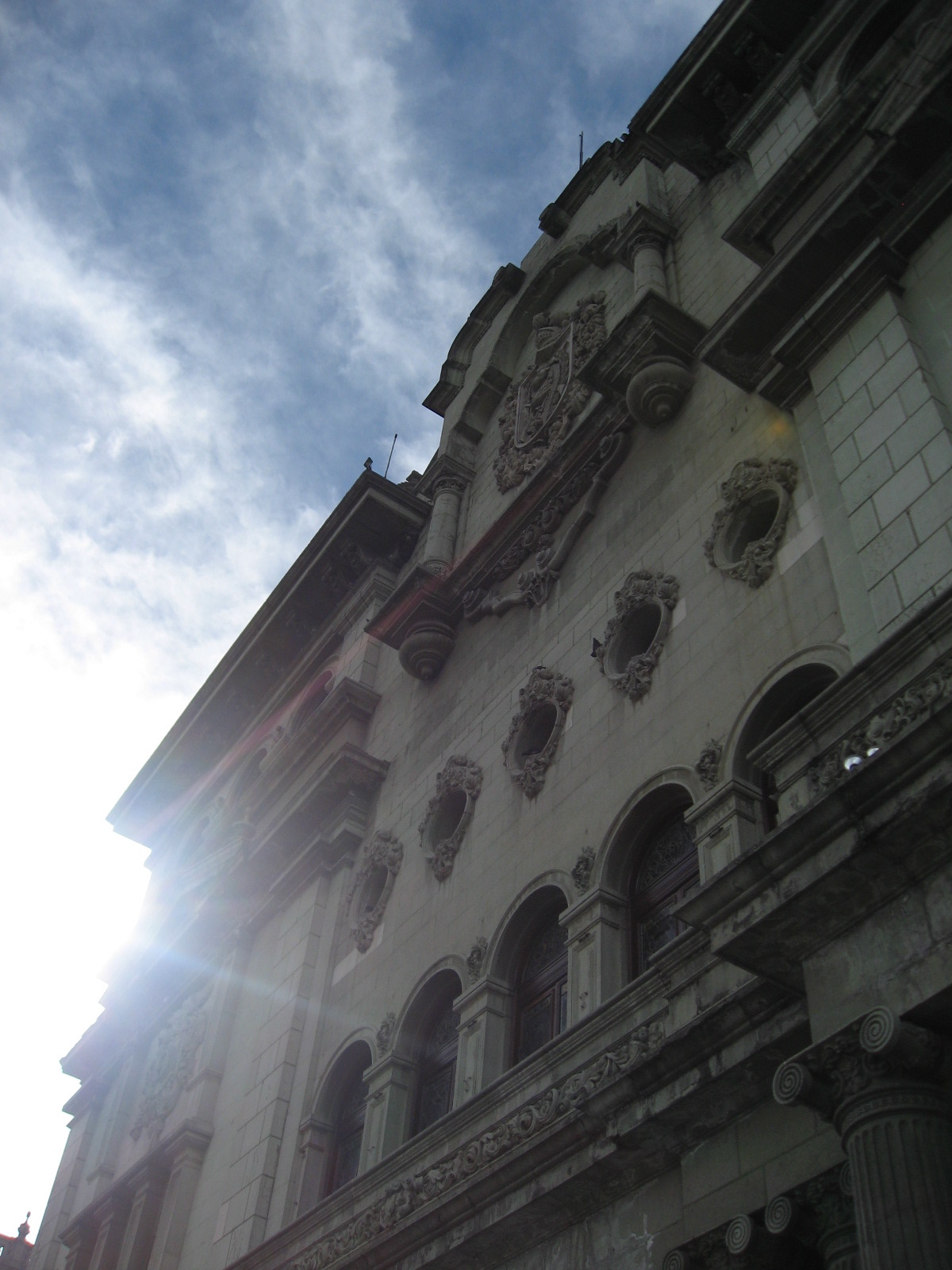
National Palace (Guatemala)
Every road in Guatemala begins here. A spot on the floor of the Palacio Nacional de la Cultura marks Kilometro Cero — Kilometer Zero — the literal origin point from which all distances in the republic are measured. The building itself, colloquially known as the "Palacio Verde" for its distinctive green-tinted stone, took the country nearly four hundred years and five failed attempts to achieve. Presidents commissioned it, earthquakes destroyed its predecessors, fires consumed temporary replacements, and winning architectural designs were abandoned before a single stone was laid. When the building finally opened on November 10, 1943 — chosen because it was the birthday of President Jorge Ubico, the dictator who forced it into existence — Guatemala had its palace at last. What it could not have known was how much dark history those walls would witness in the decades to come.
Four Centuries of False Starts
The story of Guatemala's seat of government begins in 1528, when the first Government House was built in Santiago de Guatemala in the Valle de Almolonga. In 1549, President Alonso Lopez de Cerrato moved the colonial court from Gracias a Dios in Honduras to Santiago. By 1761, a new seat of government was under construction, designed by the Spanish military engineer Luis Diez de Navarro. But Guatemala's geography is relentlessly seismic, and colonial architecture was no match for it. The capital itself would eventually relocate to the Ermita Valley after the devastating earthquakes of 1773 destroyed much of Santiago — modern-day Antigua Guatemala. In the new capital, the search for a proper government building continued. In 1919, President Manuel Estrada Cabrera laid the first stone for a palace to celebrate the centenary of independence and hired the Italian architect Guido Albani to design it. Then Estrada Cabrera's government collapsed. In 1921, President Carlos Herrera rushed a replacement into existence in three months on a small budget. Guatemalans called it the Palacio de Carton — the Cardboard Palace. In 1925, fire proved the nickname apt.
Ubico's Monument
It took a strongman to finish the job. In 1927, President Lazaro Chacon declared a design contest, won by artist Agustin Iriarte, but that project also stalled. Finally, in 1932, General Jorge Ubico — who ruled Guatemala with authoritarian control from 1931 to 1944 — published the basis for a new design. The first stone was placed on July 4, 1937, and construction ran from January 1939 through 1943. The result was a building of imposing scale and deliberate grandeur, blending neoclassical and colonial revival elements. Ubico opened it on his own birthday, a choice that was entirely in character for a president who compared himself to Napoleon and demanded absolute obedience. The palace became the headquarters of Guatemala's government — the place where presidents governed, where decrees were signed, where power concentrated. It survived the magnitude 7.5 earthquake of February 4, 1976, that killed approximately 23,000 Guatemalans and destroyed much of the surrounding city.
Coups and Secret Tribunals
The palace witnessed some of Guatemala's darkest political chapters. On March 23, 1982, young army officers deposed President Fernando Romeo Lucas Garcia and installed General Efrain Rios Montt, who had been director of the Military Academy when those same officers were cadets. From the palace, Rios Montt gave a speech declaring his willingness to use open trials against suspected guerrillas. What followed was something far less open. He established "special jurisdiction tribunals" — secret courts whose members were appointed by the president but whose identities were unknown to the public. These tribunals operated from the National Palace itself, under the direct control of the Defense Secretary, General Oscar Humberto Mejia Victores. The proceedings were swift and merciless: fifteen people were executed less than a month after capture. The tribunals operated in parallel to Guatemala's judiciary, answerable to no one but the military chain of command, until Mejia Victores himself overthrew Rios Montt in a coup on August 8, 1983.
From Power to Memory
The National Palace is now a museum, the Palacio Nacional de la Cultura, and is used for select government ceremonies. The transition from seat of power to cultural institution mirrors a broader reckoning in Guatemala, where buildings that once housed authoritarian rule are being reframed as sites of historical memory. Visitors can walk the halls where generals once governed and secret tribunals once convened. The architecture remains impressive — the green-tinted stone that gives the building its nickname, the grand staircases, the courtyards that echo with footsteps in a building designed to project authority. But the building's meaning has shifted. It no longer represents the power of the state over its people. It represents what that power did, and what came after. Kilometro Cero still marks the floor. Every road in Guatemala still begins at the palace. But now, at least, the building belongs to the public rather than to the men who once ruled from within it.
From the Air
The National Palace sits at 14.643°N, 90.513°W on the north side of the Parque Central in the heart of Guatemala City. From 3,000-5,000 feet AGL, look for the large open plaza of the Parque Central in the dense urban core — the palace is the prominent green-tinted building on its north edge, with the Metropolitan Cathedral adjacent. La Aurora International Airport (MGGT) lies approximately 4 km south-southwest. Guatemala City occupies a highland valley at roughly 4,900 feet elevation. Volcanic peaks — Agua, Fuego, and Acatenango — are visible to the west and southwest on clear days.