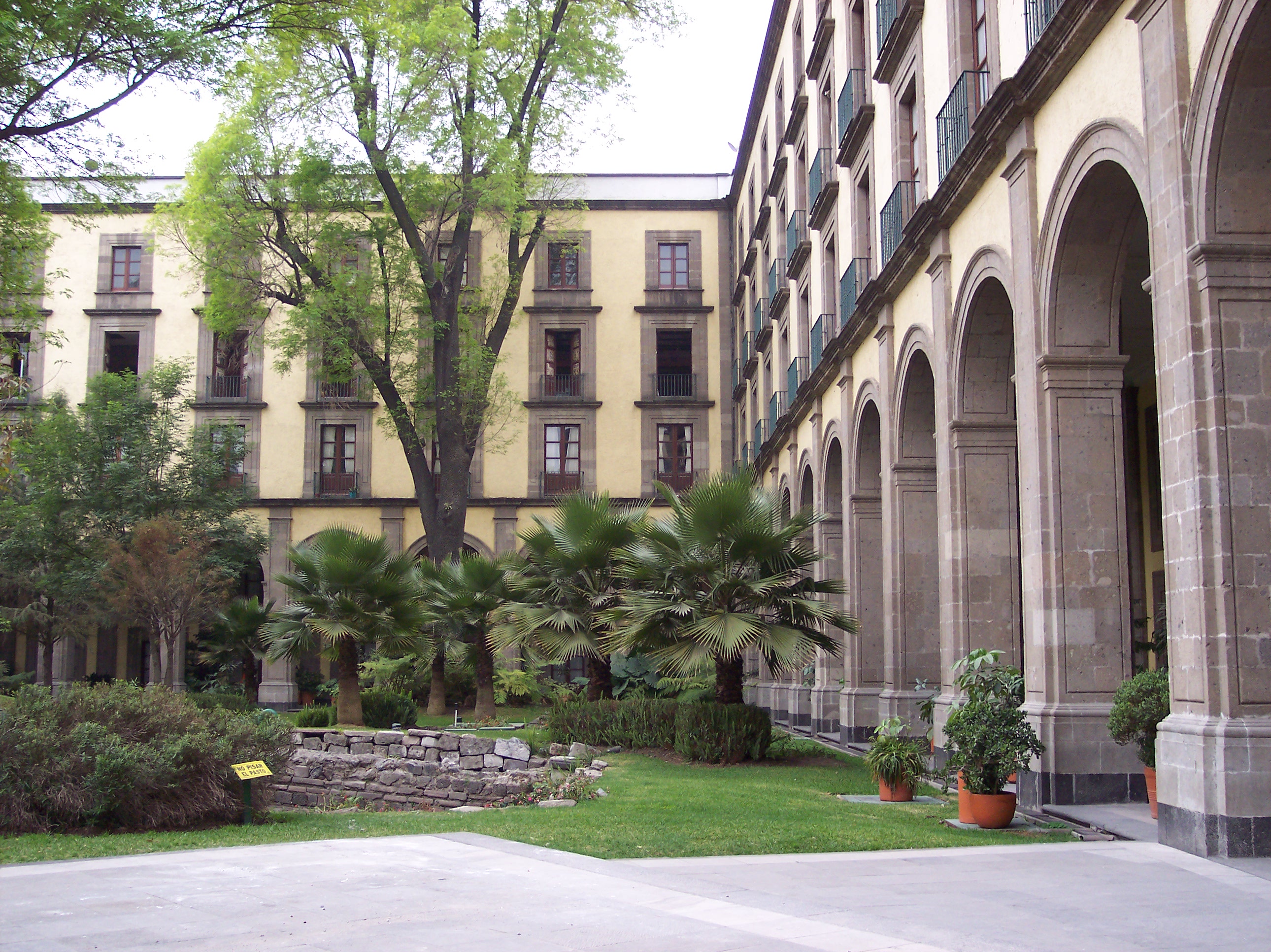
National Palace of Mexico
The same ground has held a throne for over 500 years. Before the red volcanic stone facade stretched across the east side of the Zocalo, before Diego Rivera climbed scaffolding to paint six years' worth of Mexican history on its stairwell walls, before the Spanish viceroys installed their courts and prisons within its corridors, this was where Moctezuma II held audiences in his New Houses. Much of the building material in the current palace was recycled from those Aztec structures after the Conquest, which means the walls of Mexican democracy are literally cemented together with the stones of the civilization that preceded it.
Stones That Remember
The National Palace stretches over 200 meters along the Zocalo's eastern edge, its facade built from tezontle, the porous red volcanic rock that gives much of Mexico City's colonial architecture its distinctive warmth. The site predates the Spanish arrival by centuries. Aztec emperors maintained a chamber called the tlacxitlan here, where elders presided over by the emperor settled disputes among citizens. After the Conquest, the Spanish did not completely level the Aztec structures but destroyed them enough to render them uninhabitable, then built atop the rubble. Italian Capuchin friar Ilarione da Bergamo described the viceregal palace as not merely a residence but a small city unto itself: high court, treasury offices, attorneys for the General Indian Court, and even small prisons all shared the complex.
A Palace That Burns and Rebuilds
Power attracts violence, and the palace has absorbed more than its share. In 1624, supporters of the archbishop set fire to it during a bitter feud with the viceroy. On June 8, 1692, it was almost completely destroyed in a riot, and Viceroy Gaspar de Sandoval had Friar Diego Valverde rebuild it from the ashes. After Mexican independence, the building endured a twelve-day siege during an uprising led by Valentin Gomez Farias against President Anastasio Bustamante, seriously damaging the southwest balustrade. In 1864, Habsburg emperor Maximilian installed three flagpoles before the main doors - the Mexican flag at center, Austria's at the north, France's at the south - and commissioned Lorenzo de la Hidalga to build the grand marble staircase that still anchors the Patio of Honor. Benito Juarez, in deliberate contrast, chose quarters at the palace's north end rather than the traditional south.
Rivera's Six-Year Argument
Beginning in August 1929, Diego Rivera spent six years painting The History of Mexico across the palace's main stairwell. The mural is enormous and unapologetic. Its central west wall depicts Mexico's history as a continuous struggle: Aztecs fighting Cortes at the bottom, the Inquisition destroying sacred books in the middle, the French intervention and Maximilian's execution in the upper corners, and Zapata and Pancho Villa's revolutionary armies at the top beneath a red banner reading Tierra y Libertad. The south wall imagines a socialist future, featuring the Soviet flag, Karl Marx, and Rivera's wife Frida Kahlo shown alongside her sister Cristina as teachers. Rivera painted J.P. Morgan, Rockefeller, and Vanderbilt into the left panel as villains of capital. The mural does not pretend to neutrality; it is an argument rendered in pigment on a government wall.
The Bell and the Balcony
Every September 15, the president steps onto the central balcony and rings the same bell that Miguel Hidalgo rang at dawn on September 16, 1810, in the Grito de Dolores that launched Mexico's war of independence. President Porfirio Diaz had the bell transferred from the town of Dolores Hidalgo to the palace in 1896, and the niche and sculptures surrounding it were reconstructed between 1926 and the 1930s. The ritual of El Grito connects the palace directly to the founding act of the Mexican nation. Famous residents and guests over the centuries have included the poet Sor Juana Ines de la Cruz, explorer Alexander von Humboldt, and liberator Simon Bolivar. Mexico's first president, Guadalupe Victoria, lived here, as did both emperors who briefly ruled. The presidential residence moved to Chapultepec Castle and later to Los Pinos, but in 2018 President Andres Manuel Lopez Obrador returned it to the National Palace.
Traveling and Immobile
Writer Carlos Fuentes called the National Palace both traveling and immobile. Traveling because its Spanish architectural style symbolizes the transplanting of European civilization across the Atlantic. Immobile because since Aztec times, this precise spot has been the seat of earthly political power in Mexico - first for the tlatoani, then viceroys, then presidents. Archaeological work during the construction of Metro Line 2 uncovered the original column bases of the Viceroy Palace and old cedar rafters that formed the building's earliest foundations. The palace sinks along with the rest of Mexico City's historic center, requiring constant work to shore up its structure. Even the ground beneath it is in motion, yet the institution it represents has not moved in half a millennium.
From the Air
Located at 19.4325°N, 99.1314°W on the east side of the Zocalo in Mexico City's historic center, at approximately 7,350 feet elevation. From altitude, look for the enormous central plaza (Zocalo) - the palace is the long red-stone building filling its entire eastern edge. The Metropolitan Cathedral sits on the north side of the same plaza. Nearest major airport is Mexico City International (MMMX/MEX), approximately 5 km east. The Templo Mayor archaeological site is immediately adjacent to the northwest.