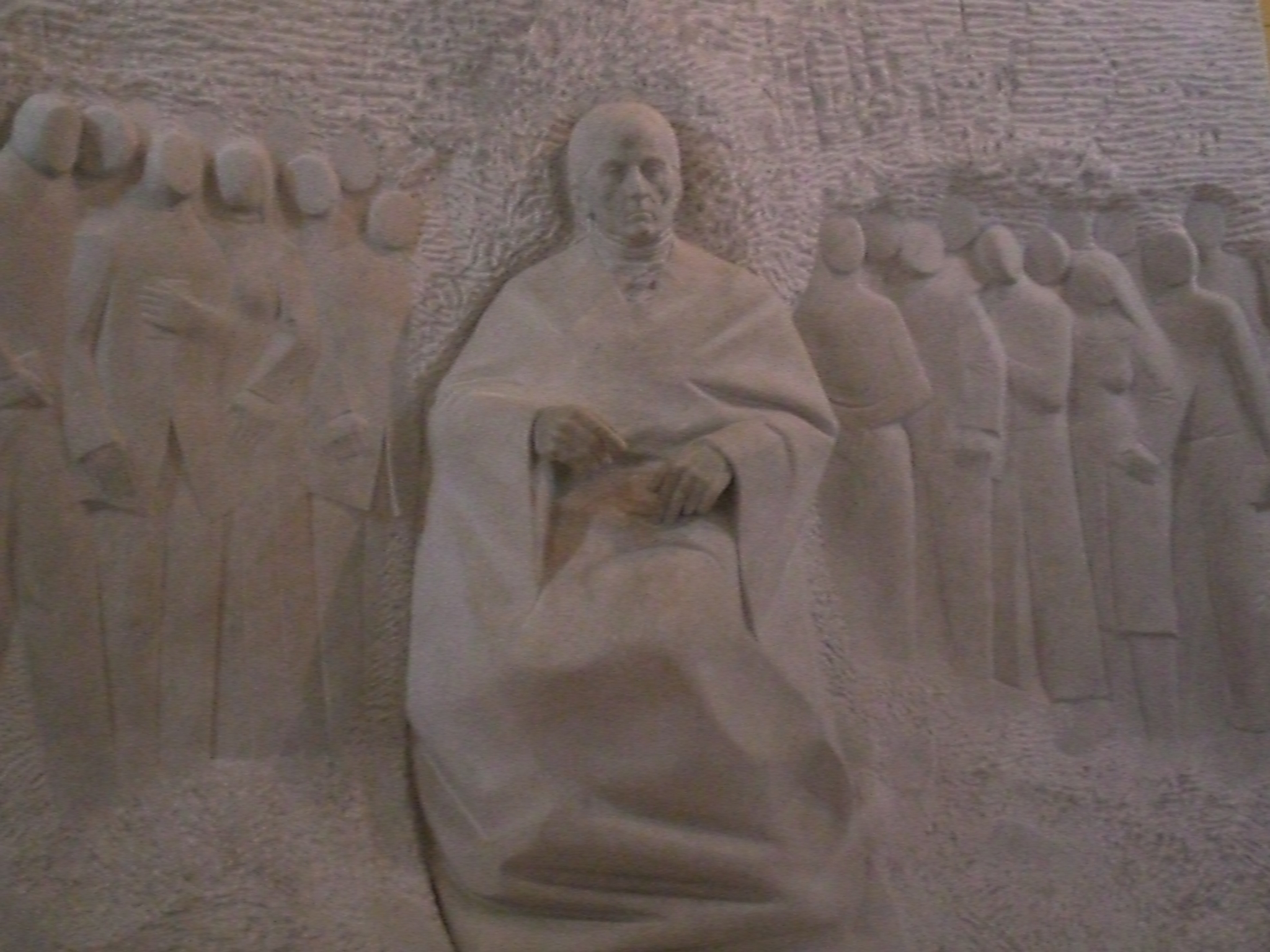
National Pantheon of Venezuela
An empty tomb stands next to Simon Bolivar's sarcophagus in the central nave of Venezuela's National Pantheon. It belongs to Antonio Jose de Sucre, hero of the South American independence wars and second president of Bolivia, whose remains have never been recovered. The tomb has waited since the Pantheon's creation in the 1870s -- a space held open on the chance that a body might someday come home. It is a gesture that says more about what this building means to Venezuela than any architectural description could.
A Church That Refused to Stay Down
The Pantheon stands on the northern edge of old Caracas, on ground that has been sacred -- and unstable -- for nearly three centuries. The original Santisima Trinidad church was built here in 1744, one of the many colonial churches that gave Caracas its Spanish character. It was destroyed, likely by the same seismic forces that have rattled the city throughout its history. In the 1870s, President Antonio Guzman Blanco -- the same modernizer who built the Federal Legislative Palace -- chose the ruined church site for a new purpose. Rather than rebuilding a house of worship, he transformed it into a secular temple to national heroism. The conversion from church to pantheon was more than architectural. It reflected Guzman Blanco's anticlerical politics and his vision of a Venezuela whose identity would be built on republican ideals rather than colonial piety.
Bolivar's Central Stage
Everything in the Pantheon radiates from one point: Bolivar's bronze sarcophagus, which occupies the position where the altar once stood. The entire central nave belongs to the Liberator alone, while other national figures are relegated to the side aisles. Above, the vault is covered with paintings from the 1930s depicting scenes from his life -- works by the artist Tito Salas that include Bolivar's triumphal entry into Caracas after the Battle of Carabobo in 1821, his ascent of Cerro de Potosi in 1825, and allegorical scenes of liberation. A massive crystal chandelier, installed in 1883 on the centennial of Bolivar's birth, hangs overhead. The Pantheon was closed for three years and reopened in 2013 after a major expansion and restoration, but the fundamental arrangement has not changed: Bolivar at the center, everyone else arranged around him, the architecture itself making an argument about the hierarchy of Venezuelan history.
The Roll Call of a Nation
More than a hundred individuals are interred or commemorated within the Pantheon, and the list reads as a compressed history of Venezuela. There are generals of the independence wars -- Jose Antonio Paez, the first president after separation from Gran Colombia in 1830; Rafael Urdaneta, who fought alongside Bolivar across the continent. There are presidents and politicians, writers and scientists. Teresa Carreno, the pianist and composer recognized as one of the greatest of the nineteenth century, was interred in 1977. Manuela Saenz, who saved Bolivar from assassination in 1828 and fought for Peruvian independence and women's rights, was honored in 2010. The Pantheon also holds cenotaphs for those whose remains were never found, including Francisco de Miranda -- the revolutionary who preceded Bolivar, fought in the American Revolution and the French Revolution, and died in a Spanish prison. In 2001, the indigenous chief Guaicaipuro, who resisted the Spanish conquest, was symbolically inducted, an acknowledgment of the nation's pre-colonial roots.
Monuments in Stone and Paint
The Pantheon's interior is dense with sculpture and painting. The central nave holds a monument to Bolivar by the Italian sculptor Pietro Tenerani. In the right nave, Hugo Daini's monument to the First Republic stands alongside Julio Roversi's tribute to Jose Gregorio Monagas, the president who abolished slavery by decree in 1854. The left nave holds monuments to Paez, Urdaneta, and others. Tito Salas's paintings dominate the walls and ceilings -- seventeen works in total, spanning from the foundation of Caracas to allegories of liberty. The artistic program is deliberately overwhelming, every surface pressed into service to tell the story of a nation forged in revolution. Among the most striking pieces are the cenotaphs: empty monuments to Miranda, Sucre, and the scholar Andres Bello, each an admission that the nation's full history cannot be gathered in one place, no matter how grand the building.
From the Air
The National Pantheon of Venezuela is located at 10.513N, 66.913W on the northern edge of the historic center of Caracas. From the air, look for the large building at the northern boundary of the colonial street grid, north of Plaza Bolivar. The Pantheon sits near other landmarks including the Federal Legislative Palace and the Cathedral. Nearest major airport: Simon Bolivar International Airport (SVMI/CCS), approximately 20km north across the Avila mountain range. Recommended viewing altitude: 2,000-4,000 feet for perspective on the relationship between the Pantheon and the surrounding historic district.