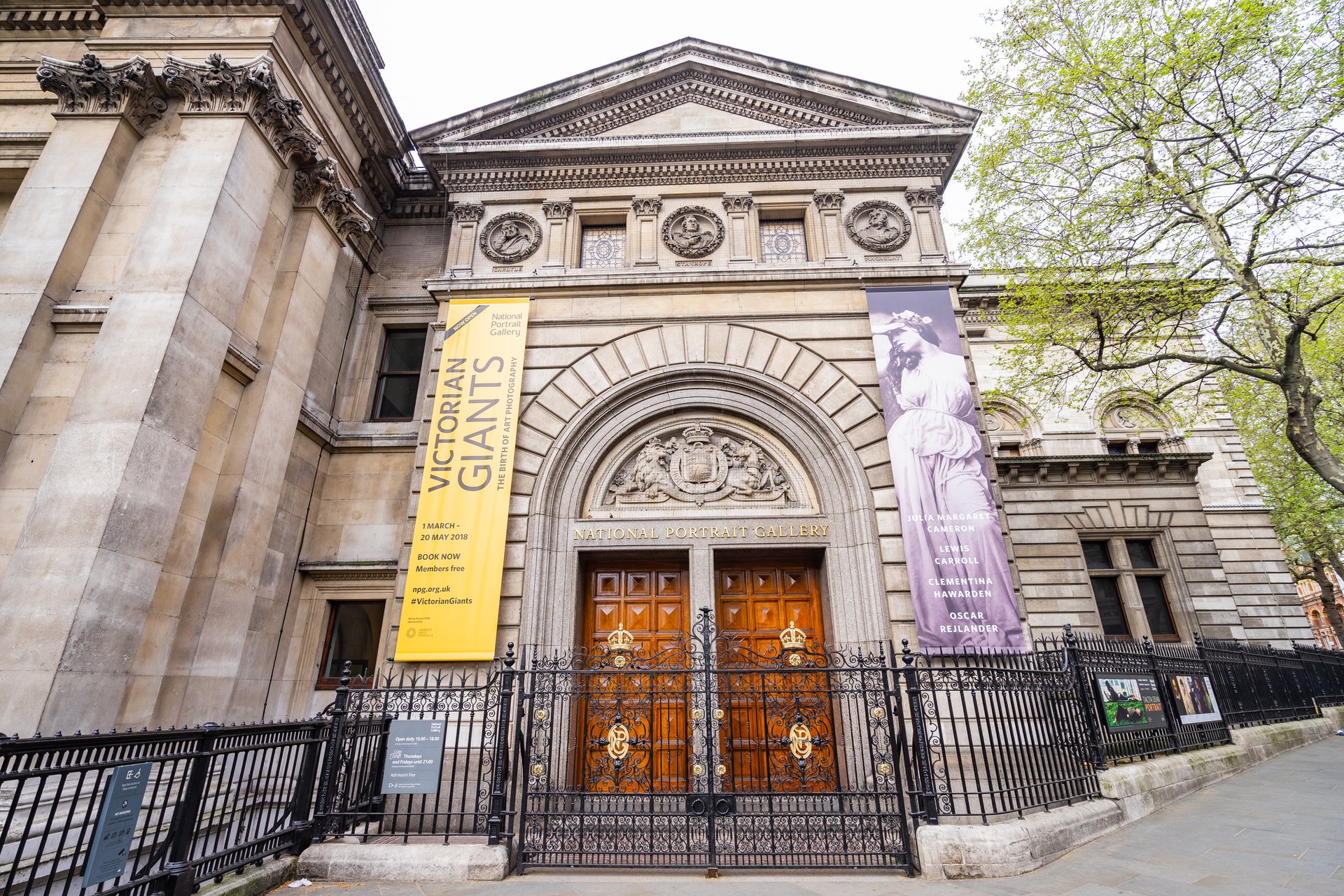
National Portrait Gallery, London
The painting that started it all is a portrait of a man who may or may not be William Shakespeare. The Chandos portrait, named after a former owner, is the most famous image of the playwright, though scholars have never conclusively proved the sitter's identity. It was the first work acquired by the National Portrait Gallery when it was founded in 1856, and it established the institution's unusual operating principle from the very beginning: here, the significance of the person depicted matters more than the skill of the artist who painted them.
Faces That Made Britain
The collection spans more than five centuries of British public life, from Tudor monarchs to contemporary cultural figures. Henry VIII stares from his famous Holbein-attributed portrait with the bloated confidence of absolute power. The Bronte sisters appear in a damaged painting by their brother Branwell, who painted himself out of the picture, leaving a ghostly pillar where he once stood. Charles Darwin gazes with the weary patience of a man who knew his ideas would outlast his critics. The gallery holds photographs, caricatures, drawings, and sculptures alongside paintings, making it a comprehensive visual record of the people who have shaped British life. Not all the art is exceptional, and that is the point. A mediocre painting of an extraordinary person has a place here; a masterful painting of nobody in particular does not.
A Gallery Without a Home
For its first four decades, the National Portrait Gallery was essentially homeless, shuttling between borrowed rooms in various London buildings. It opened in 1856 at 29 Great George Street, Westminster, then moved three more times before finally settling in 1896 at its current location on St Martin's Place, just off Trafalgar Square, tucked behind and adjoining the larger National Gallery. The building, designed by Ewan Christian, is modest compared to its neighbour, reflecting the gallery's perpetual status as the quieter sibling of Trafalgar Square's art institutions. A major extension by Sir John Dixon Butler was added in 1933, and the Ondaatje Wing in 2000 gave the gallery its first modern architectural statement.
The Criterion of Fame
What qualifies a person for inclusion has always been a matter of delicate judgment. The gallery's original mandate specified historical importance and fame, and for most of its history the collection skewed heavily toward politicians, monarchs, military leaders, and clergymen. The 20th century broadened the definition considerably to include scientists, writers, athletes, musicians, and cultural figures. Living subjects were once excluded entirely; now they are welcomed, and the gallery regularly commissions new portraits of contemporary Britons. The BP Portrait Award, held annually, has become one of the most prestigious portrait painting competitions in the world. Every new acquisition is a statement about who matters enough to be remembered by their face.
A Recent Reinvention
After a three-year closure for a major renovation, the gallery reopened in 2023 with reimagined galleries and a new entrance on the north façade of the building. The project, designed by Jamie Fobert Architects, added 20 percent more gallery space and fundamentally rethought how the collection is presented, moving away from a strictly chronological march through British history and instead grouping portraits thematically to create conversations across centuries. A Tudor courtier might now share a room with a Victorian industrialist if their stories resonate. The renovation also opened up previously hidden spaces in the building and improved accessibility throughout. The gallery remains free to enter, honoring the Victorian founders' belief that access to the faces of the famous should be available to everyone.
From the Air
Located at 51.509N, 0.128W on St Martin's Place, just north of Trafalgar Square in central London. The gallery sits behind the National Gallery and is difficult to distinguish as a separate building from altitude. Nearest airports: EGLC (London City, 6nm E), EGLL (Heathrow, 14nm W). Best viewed at 2,000-3,000 ft AGL.