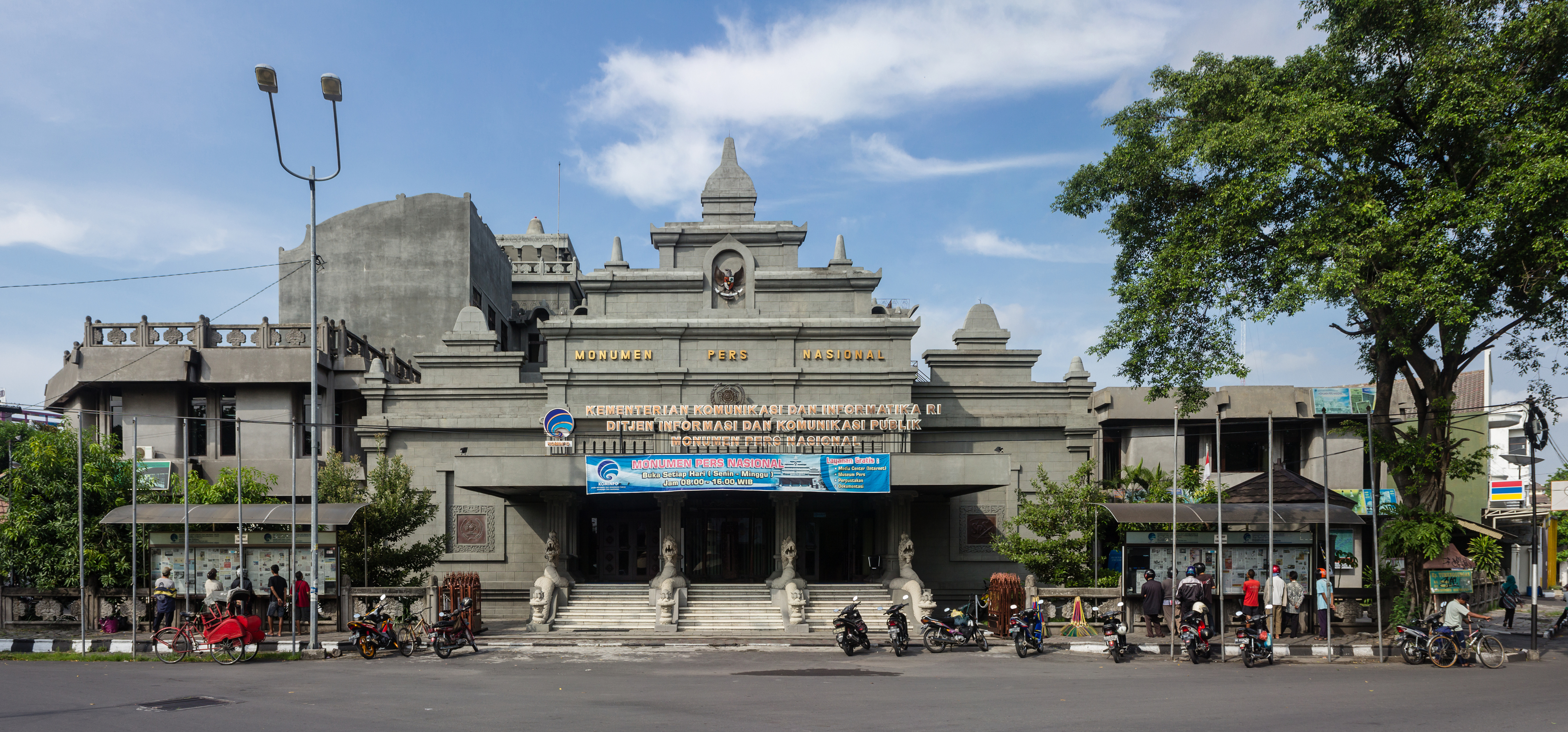
National Press Monument
"Exercising freedom for freedom's sake is a luxury we cannot afford." President Suharto spoke those words in 1978 while dedicating a museum to the very institution his government spent decades suppressing. The irony lives in the walls of the National Press Monument in Surakarta, Central Java, where over a million newspapers and magazines chronicle four centuries of Indonesian media -- including the long stretches when telling the truth could get a journalist killed. The building itself began as a society hall in 1918, became the birthplace of the Indonesian Journalists Association in 1946, and took another thirty-two years to officially become the museum someone first proposed in 1956.
A Hall for Gathering, Then for History
Mangkunegara VII, the prince of Mangkunegaran Palace, commissioned the original building in 1918 as a society hall and meeting space called Sasana Soeka. Its architect, Mas Abu Kasan Atmodirono, designed a structure meant for colonial-era socializing -- the kind of genteel gathering space the Dutch called a Societeit. But the building kept outgrowing its purpose. In 1933, R.M. Sarsito Mangunkusumo and several engineers gathered there to establish the Soloche Radio Vereeniging, the first public radio station operated by native Indonesians. During the Japanese occupation, the hall served as a military clinic. During the Indonesian National Revolution, it housed Red Cross offices. Then, on February 9, 1946, journalists formed the Persatuan Wartawan Indonesia -- the Indonesian Journalists Association -- within its walls. That date is now celebrated nationally as Press Day, and it anchored the building's transformation from social hall to symbol.
Thirty-Two Years in the Making
The path from idea to museum was extraordinarily slow, even by bureaucratic standards. On February 9, 1956, during the PWI's tenth anniversary celebration, prominent reporters including Rosihan Anwar and B.M. Diah proposed a foundation to manage a national press museum. The foundation was formalized that May, with collector Soedarjo Tjokrosisworo donating the bulk of its initial holdings. Then almost nothing happened for fifteen years. Plans for a physical museum were not announced until 1971. The name "National Press Monument" was not formalized until 1973. The land was not donated to the government until 1977. When the museum finally opened on February 9, 1978, Suharto's dedicatory speech served as an unintentional thesis statement for everything the collection would document: the tension between a free press and the governments that fear it.
A Million Pages of Witness
The museum's collection reaches back to 1615, when Memories der Nouvelles became the first newspaper published in the Dutch East Indies. The first printed newspaper, Bataviasche Nouvelles, followed in 1744. The first Javanese-language paper, Bromartani, appeared in 1855. These milestones anchor a collection of over a million publications spanning from colonial times to the present, drawn from across the Indonesian archipelago. Six dioramas in the rear entrance hall walk visitors through this history -- from pre-colonial communication methods through the Dutch period, the Japanese occupation, the National Revolution, the heavy censorship of Suharto's New Order, and finally the relative press freedom that arrived with Reformasi in 1998. Ten busts of pioneering journalists line the front hall, including Tirto Adhi Soerjo, often called the father of Indonesian journalism, and Ernest Douwes Dekker, a descendant of the author whose pen name Multatuli exposed colonial abuses.
Artifacts of Courage
The most haunting objects in the museum are personal. An Underwood typewriter once belonged to Bakrie Soeriatmadja, a vocal journalist for the Bandung-based Sipatahoenan. A blood-stained shirt was worn by Hendro Subroto when he was shot while covering the Indonesian military's entry into East Timor in 1975. Parachuting gear used by Trisnojuwono to cover a solar eclipse in 1983 speaks to the lengths journalists went for a story. Most sobering is a camera that belonged to Fuad Muhammad Syafruddin, a reporter for the Yogyakarta newspaper Bernas, who was murdered in 1996 after investigating a corruption scandal. Each artifact personalizes what the dioramas present as historical sweep -- these were individual people who risked something tangible for the act of reporting. The museum continues to acquire such objects, building a collection that functions as both archive and memorial.
Keeping the Doors Open
For years the museum struggled with a problem common to institutions of its kind: people found it boring. A 2012 study by David Kristian Budhiyanto of Petra Christian University noted the facility was rarely visited and sometimes poorly maintained. The museum responded with an aggressive outreach campaign -- photography contests on social media, mobile exhibitions sent to Yogyakarta and Magelang, and educational tourism programs. The results were dramatic: between January and September 2013, the museum received 26,249 visitors, a 250 percent increase over the previous year's target. Today the complex includes the original Sasana Soeka building alongside later additions, a library of 12,000 books, a digital archive room, nine public-access computers, and newspaper boards at the entrance where passersby can read the daily editions of Solopos, Suara Merdeka, and Republika. The front facade features a naga design encoding the year 1980, when the final construction phase was completed. It is listed as a Cultural Property of Indonesia -- a building that survived colonial rule, occupation, revolution, and autocracy, now dedicated to the craft of bearing witness.
From the Air
The National Press Monument is located at 7.565S, 110.818E on Gajah Mada Street in Surakarta (Solo), Central Java, just west of Mangkunegaran Palace. The complex is not easily distinguishable from the air amid surrounding urban development, but the broader Surakarta city center is identifiable by the grid of main roads and the nearby palace compounds. The nearest major airport is Adisumarmo International Airport (ICAO: WARQ), approximately 10 km northwest. Mount Lawu rises prominently to the east on clear days, and Mount Merapi is visible to the northwest.