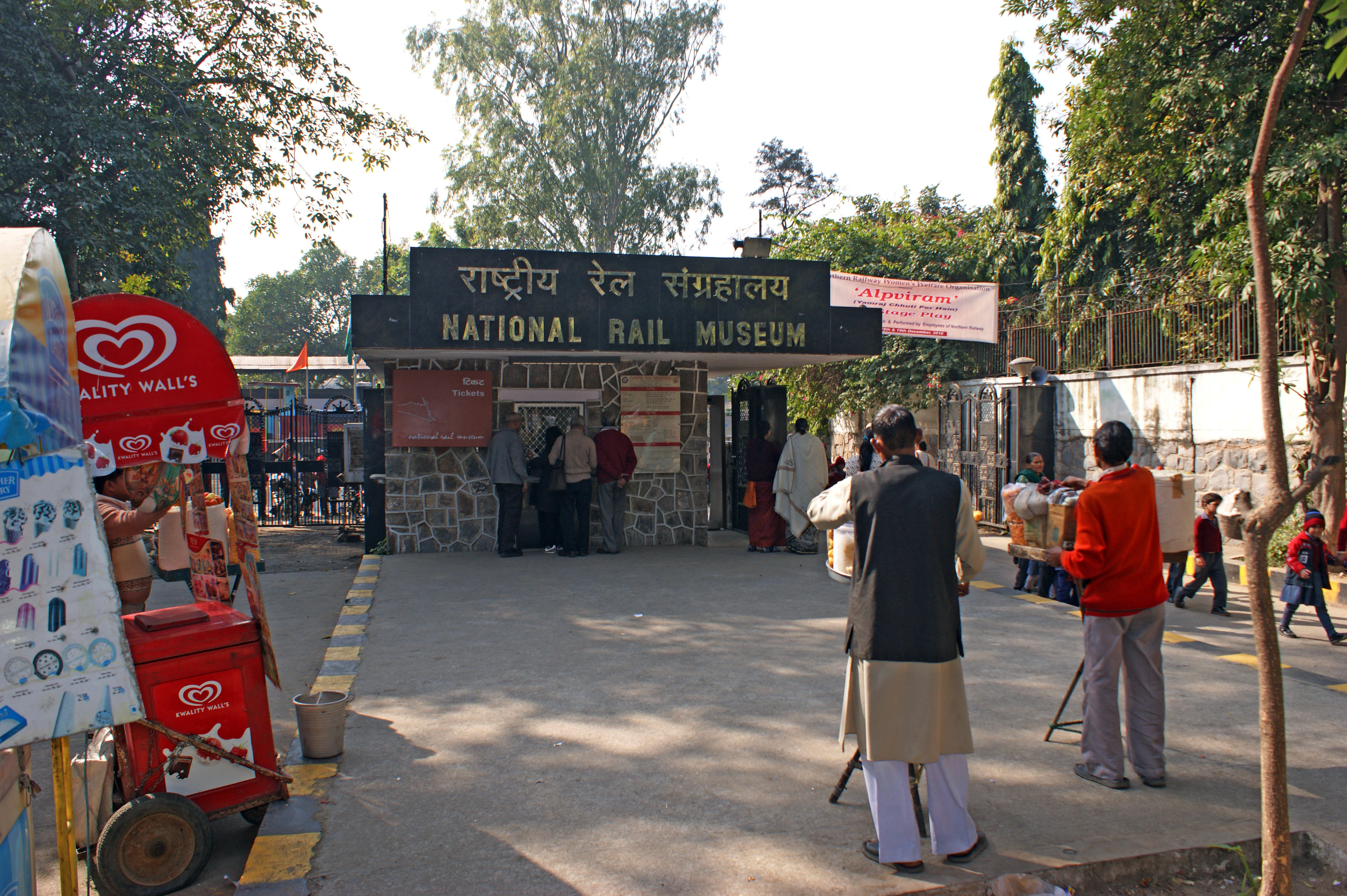
National Rail Museum, New Delhi
At the restaurant inside the National Rail Museum, a miniature steam locomotive chugs around the dining room delivering food to your table. The tables are named after historic Indian railway stations. The restaurant itself sits beneath a replica of the dome of Chhatrapati Shivaji Terminus in Mumbai. It is a deeply Indian experience -- whimsical, grand, and completely sincere -- and it captures something essential about this museum: the railways in India are not merely transportation. They are national mythology, and this 4.4-hectare site in the diplomatic quarter of Chanakyapuri is their shrine.
A Dream Rescued from the Scrapyard
The museum exists because a British rail enthusiast named Michael Graham Satow refused to let India's railway heritage disappear. In 1962, Satow proposed a Transport Museum -- and it was Satow who, that same year, discovered the rusting remains of a unique steam monorail engine in a railway scrapyard. The Patiala State Monorail, built by Orenstein & Koppel of Berlin in 1907, had once connected the town of Bassi with Sirhind-Fatehgarh, running on a single rail with large iron wheels on either side for balance. The line closed in 1927, and the engine and the chief engineer's inspection car had sat abandoned for thirty-five years. Satow's discovery led to their restoration at the Northern Railway Workshops in Amritsar. Both are now in working condition and on display -- rescued relics of an engineering experiment that the world forgot.
Maharajas, Viceroys, and a Future King
The museum's collection of royal saloon cars reads like a guest list for the most exclusive party in colonial history. The Maharaja of Mysore's saloon was finished in teak, gold, and ivory. The Gaekwar of Baroda's saloon was built in the 1880s at the Parel Locomotive Workshop in Bombay. The Viceregal Dining Car served meals to the British viceroy as he traversed the subcontinent. And there is the saloon built for the Prince of Wales -- later King Edward VII -- for his visit to India, a railway carriage designed to communicate that the man inside it ruled a quarter of the world's population. These coaches represent the strange duality of Indian railways: infrastructure built for imperial extraction and control that the nation subsequently made entirely its own. The museum presents them without irony -- as engineering marvels and historical artefacts, not relics of subjugation.
The Fairy Queen and the Moaning Crabs
The star locomotive is the Fairy Queen, the world's oldest working steam engine still in operational service. She is taken out on heritage runs several times a year, a living machine in a museum of static ones. But the collection holds stranger treasures. Electric locomotive 4502, named Sir Leslie Wilson, is a 1928 WCG-1 that belonged to the Great Indian Peninsular Railway. These first-generation 1,500-volt DC electric locomotives were nicknamed khakis -- Hindi slang for crabs -- because they emitted a curious moaning sound at rest and an unusual swishing noise in motion. Their articulated bodies made them ideal for the steep curves of the Western Ghats. Sir Leslie Wilson worked as a shunting locomotive at Mumbai's Chhatrapati Shivaji Terminus until 1994, sixty-six years of service. Then there is the fireless steam locomotive, manufactured in 1953, which operated without any fire at all -- its pressure vessel was prefilled with steam from a static boiler, a quiet workhorse for environments where open flame was dangerous.
Forty-Two Railways Becoming One
The museum's deeper story is the story of Indian unification. Before independence, forty-two separate railway companies operated across the subcontinent, owned by princely states and the British East India Company. The restaurant's replica of the Chhatrapati Shivaji Terminus dome is not mere decoration -- it commemorates the process by which those forty-two networks merged into Indian Railways, today one of the largest employers on Earth. President V. V. Giri laid the foundation stone on 7 October 1971. The museum opened on 1 February 1977, inaugurated by transport minister Kamalapati Tripathi as the Rail Transport Museum. It was originally envisioned as part of a larger complex covering railways, roadways, airways, and waterways, but the other sections never materialized. In 1995, it was officially renamed the National Rail Museum -- a title that acknowledged what had become obvious: India's story, from empire to independence to modernity, runs on rails.
From the Air
The National Rail Museum is located at 28.5848N, 77.1814E in Chanakyapuri, New Delhi's diplomatic enclave, approximately 4 km southwest of India Gate. The museum's 4.4-hectare outdoor display area with locomotives and rolling stock visible in an open railway yard layout can be spotted from lower altitudes. Nearby landmarks include the Nehru Memorial Museum to the northeast and Safdarjung Airport (VIDD) immediately to the southeast. Indira Gandhi International Airport (VIDP) is approximately 11 km to the southwest. Best viewed at 2,000-4,000 feet AGL in clear conditions.