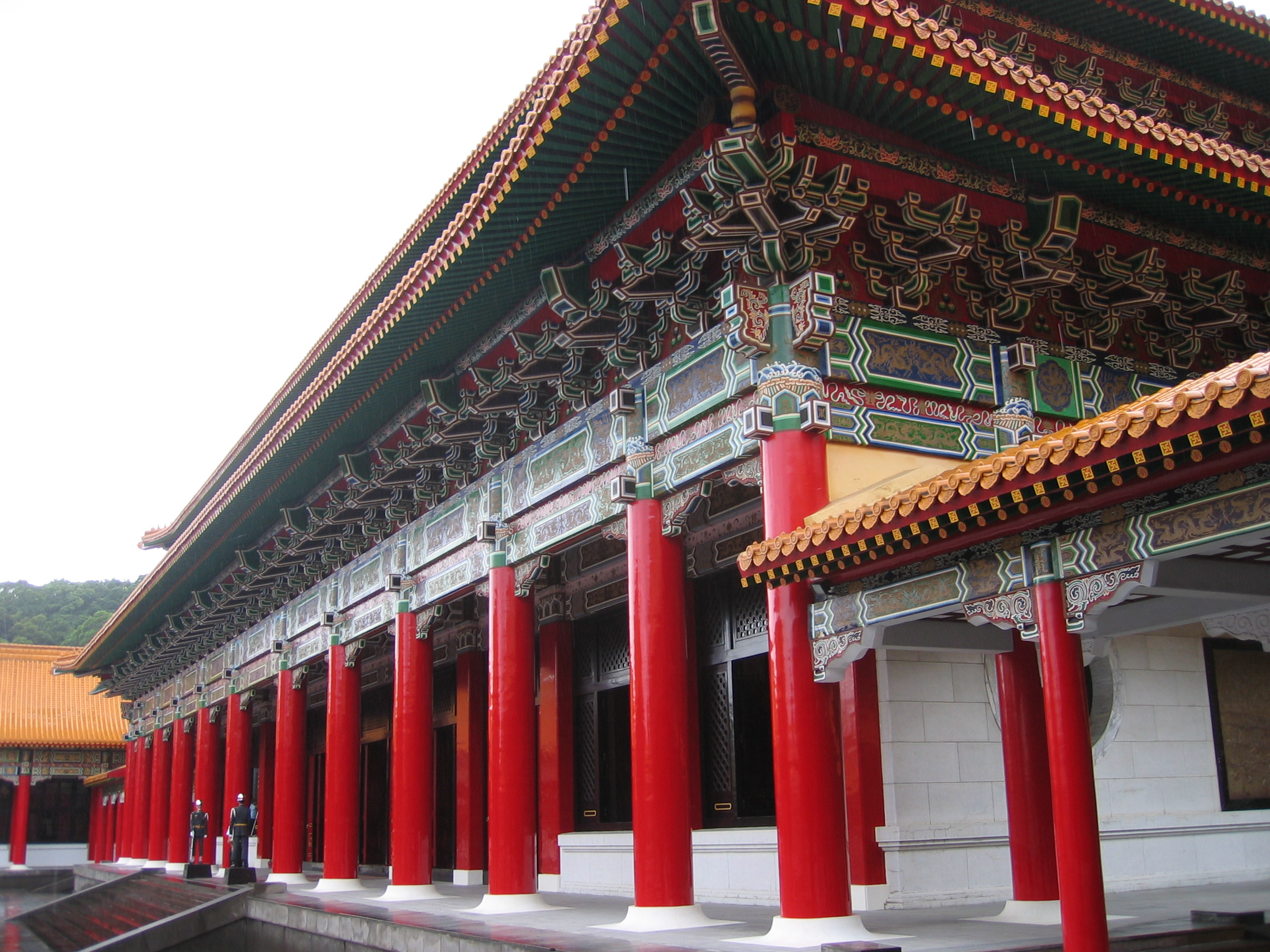
National Revolutionary Martyrs' Shrine
Every hour, on the hour, the silence breaks. Three soldiers in white gloves and polished boots begin a slow, choreographed march from the entrance gate to the main hall, rifles balanced at precise angles, boots striking flagstone in perfect unison. The changing of the guard at the National Revolutionary Martyrs' Shrine draws crowds of visitors who stand hushed along the processional route, watching a ritual that has repeated daily for decades. But the ceremony is the surface. Beneath it lies a more complicated story -- of 390,000 spirit tablets, a building that used to be a Shinto shrine, and a nation still defining whom it chooses to remember.
A Forbidden City in Miniature
The shrine stands on Chingshan Mountain in Taipei's Zhongshan District, overlooking the Keelung River. Built in 1969, its architecture deliberately recalls the Hall of Supreme Harmony in Beijing's Forbidden City -- sweeping eaved roofs, crimson columns, ornamental brackets, a grandeur meant to invoke the weight of Chinese imperial tradition. The choice was intentional. For the Republic of China government that commissioned it, the shrine served a dual purpose: honoring the dead and asserting cultural continuity with the mainland they had left behind. The building replaced a Japanese Gokoku Shrine that had occupied the site since the colonial era, one of many Shinto shrines repurposed or demolished after Japan's surrender in 1945.
Wars Across a Continent
The spirit tablets inside the shrine tell a condensed history of twentieth-century China's conflicts. The 390,000 names encompass those who died in the Xinhai Revolution that toppled the Qing dynasty in 1911, the Northern Expedition that sought to unify China in the 1920s, the Second Sino-Japanese War that consumed the nation from 1937 to 1945, and the Chinese Civil War that drove the Nationalists to Taiwan. The First and Second Taiwan Strait Crises of the 1950s added more names. Most of the soldiers commemorated were born on the Chinese mainland, a fact that adds poignancy -- these were people who fought for a republic that no longer controlled the land where they lived and died. Taiwan itself was under Japanese rule throughout World War II, and roughly 200,000 Taiwanese served in the Japanese Imperial Army.
Beyond the Battlefield
A 1998 legal amendment expanded the shrine's definition of heroism beyond the military. Lin Ching-chuan, a schoolteacher who died trying to save children in the 1992 Taoyuan County tour bus fire, became the first civilian inductee. Since then, the shrine has honored police officers and firefighters killed in the line of duty, including Yang Chi-chang, who died in the Taiwan McDonald's bombings. Healthcare workers who served during the Hoping Hospital lockdown in the 2003 SARS outbreak have also been commemorated. One of the most unlikely inductees is Wen Yung-nan, a postal worker who died in 1973 delivering mail in the aftermath of Typhoon Nora. The expanding roster reflects a society rethinking what sacrifice means.
Ritual and Remembrance
Twice a year, on March 29 -- Youth Day, commemorating the 1911 Huanghuagang Uprising -- and September 3, Armed Forces Day, the President of the Republic of China leads the heads of all five branches of government to the shrine. They bow and offer incense, a ceremony replicated in smaller martyrs' shrines across every county in Taiwan, led by local magistrates and mayors. The funeral of President Chiang Ching-kuo was held here in 1988, adding another layer to the site's already dense political symbolism. For visitors who arrive on an ordinary afternoon, though, the shrine's power is quieter: the precision of the honor guard's march, the hush of the surrounding gardens, and the sheer number of names on the spirit tablets inside, each one a life cut short by conflicts that shaped modern Asia.
From the Air
Coordinates: 25.080N, 121.533E. Located on Chingshan Mountain in Zhongshan District, north-central Taipei, overlooking the Keelung River. The traditional Chinese palace-style architecture with its distinctive red walls and sweeping roofs is visible from the air. Nearby airport: RCSS (Taipei Songshan Airport, ~3 km southeast). Best viewed at 2,000-3,000 feet. Look for the large temple complex on the hillside near the Grand Hotel Taipei.