The 9/11 Memorial: Where Absence Speaks Louder Than Stone
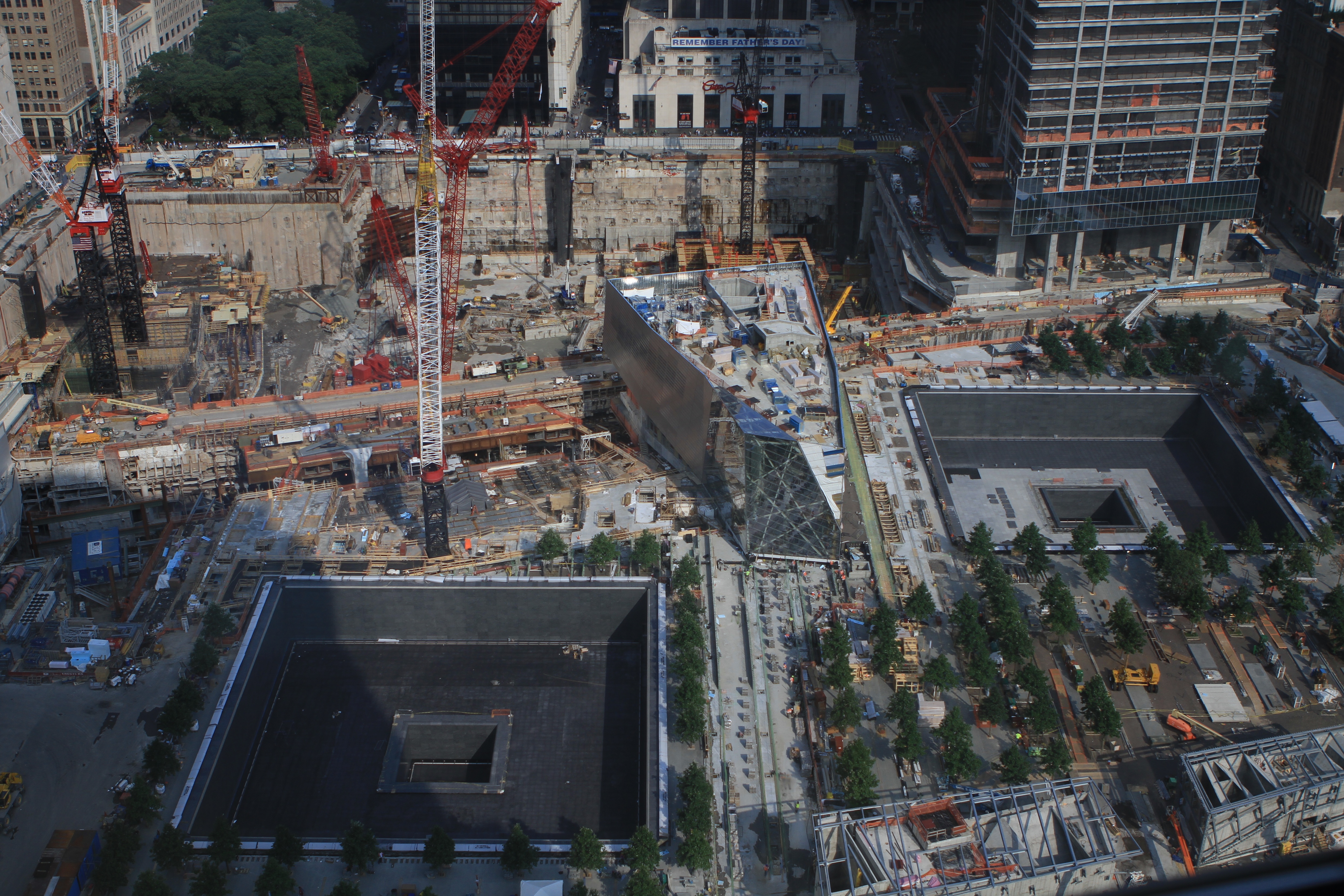
The names of 2,983 people are inscribed on bronze parapets surrounding two square voids in Lower Manhattan. The voids are exact footprints of the Twin Towers, and into each one, water cascades thirty feet down granite walls before disappearing into a smaller, seemingly bottomless opening at the center. The sound of the waterfalls -- the largest man-made waterfalls in the United States -- mutes the noise of the city. The architect Michael Arad called his design "Reflecting Absence," and the name captures exactly what happens here. There is no triumphal arch, no heroic sculpture. There is a forest of more than 400 swamp white oak trees, two enormous holes in the ground, and the weight of nearly three thousand individual lives rendered in bronze lettering arranged not alphabetically but by connection -- coworkers beside coworkers, friends beside friends, the living memory of relationship etched into metal.
Five Thousand Visions of Grief
In 2003, the Lower Manhattan Development Corporation launched an international competition to determine what should fill the ground where the towers had stood. From 63 countries, 5,201 proposals arrived. Some were monumental. Some were spare. The winner was Arad, an Israeli-American architect working for the New York City Housing Authority who had been riding the New York subway one night when the idea of two recessed pools came to him. He partnered with landscape architect Peter Walker to surround those pools with a forest of deciduous trees that would mark the seasons -- green in summer, gold in autumn, bare in winter. The design sat within Daniel Libeskind's master plan for the rebuilt World Trade Center site, and it was the only finalist to break Libeskind's requirement that buildings overhang the footprints. The foundation was renamed the National September 11 Memorial & Museum in 2007, and after years of political battles, budget cuts, and construction delays, the memorial opened to the public on September 12, 2011 -- one day after the tenth anniversary of the attacks.
The Algorithm of Adjacency
The names on the bronze parapets are not listed alphabetically or randomly. They are arranged by what the designers call "meaningful adjacencies" -- an algorithm that groups people by where they were and whom they were with. Employees of the same company stand together. Passengers on the same flight appear under their flight number. First responders are listed with their units. About 1,200 requests from family members further shaped the arrangement. Software developed by Local Projects implemented the final configuration, and the names are rendered in the Optima typeface using small capitals for visual balance. The six victims of the 1993 World Trade Center bombing appear on Panel N-73 at the North Pool. Ten pregnant women who died on September 11 are followed by the words "and her unborn child." Edith Lutnick of the Cantor Fitzgerald Relief Fund said it plainly: "Your loved ones' names are surrounded by the names of those they sat with, those they worked with, those they lived with and, very possibly, those they died with."
A Tree That Refused to Die
Among the 400 swamp white oaks on the memorial plaza stands a single Callery pear tree. Workers recovered it from the rubble in October 2001, badly damaged and barely alive. The New York City Department of Parks and Recreation moved it to the Arthur Ross Nursery in Van Cortlandt Park in the Bronx, where it was replanted on November 11, 2001. No one expected it to survive, but the following spring it showed new growth. Mayor Michael Bloomberg said at the time: "Again, we and the tree refused to throw in the towel. We replanted the tree, and it bounced back immediately." The Callery pear was returned to the memorial plaza in December 2010, and it became known as the Survivor Tree. Six additional survivor trees -- three Callery pears and three little-leaf lindens -- were later planted near City Hall and the Brooklyn Bridge. The Survivor Tree glade opened on May 24, 2019. Nursery manager Richie Cabo put the symbolism simply: "It represents all of us."
Seventy Feet Below the City
The museum, dedicated on May 15, 2014, descends deep below street level. Designed by Davis Brody Bond and accessible through a pavilion by the Norwegian firm Snohetta, the museum encloses a vast space of publicly accessible galleries. One wall is the exposed slurry wall -- the original retaining barrier that held back the Hudson River and remained intact through the collapse of both towers. Artifacts include wrecked fire engines, twisted steel from all seven original World Trade Center buildings, recordings of 911 calls, and the Survivors' Staircase, the first artifact lowered to bedrock in July 2008. The Waterford Crystal "Hope for Healing" panels from the 2002 New Year's Eve Times Square Ball are also in the collection. The museum's dedication ceremony drew President Barack Obama, former President Bill Clinton, and five New York mayors spanning decades. During the ceremony, the Broadway performer LaChanze sang "Amazing Grace," dedicating it to her husband Calvin Gooding, who was killed in the attacks. In the five days between dedication and public opening, more than 42,000 first responders and family members walked through the galleries.
Sacred Ground and Open Wounds
The memorial has not been free of controversy, and that is part of its story. The unidentified remains of 1,115 victims were transferred to a repository in the museum's bedrock in an early-morning ceremony on May 10, 2014 -- early in the morning, some family members noted, because of the opposition to the decision. NYPD cadet Mohammad Salman Hamdani, whose remains were found in the North Tower wreckage and who received a full police funeral, was not listed among first responders on the memorial but placed in a separate grouping. Fritz Koenig's bronze sculpture "The Sphere," commissioned for the original World Trade Center plaza in 1971 and damaged but not destroyed in the attacks, was relocated to adjacent Liberty Park in 2017. Over a thousand pieces of World Trade Center steel have been distributed to communities across the country, and memorials built around those fragments stand in cities and towns from coast to coast. The memorial itself, in the years since it opened, has been visited by millions. The waterfalls keep falling, the oaks keep growing, and the names -- those 2,983 names -- remain exactly where their loved ones wanted them.
From the Air
The National September 11 Memorial & Museum (40.7117N, 74.0136W) occupies the footprints of the original Twin Towers in Lower Manhattan. From the air, the two square reflecting pools are clearly visible as dark voids within a green tree canopy at the base of One World Trade Center. The memorial is bounded by Greenwich Street to the east and West Street to the west. Nearby airports: KEWR (Newark Liberty, 14km W), KJFK (John F. Kennedy, 22km SE), KLGA (LaGuardia, 14km NE). Best viewed at 2,000-4,000 feet AGL approaching from the south over New York Harbor, where the memorial pools and the spire of One World Trade Center form a unified composition. The Statue of Liberty and Ellis Island provide visual references to the southwest.