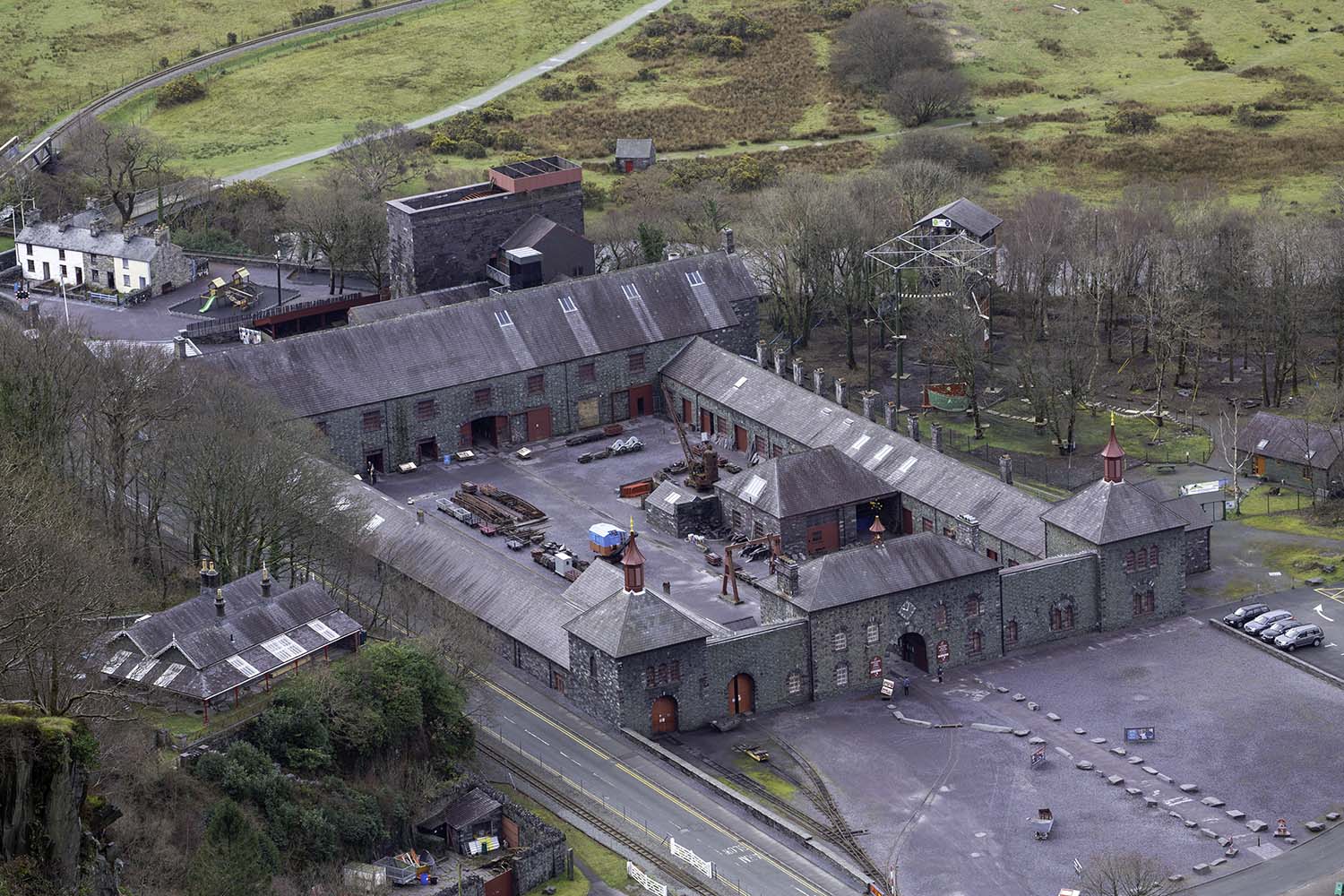
National Slate Museum
The waterwheel at the National Slate Museum is fifty feet in diameter and five feet wide, built in 1870 by De Winton of Caernarfon around a twelve-inch axle. It is the largest working waterwheel in mainland Britain, and it once powered the workshops that kept the Dinorwic quarry running -- forging tools, maintaining locomotives, repairing the endless machinery of extraction. When the quarry closed in 1969, the workshops fell silent. Three years later, they reopened as a museum. The machines stayed where they were. So did the grime.
The Mountain They Took Apart
The Dinorwic quarry, which the museum's workshops served, was one of the great industrial enterprises of Victorian Wales. At its peak, it was among the largest slate quarries in the world, carving terraces into the mountainside above Llyn Padarn. The slate from these hills roofed houses across Britain and far beyond -- a durable, waterproof material split along its natural grain by men who learned the skill from their fathers. The quarry employed thousands, and the communities that grew up around it -- Llanberis, Deiniolen, Bethesda -- were shaped entirely by the rhythm of extraction. When you left school, you went to the quarry. When the quarry closed, the world those communities knew closed with it.
The Workshops at Gilfach Ddu
The museum occupies Gilfach Ddu, the quarry's maintenance workshops, built in 1870 on land created from decades of spoil-tipping. Rail access came from two directions: narrow gauge lines from the quarry itself, and the Padarn Railway, which carried finished slate down to Port Dinorwic for export. Inside the workshops, blacksmiths forged tools, engineers maintained the quarry's locomotives, and carpenters built the wagons that hauled slate along the terraces. The buildings themselves are constructed of the material they served -- roofed in slate, walled in stone -- and they survive largely intact, the machinery still positioned where it was used.
Cottages from Tanygrisiau
Among the museum's most affecting exhibits are the Victorian-era slateworkers' cottages, originally from Tanygrisiau near Blaenau Ffestiniog. The cottages were dismantled stone by stone and rebuilt on the museum site after receiving a grant of 1.6 million pounds from the Heritage Lottery Fund. Walking through them, you see the scale of a quarryman's domestic life: small rooms, practical furnishings, lives organized around work that was dangerous and poorly paid. The multimedia display To Steal a Mountain tells the story of the men who quarried here, a phrase that captures both the ambition of the industry and the toll it exacted.
A UNESCO Landscape
The slate landscape of northwest Wales, including the Dinorwic quarry and its associated infrastructure, was inscribed as a UNESCO World Heritage Site in 2021. The designation recognizes not just the quarries themselves but the entire industrial system: the railways, the ports, the workers' housing, and the cultural institutions that grew from the industry. The National Slate Museum sits at the heart of this landscape, an anchor point of the European Route of Industrial Heritage. Nearby, the partly restored Vivian incline -- a gravity balance system where loaded slate wagons hauled empty ones back up the slope -- demonstrates the engineering ingenuity that made the industry possible.
Silence and Renewal
The museum closed in November 2024 for a twenty-one-million-pound renovation, with plans to reopen in 2026. The closure is a reminder that preservation is itself a form of ongoing work. The Llanberis Lake Railway, which connects the museum to the village using part of the old quarry line, shares the building as its workshops -- a continuity of function that would have pleased the engineers who built the place. Part of the collection includes converted motorcycles and narrow-gauge locomotives that once navigated the quarry tramways, machines adapted by the men who used them to fit the specific demands of their work. In a place dedicated to the memory of an industry that prized craft and improvisation, even the exhibits feel handmade.
From the Air
The National Slate Museum is at 53.1209N, 4.1152W, at Gilfach Ddu beside Llyn Padarn in Llanberis. From the air, look for the terraced scars of the Dinorwic quarry on the mountainside above the lake -- one of the most visually striking industrial landscapes in Britain. The Llanberis Lake Railway runs along the lake's northern shore. Nearest airports: Caernarfon (EGCK), RAF Valley (EGOV). Recommended altitude: 2,000-3,500 ft AGL for the full quarry landscape context. Snowdon rises to the southeast.