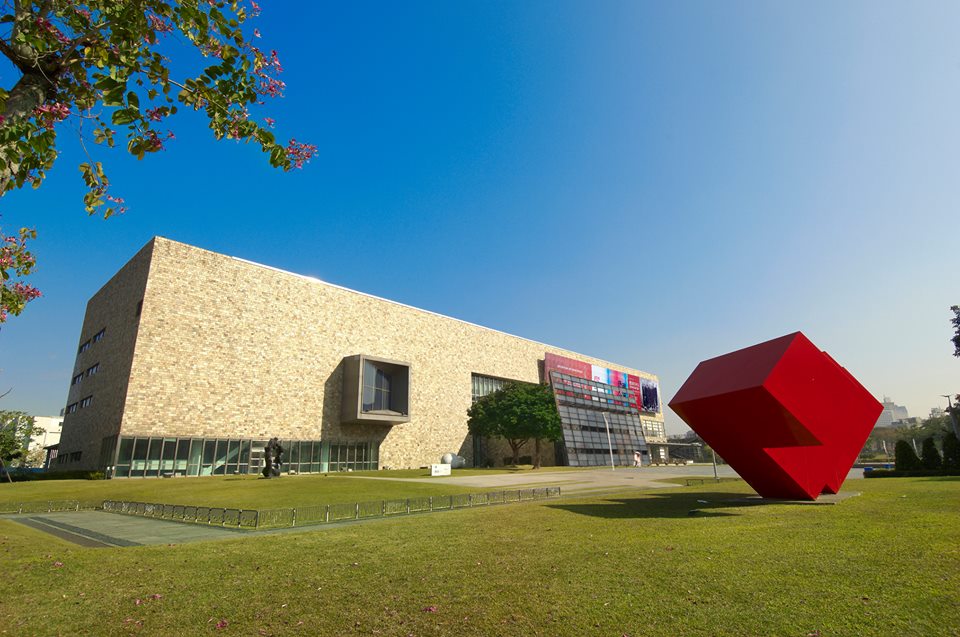
National Taiwan Museum of Fine Arts
Fifty calligraphic stone tablets stand in a forest beside the museum, each one carved with the brushwork of a renowned Taiwanese scholar. Walk past them along the Calligraphy Greenway, a linear park that threads through Taichung's West District, and you arrive at one of the largest art museums in Asia. The National Taiwan Museum of Fine Arts opened on June 26, 1988, as a provincial institution called simply the Museum of Art. It has since grown into Taiwan's first and only national-grade fine arts museum, a sprawling four-story building with 16 galleries, a sculpture park of 45 works, and an outdoor courtyard covering 102,000 square meters. Between 2011 and 2016, more than a million visitors passed through each year.
From Provincial Gallery to National Institution
The museum began under the auspices of the Taiwan Provincial Government's department of education, established as part of a policy to strengthen cultural development on the island. Its original name, Museum of Art, reflected a more modest ambition. Then the 921 earthquake struck in 1999, damaging the building badly enough to force closure for five years of renovation. When it reopened in July 2004, it did so under new management and a new name. The Council of Cultural Affairs, later restructured as the Ministry of Culture on May 20, 2012, took jurisdiction and renamed it the National Taiwan Museum of Fine Arts. The earthquake had, paradoxically, given the museum the opportunity to reimagine itself at a national scale.
Architecture Without Walls
The museum's design intentionally blurs the boundary between interior and exterior. A transparent corridor connects the galleries to the outdoor landscape, creating a spatial transition that dissolves the traditional separation between exhibition space and public park. With a building area of 37,953 square meters and an exhibition area of 13,525 square meters spread across 16 galleries, a gallery street, and a main lobby, the scale is immense. But the outdoor spaces are where the museum's ambitions become most visible. The sculpture park showcases the development of Taiwanese sculptural art through 45 works installed along paths and lawns. The stone tablet forest preserves 50 calligraphic tablets in traditional inkbrush styles. The Calligraphy Greenway, a linear park running through the museum's grounds, connects the institution to the surrounding city.
The Digital Turn
Since reopening in 2004, NTMoFA has positioned itself as a hub for digital art in Asia. International digital art exhibitions, forums, and events have been held on-site to showcase work from countries around the world. In 2007, the museum established DigiArt, the Digital Art Creativity and Resource Center, dedicated to building the infrastructure for digital arts in Taiwan. A Cyclorama Theater was constructed in 2008 to house commissioned and juried digital works. The Digital Technology and Visual Arts Collaborative Project, initiated in 2012, promotes cross-disciplinary work between artists and technologists. A biennial exhibition series, launched in 2007, has expanded the museum's international networks and deepened Taiwan's dialogue with the global art scene.
Collecting Taiwan's Visual Identity
The museum's collection focuses on works by Taiwanese artists, spanning modern and contemporary art. The Collection Committee selects representative works annually, and donations from individuals and organizations form a significant portion of the holdings. The Young Artist Collection Project, an open call held each year, acquires outstanding work from emerging creators, ensuring the collection evolves with each generation. A library of over 119,000 titles supports research, including more than 77,000 books, 29,000 periodicals, and nearly 9,000 multimedia collections. A Family Room designed for children offers hands-on activities tied to current exhibitions. The museum charges no admission except for special exhibitions, a policy that treats access to art not as a luxury but as a public right.
From the Air
Located at 24.14N, 120.66E in West District, Taichung, Taiwan. The museum's massive footprint, including the 102,000-square-meter outdoor courtyard and sculpture park, is visible as a large green institutional campus in the western part of the Taichung urban area. The Calligraphy Greenway linear park extends from the museum grounds. Nearest airport: Taichung Airport (RCLG/RMQ), approximately 14 km north-northwest. The museum is near the intersection of major city roads including Wu-Chuan West Road.