National Theater and Concert Hall
On a warm evening in 2005, thousands of people filled Liberty Square in central Taipei, spilling across the open plaza to hear Sir Simon Rattle conduct the Berlin Philharmonic inside the National Concert Hall. The overflow crowd listened through speakers, seated beneath the same sweeping palace roofs that had been designed to honor a dead dictator. That a memorial to Chiang Kai-shek became one of Asia's most celebrated performing arts complexes is one of Taipei's more productive ironies -- a monument to political power transformed, by the sheer accumulation of art staged within its walls, into something that belongs to everyone.
A Memorial Becomes a Stage
When Chiang Kai-shek died in 1975, the Kuomintang government authorized the construction of a memorial plaza that would include cultural arts facilities. Architect Yang Cho-cheng designed two buildings that borrowed heavily from traditional Chinese palace architecture -- upswept eaves, ornamental ridgelines, elaborate bracket systems -- while housing thoroughly modern interiors. The German firm G+H and Dutch electronics giant Philips led the design of stage lighting, acoustics, and mechanical systems. Six directors oversaw the project from concept to completion. The structures opened on October 31, 1987, as venues of the National Chiang Kai-shek Cultural Center, with Vice President Lee Teng-hui and Premier Yu Kuo-hua presiding over the ceremony. The project cost TWD 7.4 billion.
Where the World Performs
The roster of artists who have performed in these halls reads like an encyclopedia of twentieth and twenty-first century performance. The National Theater has hosted Cloud Gate Dance Theater, the Kirov Ballet, choreographers Pina Bausch and Martha Graham, dancer Rudolf Nureyev, and stage director Robert Wilson. The Concert Hall has welcomed all three tenors -- Placido Domingo, Jose Carreras, and Luciano Pavarotti -- alongside cellists Mstislav Rostropovich and Yo-Yo Ma, violinist Hilary Hahn, and pianists Vladimir Ashkenazy and Fou Ts'ong. Orchestras including the Vienna Philharmonic, the Royal Concertgebouw of Amsterdam, the Berlin Philharmonic, and the Czech Philharmonic have filled the hall's 2,074 seats. Concerts by visiting ensembles are often broadcast to overflow crowds in the thousands gathered on the square outside.
Every Tradition Under One Roof
What makes the NTCH distinctive is not just the caliber of its programming but its breadth. A single season might include kabuki theater, Shakespearean drama, Taiwanese opera and puppet shows, Verdi opera, Beijing opera, Broadway musicals, Wagnerian music drama, American jazz, and Latin dance. The venues host the annual Taipei International Arts Festival, the British Theatre Festival, the Chinese Drama Festival, and the Taipei Film Festival. Both buildings serve as backdrops for outdoor events on Liberty Square, from visits by foreign dignitaries to the annual Taipei Lantern Festival. Distinguished visitors over the years have included Margaret Thatcher, Mikhail Gorbachev, Lee Kuan Yew, and Betty Ford -- a guest list that underscores the halls' diplomatic role alongside their artistic one.
Palace Roofs and Pipe Organs
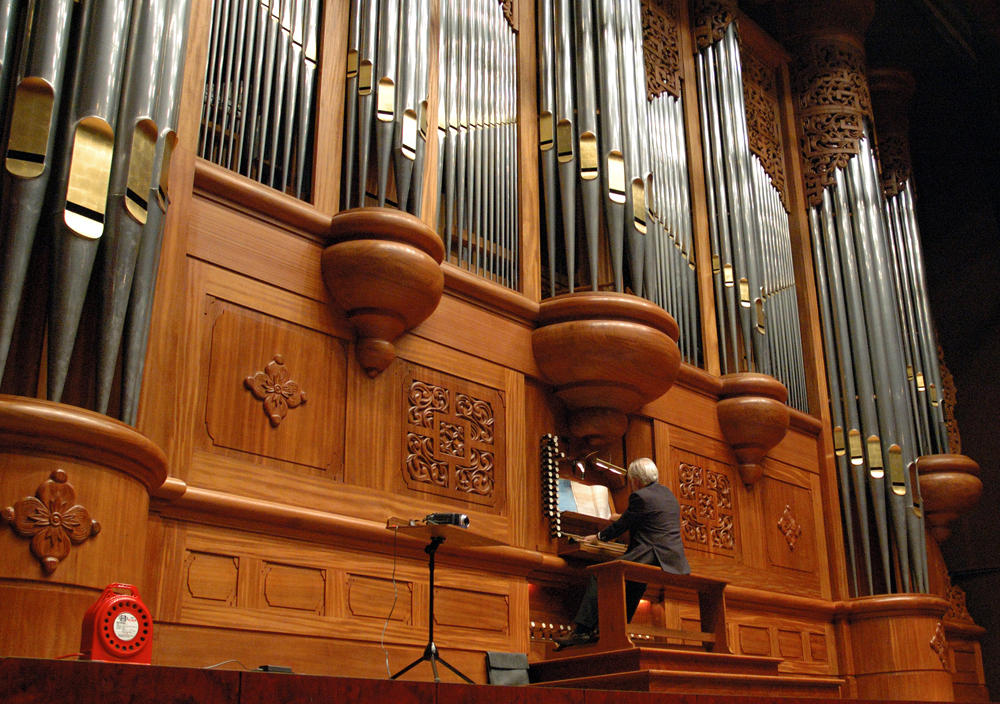
The buildings themselves are architectural hybrids. From the outside, they present the symmetry and ornamentation of imperial Chinese palaces, flanking the vast Liberty Square with Chiang Kai-shek Memorial Hall to the east. Step inside and the illusion dissolves into modern concert infrastructure: adjustable acoustics, fly towers, orchestra pits, and a Flentrop pipe organ in the Concert Hall. Both structures house art galleries, libraries, shops, and restaurants. The National Theater contains a Performing Arts Library and publication offices for Taiwan's Performing Arts Review. The complex sits near Ketagalan Boulevard, within walking distance of the Presidential Office Building, the National Central Library, the National Taiwan Museum, and 228 Peace Memorial Park -- a concentration of national institutions that makes this stretch of central Taipei the cultural heart of the capital.
From the Air
Coordinates: 25.035N, 121.518E. Located at Liberty Square in Zhongzheng District, central Taipei. The twin palace-style buildings flank the open plaza, with Chiang Kai-shek Memorial Hall visible to the east. The distinctive Chinese imperial rooflines make the complex identifiable from the air. Nearby airport: RCSS (Taipei Songshan Airport, ~5 km northeast). Best viewed at 2,000-4,000 feet. Look for the large open plaza surrounded by traditional-style buildings south of Taipei Main Station.