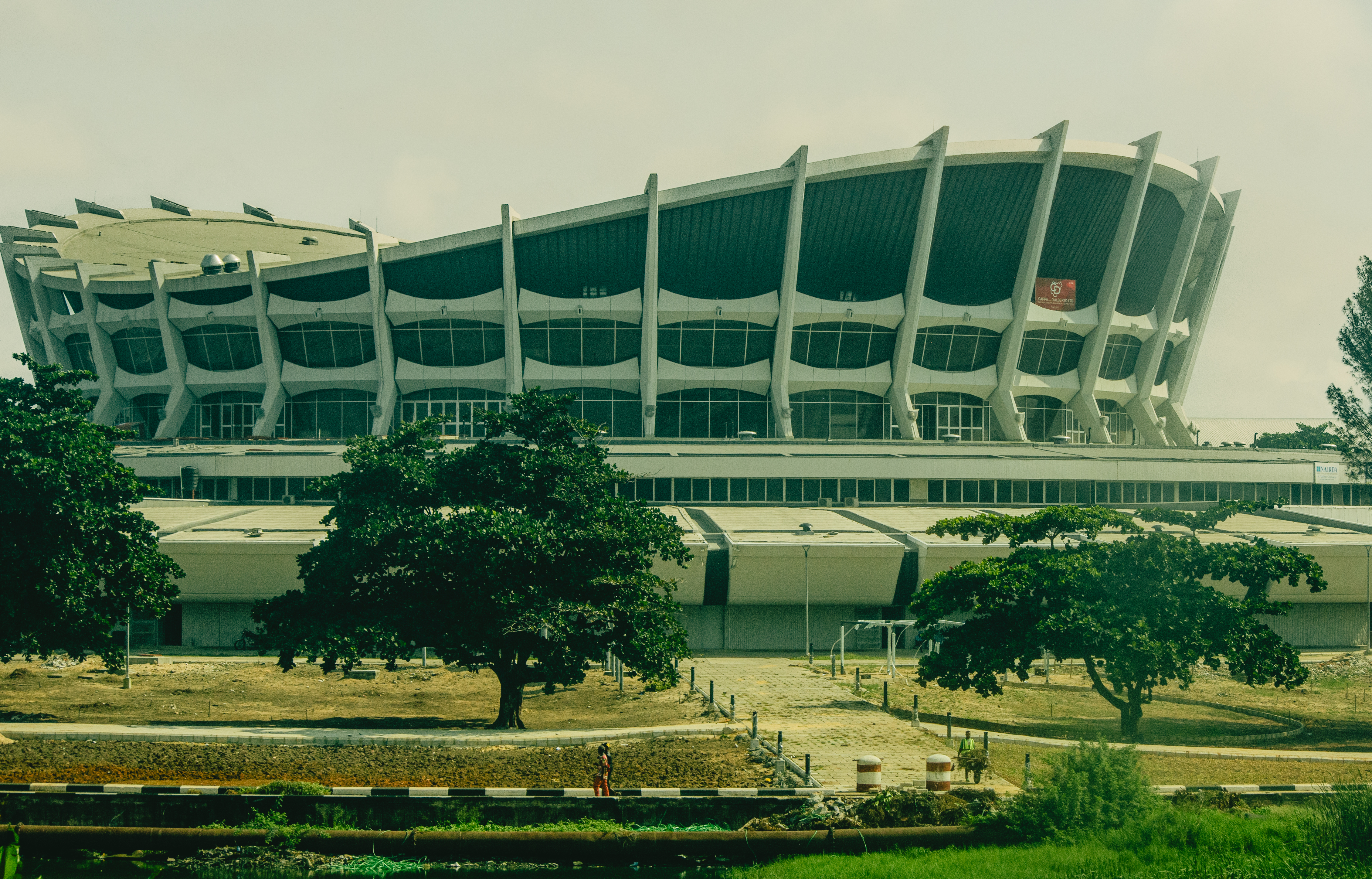
National Theatre, Nigeria
Wole Soyinka once joked that the building should be blown up. The Nobel laureate had watched Nigeria's National Theatre decay for decades -- leaking roofs, exposed wiring, conditions so dangerous that actors performed at physical risk. Then the Bankers' Committee stepped in, the renovation began, and on October 1, 2025, Soyinka stood inside the restored complex as it was rededicated in his name. He accepted the honor with what he called 'mixed feelings,' acknowledging that the committee's work had made him 'eat his words.' The building he had written off was alive again, its military-hat silhouette once more dominating the Iganmu skyline in Surulere, Lagos.
A Hat for the Nation
The National Theatre's exterior was deliberately designed to resemble a military hat -- an unusual choice for a cultural venue, but one that made sense in a country where the military had been central to national identity since independence. Construction began under the regime of General Yakubu Gowon and was completed during the regime of Olusegun Obasanjo, with the building finished in 1976 in preparation for the Second World Black and African Festival of Arts and Culture, known as FESTAC '77. The design came from the Bulgarian construction company Techno Exporstroy, which had built the Palace of Culture and Sports in Varna, Bulgaria in 1968. The Lagos version is four times larger than its Bulgarian twin. Inside, the Main Auditorium seats 5,000 -- one of the largest performance spaces in Africa -- with a collapsible stage, three cinemas, and facilities for simultaneous translation in eight languages.
Forty Carved Panels and a Bronze Wall
The interior of the National Theatre is a catalogue of Nigerian artistic traditions rendered in wood, bronze, mosaic, and fiberglass. The main lobby features forty carved wooden panels, each reflecting a distinct cultural theme, in a space that rises six to eight meters high. The VIP section is adorned with stained glass by members of the Zaria Art Society -- the group known as the Zaria Rebels who revolutionized Nigerian art education in the 1960s. Carved wooden panels depicting Benin royal processions line the walls, and an imposing bronze relief panel approximately eight meters long dominates the VIP lounge. The banquet hall contains ten carved wooden panels with iconography rooted in Nigerian storytelling traditions, flanked by standing wooden sculptures and mosaic artworks. The building also houses Nigeria's first conservation laboratory, where artworks and historical materials from FESTAC '77 are preserved under controlled humidity and temperature.
Decay and the Threat of the Wrecking Ball
After FESTAC '77, the theatre cycled through a series of management teams and a long decline. By the 2000s, the building that had hosted one of the most ambitious cultural festivals in African history was falling apart. In 2005, President Olusegun Obasanjo announced plans to privatize the theatre, sparking outrage among Nigerian artists and playwrights -- Soyinka among them. In December 2014, reports emerged that the building had been sold to a Dubai-based conglomerate for 31.5 billion naira, with plans to convert it into a duty-free shopping center. The renovation that eventually saved the theatre began in 2020, funded through a collaboration between the government and the private-sector Bankers' Committee, which included institutions such as Access Bank and Guaranty Trust Bank. The contractor CAPPA D'ALBERTO led the work, supported by specialists in stage engineering, art preservation, interior design, and mechanical services.
The Stage Reclaimed
On October 1, 2025 -- Nigeria's 65th Independence Day -- the fully restored complex was officially commissioned and rededicated as the Wole Soyinka Centre for Culture and the Creative Arts. President Bola Tinubu, who had first announced the renaming in July 2024, used the occasion to establish a National Arts Theatre Endowment Fund for ongoing maintenance. The building had already attracted global attention. Beyonce filmed the 'Keys to the Kingdom' segment of her visual album Black is King inside the theatre. Burna Boy performed a medley of his hits in front of and inside the building during the premiere ceremony of the 63rd Grammy Awards in March 2021, the same week his album Twice as Tall won the Grammy for Best Global Music Album. The roof garden, restored along with the rest of the complex, once again offers panoramic views of Lagos -- a city that nearly let this building die, then thought better of it.
From the Air
Located at 6.476N, 3.369E in Iganmu, Surulere, Lagos. The distinctive military-hat shape of the National Theatre makes it one of the most recognizable structures from the air in Lagos. The building sits in a landscaped compound that stands out from the surrounding dense urban fabric. The Lagos Lagoon is visible to the south. Nearest airport: Murtala Muhammed International Airport (DNMM), approximately 12 nm to the north.