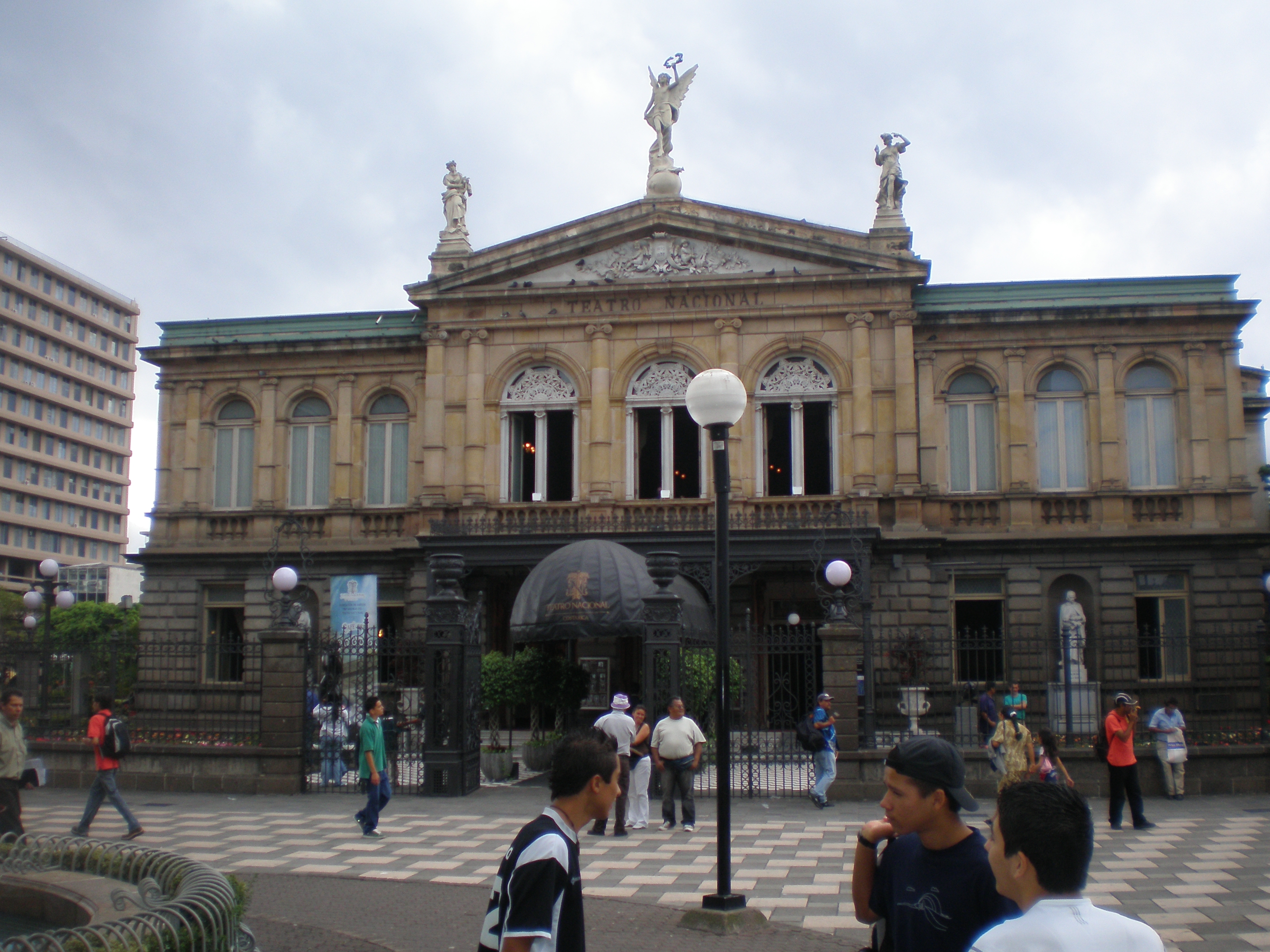
National Theatre of Costa Rica
Costa Rica paid for its national theatre with coffee. In the early 1890s, President Jose Joaquin Rodriguez Zeledon placed a tax on the country's principal export to finance a building that many thought absurd for a capital city of barely 19,000 people. One coffee planter lobbied the government to shift the tax to rice and beans instead -- a request that captures the peculiar economics of a small Central American republic pouring its agricultural wealth into Italian marble and Milanese ceiling murals. Construction began in 1891, took seven years to complete, and the result was a building that remains the finest historic structure in San Jose.
Seven Years of Trouble and Triumph
The construction was not smooth. Early errors plagued the project until an Italian engineer was brought in to direct the process and correct what had gone wrong. The problems were significant enough that the building's completion stretched across nearly the entire decade of the 1890s. But when the doors finally opened on October 21, 1897, the audience that gathered for the inaugural performance of Johann Wolfgang von Goethe's Faust found a theatre that exceeded what anyone had imagined possible in San Jose. The building could seat 1,140 people -- a remarkable capacity given that the audience would have represented roughly six percent of the entire city's population. The neoclassical facade featured statues of Pedro Calderon de la Barca, the Spanish Golden Age playwright, and Ludwig van Beethoven, while monuments to Frederic Chopin lined the entry walkway.
A Ceiling That Tells a National Story
Inside, the theatre's most celebrated feature is the ceiling mural Allegory of Coffee and Bananas by Milanese artist Aleardo Villa. The painting depicts the two agricultural products that built Costa Rica's nineteenth-century economy, rendered in the grand European allegorical style -- a visual declaration that this small nation's agricultural identity deserved the same artistic grandeur that European capitals lavished on their myths and monarchs. The mural became so iconic that it was reproduced on the Costa Rican five-colon bill, making it one of the few works of art that Costa Ricans carried in their pockets daily. The interior furnishings throughout the building match the ceiling's ambition: lavish, imported, and designed to signal that San Jose belonged among the cultured capitals of the world, even if its population suggested otherwise.
Before the National Theatre
The National Theatre did not emerge from nothing. San Jose already had the Teatro Mora, also known as the Municipal Theatre or Teatro Municipal, which had served the capital for years before the grander project was conceived. But an earthquake damaged the Teatro Mora severely enough to render it unsafe, creating the vacancy that made the National Theatre both possible and necessary. The destruction of the older venue concentrated civic ambition into a single building project, and the coffee tax provided the mechanism to fund it. What might have been a gradual evolution of the city's cultural infrastructure instead became a single bold leap -- from a damaged municipal playhouse to a national monument built to European standards.
The Coffee Republic's Monument
The National Theatre is inseparable from the coffee economy that built it. In the late nineteenth century, Costa Rica's wealth flowed overwhelmingly from its coffee plantations, and the planter class that controlled that wealth wielded enormous political influence. The decision to tax coffee exports for the theatre's construction was both a cultural statement and a political calculation -- it linked national prestige directly to the commodity that defined the economy. The statues of European composers and playwrights on the facade, the Italian engineering, the Milanese murals: all of it was purchased with beans grown in the Central Valley highlands surrounding San Jose. The building stands as a monument to a specific moment in Costa Rican history, when a small agricultural republic decided that wealth derived from the soil should express itself in art derived from Europe.
Still Performing
The National Theatre today functions as both a working performance venue and a tourist attraction. The National Symphonic Orchestra holds regular season performances featuring Costa Rican and international composers, and other productions run several times a week. Visitors who come during the day to admire the architecture and murals often return in the evening for concerts. The building has hosted events ranging from classical repertoire to the 1998 OTI Festival, a Latin American songwriting competition staged on November 13 and 14 of that year. More than a century after its improbable construction, the theatre continues to justify the tax that the coffee planters protested -- though whether any of them ever admitted as much is another question entirely.
From the Air
Located at 9.93N, 84.08W in the central section of San Jose, Costa Rica. The theatre sits in the heart of the city's historic district, near the Plaza de la Cultura. Juan Santamaria International Airport (MROC) is approximately 17 km to the northwest in Alajuela. The Central Valley is ringed by volcanic mountains, with Irazu and Poas visible on clear days. Best viewed at 3,000-6,000 feet to see the compact urban core of San Jose and the surrounding coffee-growing highlands.