National University of Colombia
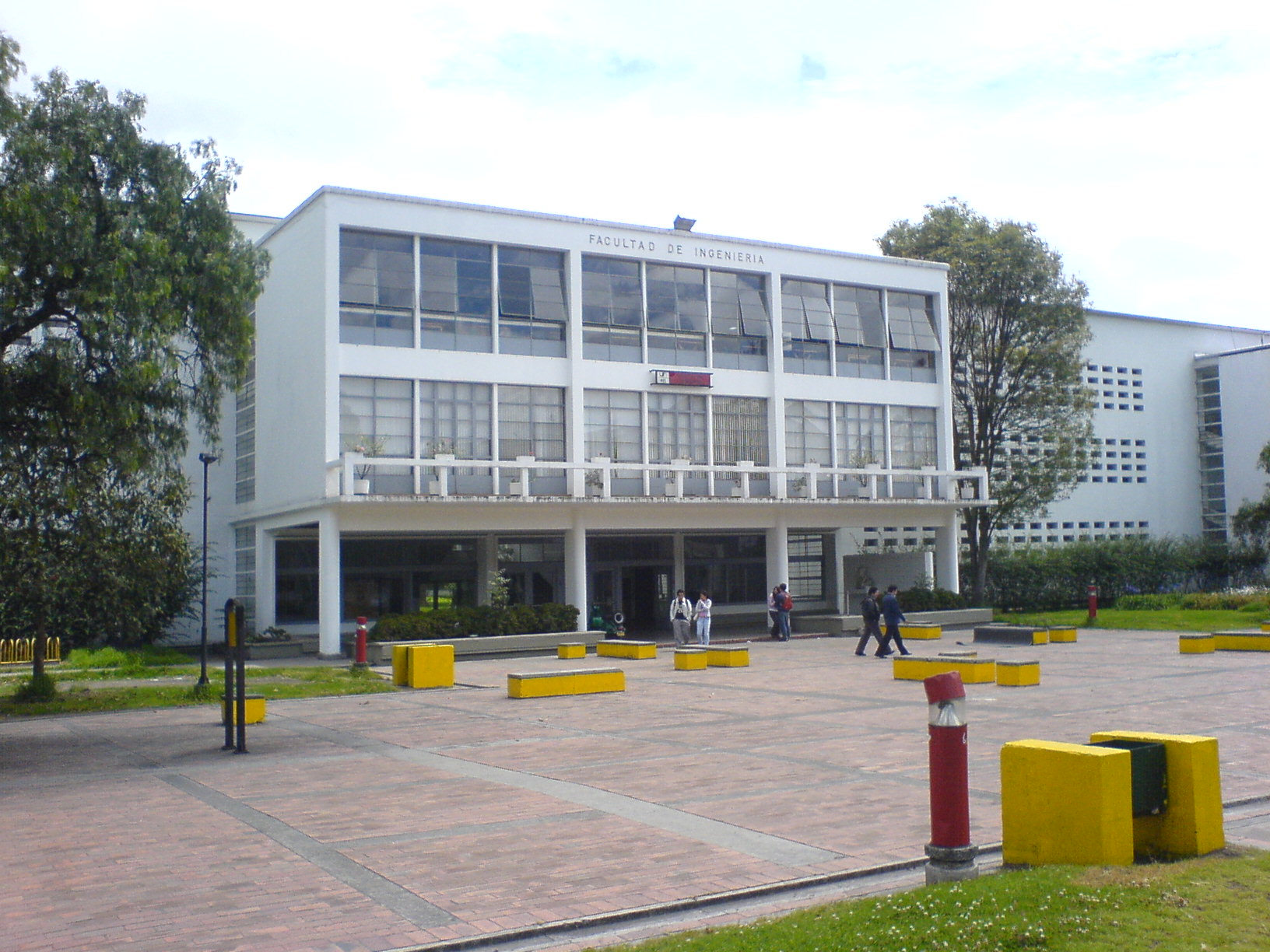
From an airplane descending toward El Dorado, the Bogotá campus of the Universidad Nacional de Colombia traces the rough shape of an owl across the altiplano. The bird is not an accident. The campus was laid out in the 1930s by Fritz Karsen, a German educationalist, and Leopold Rother, a German architect - both refugees from Hitler's regime - and the owl was emblematic of wisdom, a symbol chosen deliberately for a university the Colombian state wanted to be rigorous, secular, and free. The buildings were set into an ellipse, painted white, divided into five clean parts, and meant to look austere. Ninety years later, the students still call it the Ciudad Blanca - the White City.
A Republic's University
Congress established the Universidad Nacional de Colombia in 1867, six years after the civil war that remade the country into the United States of Colombia. It was meant to be the nation's university - public, free, federated, the instrument through which the Colombian state would train its doctors, engineers, and lawyers. It has grown into one of the largest in Latin America: more than 53,000 students across general campuses in Bogotá, Medellín, Manizales, and Palmira, and satellite campuses as far-flung as Leticia on the Amazon, San Andrés in the Caribbean, and Tumaco on the Pacific. It offers 450 academic programmes, including 65 doctorates. It was the first university in Colombia to open a graduate program in computer science, back in 1967.
The White City
Construction of the Bogotá campus began in 1935, under the reformist government of Alfonso López Pumarejo. Fritz Karsen had just been forced out of Germany for running a progressive school that Nazis wanted closed. Leopold Rother had arrived as a refugee soon after. They drew the campus as a unified composition: prismatic concrete blocks, painted white, arranged around green space and long pedestrian axes. The site covers 1,200,000 square meters - 308,541 of it built up - which makes it the largest campus in the country. Seventeen of its buildings have been declared national monuments. The Francisco de Paula Santander Plaza, known simply as the Central Plaza, anchors the ellipse. The León de Greiff Auditorium hosts concerts. The Alfonso López Pumarejo Stadium occasionally hosts professional football.
Medellín and the School of Mines
The Medellín campus has its own character - shaped not by refugees but by engineers. The School of Mines was founded in 1886 and folded into the Universidad Nacional in 1936; today it holds the single highest concentration of engineering programs of any Colombian campus. The Robledo Campus, home of the School of Mines proper, was declared a National Monument in 1994 for its architecture and for the murals painted by the Antioqueño master Pedro Nel Gómez, whose Totem Mythic still presides over the Central Campus between El Volador hill and the Medellín River. The two Medellín campuses together hold about 10,447 students. Pedro Nel Gómez's hand is visible in several blocks - public art as a pedagogical argument, hanging above generations of mining and agricultural engineers.
Museums, Observatories, Owls
The Universidad Nacional is a landscape of small museums: the Casa Museo Jorge Eliécer Gaitán, set in the home where the liberal leader was assassinated in 1948; the Leopoldo Rother Museum of Architecture, named for the man who designed the campus; the Museum of Natural History; the Entomological Museum, founded in 1937; the Museum of Mycology. The Observatorio Astronómico Nacional, the national astronomical observatory, traces its lineage back to 1803 - the oldest observatory in the Americas. The total research output is substantial: in multiple years the Nacional has produced more peer-reviewed scientific papers than any other Colombian institution, and it consistently ranks near the top of Latin America. In the 2023 QS rankings the university was 243rd globally and second in Colombia.
The Public Good, Argued Daily
Every Colombian of a certain generation has an opinion about la Nacional. Over the decades, its students have marched on Bolívar Plaza against military spending, tuition policy, paramilitary violence, and the details of peace agreements; the campus has also been closed by force during periods of public crisis. That volatility is, in a way, the point. A public university in a country with Colombia's history was never going to be a quiet place. The owl on the map is watching the republic it was built to serve, and the students underneath it are arguing about what that service means. Tuition remains free or near-free for most students. Entrance is intensely competitive. The campus, for all its political history, is also just a place where young people learn medicine, or sing in choir at León de Greiff, or read next to the library windows.
From the Air
The main Bogotá campus of the Universidad Nacional is in the Teusaquillo locality at approximately 4.6356°N, 74.0828°W - about 3 km northwest of the historic center. El Dorado International Airport (SKBO) is 8 km to the west. At 2,640 m (8,660 ft), Bogotá's altiplano weather is cool year-round. From the air, the elliptical campus with its central green plaza is distinctive against the surrounding urban grid.