National War Memorial (New Zealand)
Forty-nine bells hang inside the tower on Buckle Street, and each one carries a name. The three largest are dedicated to Anzac, Somme, and Palestine - the three theatres where New Zealand forces fought and died in the First World War. Smaller bells remember the nurses, the medical corps, the men who fell at Gallipoli in 1915. One bell, the Flanders Field bell, is dedicated to the memory of Leslie Beauchamp, brother of the writer Katherine Mansfield. Only four people have ever been appointed official carillonist of New Zealand's National War Memorial, and the instrument they play requires not finger dexterity but the full motion of hands, arms, and feet striking wooden keys and pedals connected by wires to clappers inside the bells. Timothy Hurd, one of those four, described it as "dancing to your own music."
A Memorial Visible from the Harbour
In 1919, the New Zealand government allocated 100,000 pounds for a National War Memorial in Wellington and created a committee to make it happen. Prime Minister William Massey set the standard: the memorial should be visible from any part of the city and from ships entering the harbour. By 1928, the government had agreed to a carillon - a tower of tuned bells played from a keyboard. The bells had already been cast in Croydon, England, by Gillett and Johnston, paid for by the Carillon Society before the government even approved the design. They arrived in New Zealand in January 1931. Work on the tower was completed in time for an Anzac Day dedication on 25 April 1932, witnessed by a crowd of 10,000. The 49 bells ranged from one weighing just over four kilograms to one weighing five tonnes. Their total weight exceeded 30 tonnes, and they cost 11,000 pounds.
Delays Measured in Decades
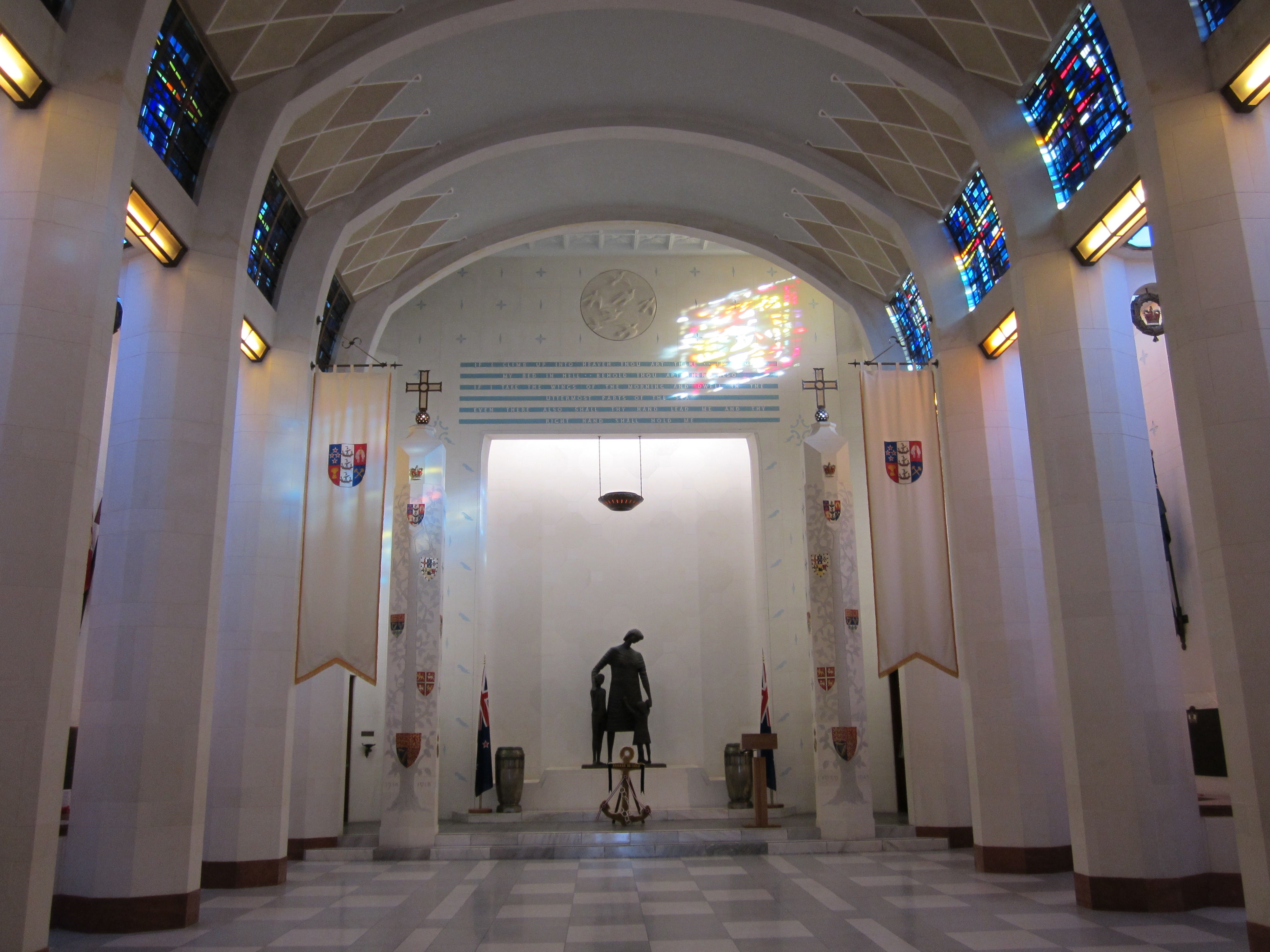
The Dominion Museum opened behind the carillon in 1936, but the Hall of Memories - intended for the tower's base - took far longer. The Great Depression stalled the first plans, drawn up in 1937. The Second World War stopped them entirely. Architects Gummer and Ford submitted a new design in 1949, but the project did not go to tender until 1960. When it finally did, the Christchurch firm P. Graham and Son won the contract for 114,000 pounds - the same firm that had built the carillon tower three decades earlier. Governor-General Sir Bernard Fergusson officially opened the Hall of Memories on 5 April 1964, thirty-two years after the carillon's dedication. Inside, four Rolls of Honour inscribed in bronze display cases bear the names and ranks of 28,654 New Zealanders who died in the country's wars. The walls of the Sanctuary carry the coats of arms of the main towns of New Zealand's nine provinces, set against large crosses. A Lamp of Brotherhood, one of 84 made after the Second World War to commemorate the war dead of all nations, hangs to one side.
Seventy Tonnes of Bells in Earthquake Country
Wellington sits on active fault lines, and the 51-metre tower holds 70 tonnes of bells - a combination that has kept structural engineers busy for years. In 2011, engineers at Dunning Thornton completed a partial seismic assessment and warned the Ministry for Culture and Heritage that the bells could fall or destabilise the building in an earthquake. They recommended checking the steel bell frames. The ministry did not follow through, opting instead to press ahead with earthquake strengthening in time for the 2015 centenary of Anzac Day. Fletcher Construction completed the work between 2012 and 2015 at a cost of $2.7 million, including new seismic bracing, re-plastering the exterior, and fixing the Hall of Memories stonework to the carillon wall with 300 steel rods drilled so carefully that the holes were filled with ground-up stone to remain invisible. Dunning Thornton reminded the ministry in 2015 and again in 2017 that the bell frames still needed assessment. A full review was not requested until August 2019 and not completed until April 2020. The estimated cost of full strengthening: $7.2 million, with completion hoped for by 2027.
The Unknown Warrior Comes Home
In 2004, an unknown New Zealand soldier was brought home from the Caterpillar Valley Cemetery in France, near where the New Zealand Division fought in 1916. The remains were chosen by the Commonwealth War Graves Commission; no name, rank, regiment, race, or religion was identified. Air Marshal Bruce Ferguson accompanied the Warrior home and made a promise: "I told him we're taking him home and that those who are taking him home are soldiers, sailors and airmen, past and present. I asked the Warrior to be the guardian of all military personnel who had died on active service. I then promised that we, the people of New Zealand, will be his guardian." The Unknown Warrior lay in state at Parliament while thousands filed past. On 11 November 2004 - Armistice Day - he was laid to rest in the Tomb of the Unknown Warrior in front of the Hall of Memories, with full military honours. In 2015, Pukeahu National War Memorial Park opened on land in front of the memorial, containing monuments from New Zealand's traditional allies and former adversaries alike, built over a traffic tunnel completed a year earlier. The park arrived in time for the centenary of the Gallipoli landings, adding yet another layer to a memorial that took a century to complete.
From the Air
Located at 41.30S, 174.78E on Buckle Street in central Wellington, adjacent to the former Dominion Museum building. The 51-metre carillon tower is one of the tallest structures in this part of Wellington and is visible as a vertical landmark in the urban landscape from moderate altitudes. Pukeahu National War Memorial Park, opened in 2015, is identifiable as green space in front of the tower, built over the Arras Tunnel. Nearest airport: Wellington International (NZWN), approximately 4 km to the southeast. The memorial sits between the Basin Reserve cricket ground (a distinctive oval) to the east and the Te Aro urban district to the north. Viewing altitude: 2,000-5,000 ft for the tower and surrounding park context.