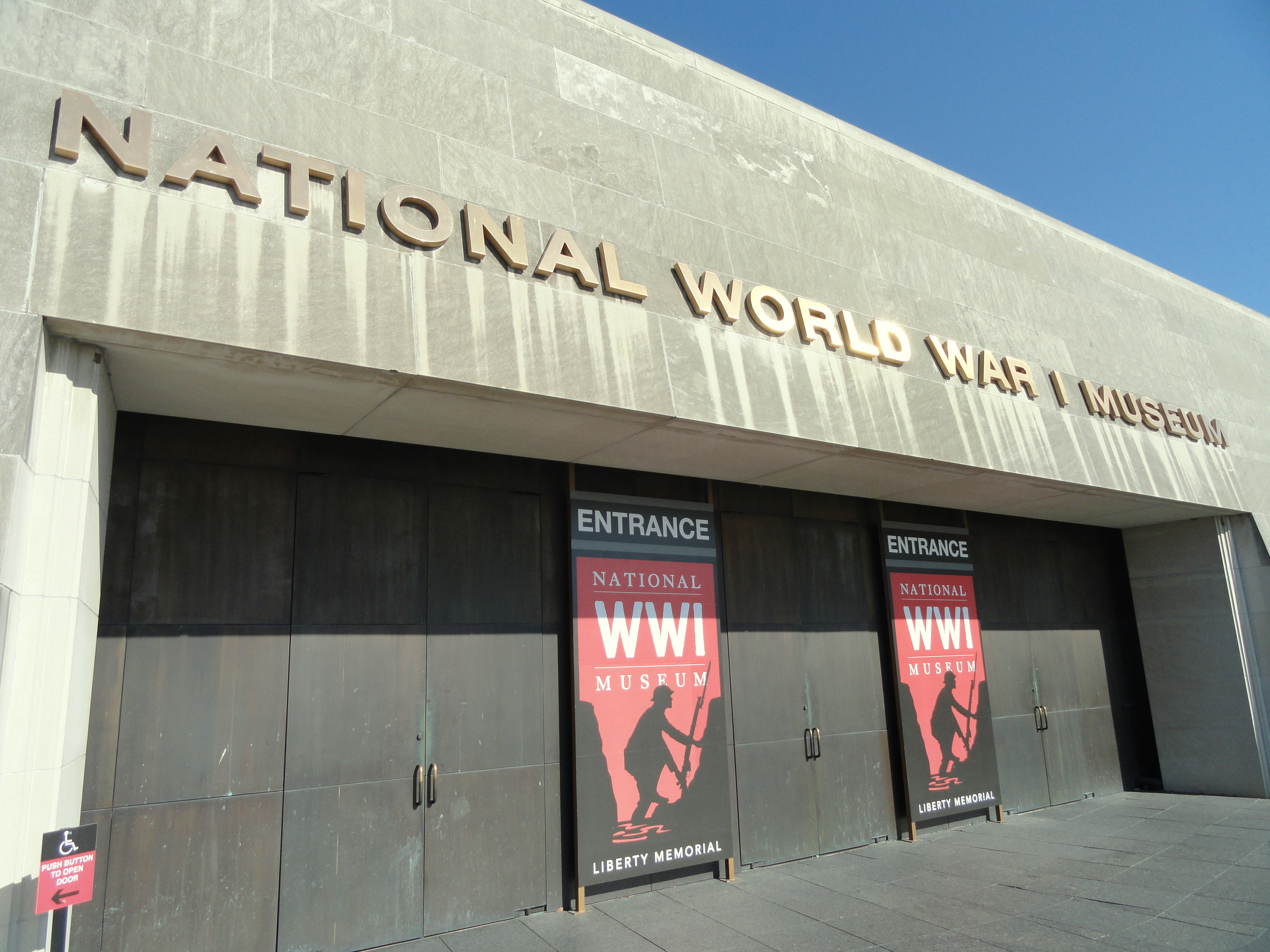
National World War I Museum and Memorial
Nine thousand red poppies fill the floor beneath a glass bridge. Each one represents a thousand combatant deaths. Visitors to the National World War I Museum and Memorial in Kansas City cross this bridge to enter the exhibit space, walking above a field of symbolic loss before confronting the artifacts of the conflict that killed them. It is a gesture of breathtaking emotional precision, designed to make the scale of the Great War intimate before a single display case is opened. The museum holds more than 350,000 items, one of the largest World War I collections in the world, but it is that bridge over the poppies that most visitors remember.
Eighty-Three Thousand Contributors
The memorial exists because of a Kansas City lumber baron named Robert A. Long, who organized 40 prominent city residents into the Liberty Memorial Association shortly after the war ended. Real estate developer J. C. Nichols championed the cause. Philanthropist William Volker helped acquire the land. Landscape designer George Kessler shaped the grounds. In 1919, the Association launched a fundraising drive that stunned the nation: 83,000 contributors donated more than $2.5 million in less than two weeks, driven by what museum curator Doran Cart has described as "complete, unbridled patriotism." The speed of the campaign avoided the decades of financial trouble that had plagued the Bunker Hill Monument in Boston a century earlier.
Two Hundred Thousand Witnesses
The groundbreaking ceremony on November 1, 1921, drew 200,000 people. Among them stood a young veteran and local politician named Harry S. Truman, who would return as 33rd President of the United States. The allied supreme commanders attended: France's Ferdinand Foch, Italy's Armando Diaz, Britain's David Beatty, Belgium's Jacques de Dixmude, and America's John J. Pershing. The finished monument was dedicated on November 11, 1926, by President Calvin Coolidge in the presence of Queen Marie of Romania. Coolidge declared that the memorial "has not been raised to commemorate war and victory, but rather the results of war and victory which are embodied in peace and liberty." The tower was crowned with four Guardian Spirit sculptures by Robert Aitken, each representing a virtue: Honor, Courage, Patriotism, and Sacrifice.
Egyptian Towers and Parisian Murals
The memorial complex was designed by New York architect Harold Van Buren Magonigle, winner of a national competition managed by Thomas Rogers Kimball, former president of the American Institute of Architects. The selection process was so contentious that nearly half the local AIA chapter resigned in protest, forming the Architectural League of Kansas City. The result justified the controversy. The tower and flanking buildings are rendered in classical Egyptian Revival style with limestone exteriors. Memory Hall contains murals originally painted for the Pantheon de la Guerre in Paris and adapted by LeRoy Daniel MacMorris. The main doors are ornamental bronze, the lobby walls are finished in Kasota stone quarried in Minnesota, and the grand stairway is travertine imported from Italy. At night, a simulated flame burns atop the tower, visible against the Kansas City skyline.
From Fading Monument to National Museum
By the 1960s, the memorial was deteriorating. Truman returned in 1961 to rededicate it, with Hallmark providing support and 15,000 people watching. Through the 1980s, the Liberty Memorial Association expanded its artifact collection, begun in 1920, and planned a proper museum. Congress designated it the nation's official World War I museum in 2004, and construction began on a new expansion and the Edward Jones Research Center beneath the original memorial. The facility reopened in December 2006 and was designated a National Historic Landmark on September 20 of that year. The museum's two main galleries walk visitors through the war chronologically: from the causes before 1914 through the armistice and the 1919 Paris Peace Conference. Exhibits include a Renault FT tank, a 1918 Ford Model T ambulance, General Pershing's headquarters flag, replica trenches, propaganda posters, and munitions. A $6.4 million renovation in 2011 upgraded security and relit the tower flame on February 1, 2013, and a new gallery for traveling exhibitions opened in 2018.
From the Air
The Liberty Memorial tower at 39.080N, 94.586W is one of Kansas City's most visible aerial landmarks, rising prominently on a hill directly south of Union Station. The Egyptian Revival tower with its flame is unmistakable from altitude. The memorial grounds include flanking Exhibition and Memory Halls. The Country Club Plaza is to the south, downtown Kansas City to the north. Nearest major airport: Kansas City International (KMCI). Recommended viewing altitude: 3,000-5,000 feet AGL. The tower-to-Union Station visual axis is one of the city's most iconic sightlines.
Sources
- Wikipedia - National World War I Museum and Memorial
- KCTV5 - 200,000 people attend groundbreaking for Liberty Memorial
- Google Arts and Culture - Guardian Spirits, Robert Aitken
- National WWI Museum - Rearranging History: Daniel MacMorris and the Pantheon de la Guerre
- Wikipedia - Thomas Rogers Kimball
- Legends of America - Robert A. Long, Lumber Baron