Natural Bridge Caverns
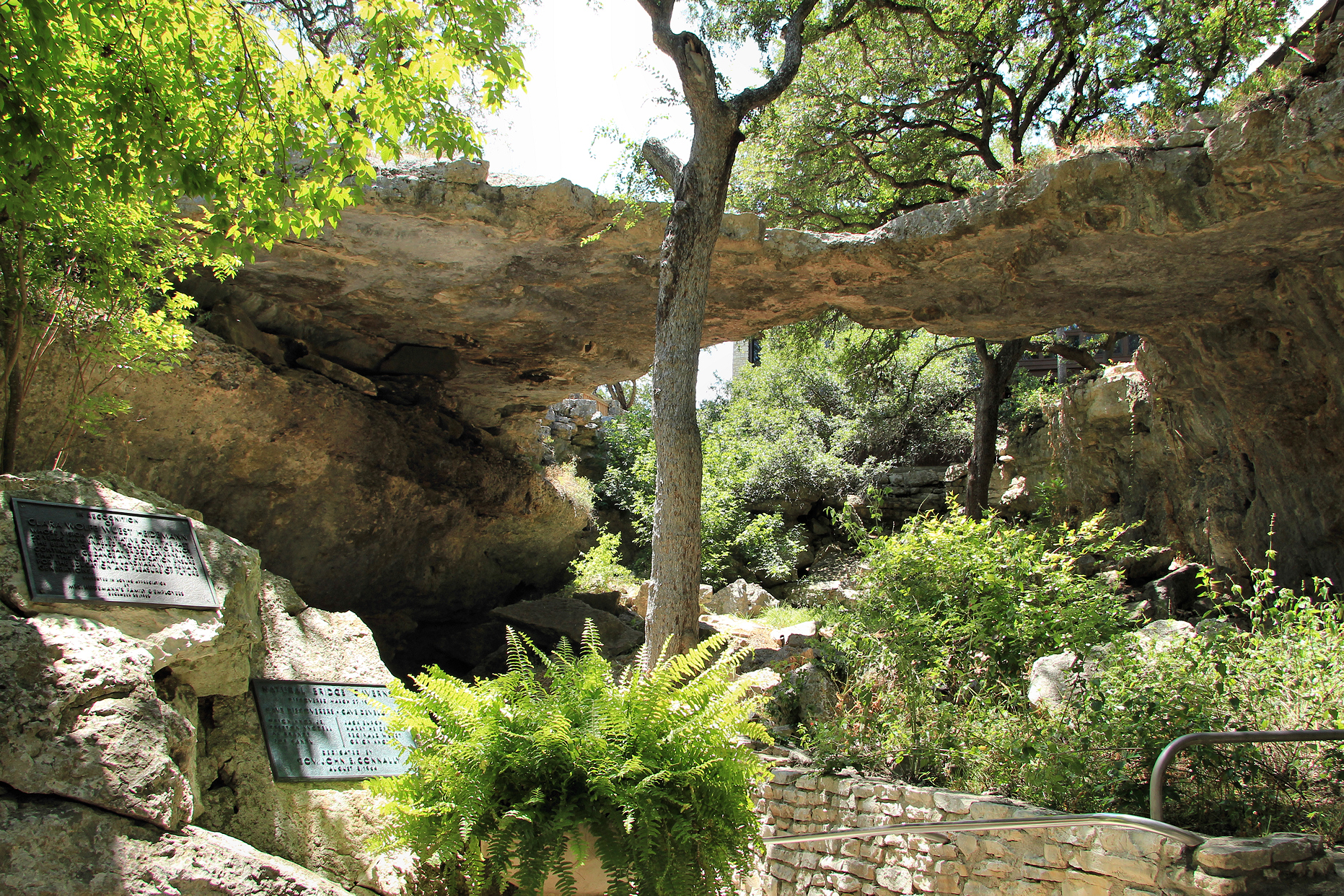
Four students from St. Mary's University in San Antonio went looking for caves on a spring day in 1960 and found the largest commercial caverns in Texas. On their fourth trip into the darkness below a natural limestone bridge in Comal County, Orion Knox Jr., Preston Knodell Jr., Al Brandt, and Joe Cantu explored over a thousand feet of passage that no human being had entered in modern history. They were not, however, the first visitors. During later excavation of the entrance trail, workers unearthed a human tooth, arrowheads, and spearheads dating to 5000 BCE, along with the jawbone and femur of an extinct species of black bear. The cavern had been a shelter for thousands of years before the limestone roof above it collapsed, creating the sinkhole that gives the place its name -- a flat slab of rock left hanging across the void like a bridge to nowhere.
A World at 99 Percent Humidity
The environment inside Natural Bridge Caverns is constant and extreme. The temperature holds steady year-round. The humidity sits at 99 percent, every day, in every passage. This perpetual dampness is what keeps the cave alive. Rainwater filters through the porous limestone of the Texas Hill Country above, dissolving calcite as it travels downward through the rock. When it finally enters the cavern, it drips and flows across every surface, depositing thin layers of mineral that build the formations over millennia. The speleothems -- stalactites, stalagmites, flowstone, columns -- retain a waxy luster because they are still growing, still wet, still accumulating. The deepest point on the public tour takes visitors well below the surface, though undeveloped areas of the cavern reach deeper still. Rooms have names befitting their scale: the Castle of the White Giants, Pluto's Anteroom, the Valley of the Fallen Lords, Grendel's Canyon.
A Family Affair Since 1963
After the 1960 discovery, Knox connected the landowners with Jack Burch, a cave developer who had just finished work on the Caverns of Sonora in west Texas. Clara Wuest Knox dropped out of school to help. Burch agreed to take on the project, and development began in early 1963. Clara Wuest had remarried Harry Heidemann, a retired Texas Highway Patrolman, and together the family formed the core development crew: Wuest-Heidemann, Heidemann, Burch, Knox, and Reggie Wuest, Clara's son. The cavern opened to the public and has never closed since. It remains owned and operated by family members to this day. In 1971, the National Park Service designated Natural Bridge Caverns a National Natural Landmark, recognizing its geological significance. Next door, the family operates the Natural Bridge Wildlife Ranch, a drive-through safari park that adds another dimension to the property.
The Jaremy Room and Beyond
In 1967, speculation about a southern extension of the known cavern was confirmed when test drilling hit a large void deep beneath the surface. A camera lowered through a narrow shaft revealed a massive chamber filled with formations. The shaft was widened, and three men were lowered into the ground: Jack Burch, Reggie Wuest, and Myles Kuykendall. They named their discovery by combining the first two letters of each of their first names -- JA, RE, MY -- the Jaremy Room. Further drilling in 1968 opened additional passages. In 2005, several hundred feet were added to the surveyed length. Explorers believe as much as another mile of passage exists in sections that have been seen but not yet mapped. Beginning in May 2019, a new team of cave explorers has pushed deeper into the system, discovering passages never before seen. Each expedition takes longer than the last as the frontier recedes further from the entrance; the most recent lasted more than 19 hours underground.
Seven Thousand Years of Shelter
The archeological record at Natural Bridge Caverns reaches back at least seven millennia. The arrowheads and spearheads found during entrance construction date to 5000 BCE, placing early inhabitants squarely in the Archaic period of Texas prehistory. The extinct black bear remains suggest the cave served as a den for animals long before humans arrived. A separate archeological site on the property -- the Natural Bridge Caverns Sinkhole Site -- is listed on the National Register of Historic Places. Its exact location is withheld from the public to preserve artifacts in their original context for ongoing research. This layering of human and natural history, from Ice Age mammals to ancient hunters to a family of cave developers, makes Natural Bridge Caverns something more than a geological attraction. It is a record of how living things have sought shelter in the same stone for thousands of years.
From the Air
Located at 29.692N, 98.343W in Comal County, about 18 miles northeast of downtown San Antonio in the Texas Hill Country. From the air, the site appears as a developed tourist complex with parking areas adjacent to rolling limestone terrain. The natural bridge itself is a small limestone slab spanning the entrance sinkhole, not visible from high altitude. Nearby Bracken Cave (bat colony) is less than one mile to the southwest. Best viewed at 2,000-4,000 ft AGL. Nearest airports: KBAZ (New Braunfels Regional, 10 nm E), KSAT (San Antonio International, 18 nm SW). The Natural Bridge Wildlife Ranch safari park is immediately adjacent.