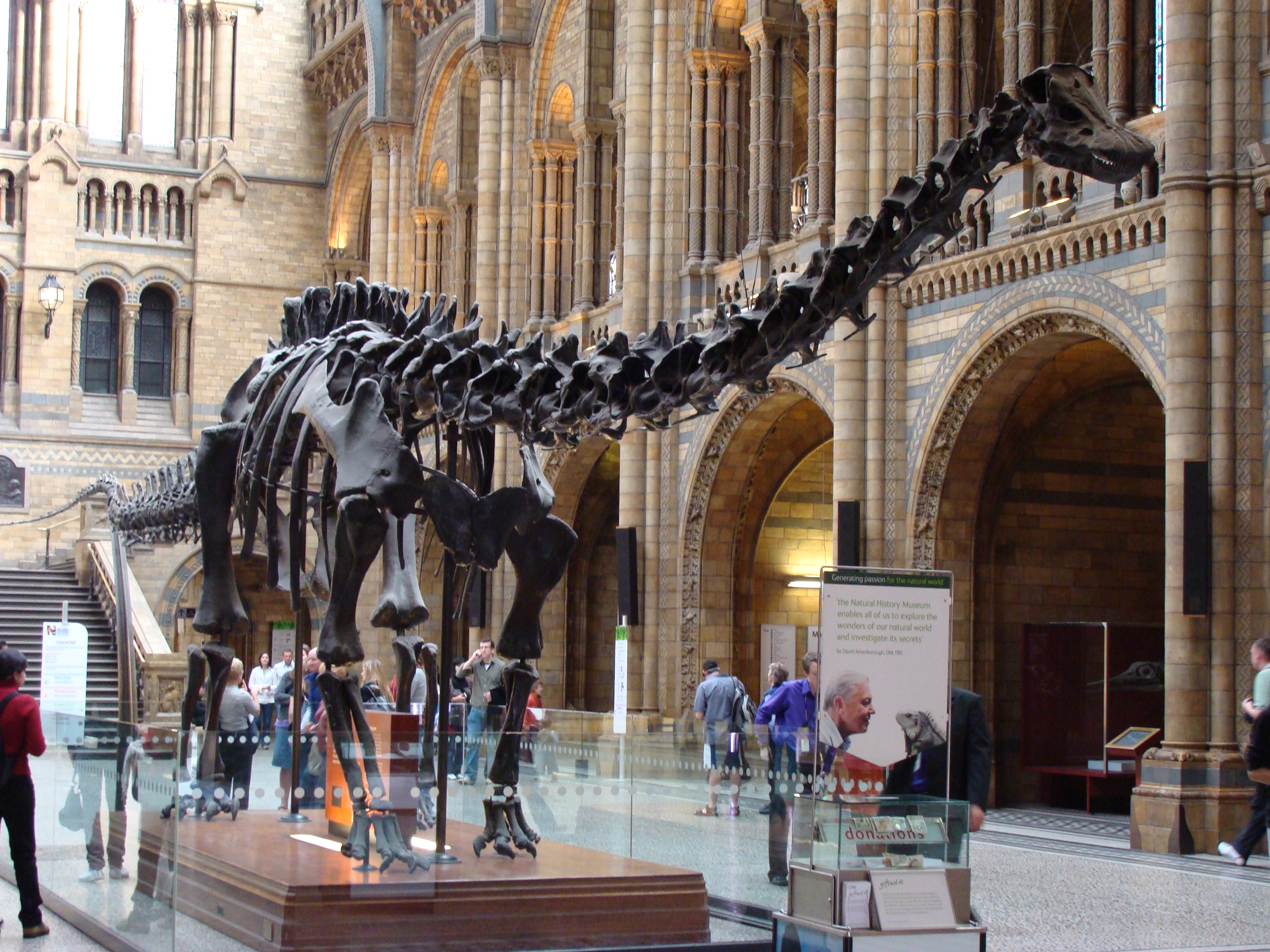
Natural History Museum, London
For decades, visitors entering through the grand arched doorway on Cromwell Road were greeted by Dippy, a plaster cast of a Diplodocus skeleton that had presided over the central hall since 1979. When Dippy was replaced in 2017 by the real skeleton of a blue whale named Hope, suspended from the vaulted ceiling as though swimming through the nave, some visitors wept. The swap captured something essential about this institution: the Natural History Museum is not a static cabinet of curiosities but a living enterprise, constantly reinterpreting the natural world for new generations.
A Cathedral for Creation
Alfred Waterhouse designed the building in the Romanesque style, and its terracotta facade, completed in 1881, is populated with carved animals and plants. Living species adorn the western wing while extinct ones haunt the eastern side. The architect intended the building itself to be a lesson in natural history, and the effect is startling: gargoyles shaped like pterodactyls cling to the roof, monkeys perch on columns, and fish swim across the ceiling tiles. Sir John Betjeman called it a cathedral of nature, and the comparison holds. The central hall, with its sweeping staircases and painted botanical panels, evokes the nave of a great church. But the congregation here worships at the altar of evidence. Over 300 scientists work behind the scenes, making the museum one of the world's leading centres for taxonomic research and conservation biology.
Eighty Million Stories
The collections stagger the imagination. Eighty million specimens are divided among five main departments: botany, entomology, mineralogy, palaeontology, and zoology. Many possess historical significance that rivals their scientific value. Specimens collected by Charles Darwin during the voyage of the Beagle sit alongside samples gathered by Joseph Banks on Captain Cook's expeditions. The mineralogy collection includes meteorite fragments older than Earth itself. The entomology department alone curates some 34 million insects, pinned and catalogued with obsessive care. Only a fraction of the total collection is ever on display; the rest resides in climate-controlled vaults that stretch beneath South Kensington, a subterranean library of life that most visitors never see.
From Curiosity to Science
The museum's origins trace to the collection of Sir Hans Sloane, whose vast assemblage of natural specimens also helped found the British Museum in 1753. By the mid-nineteenth century, the natural history collections had outgrown their Bloomsbury quarters, and Richard Owen, the superintendent of natural history departments, campaigned tirelessly for a dedicated building. Owen envisioned a museum that would serve both public education and serious research, a dual mission the institution maintains today. The move to South Kensington placed the museum on Exhibition Road alongside the Science Museum and what would become the Victoria and Albert Museum, creating a cultural district that Prince Albert had championed. The museum gained its independence from the British Museum by Act of Parliament in 1963.
Where Wonder Meets Inquiry
The Wildlife Garden, tucked behind the western wing, offers a different kind of encounter with nature. Hedgehogs, slow worms, and over 2,600 species of insects have been recorded on this small patch of managed habitat in the heart of London. Inside, the Earth Hall takes visitors through a simulated earthquake and deep into geological time. The Darwin Centre, opened in stages between 2002 and 2009, brought the museum's research into public view through a glass-walled cocoon where scientists can be observed at work. Admission has been free since 2001, a decision that pushed annual visitor numbers beyond five million. Whether they come for the animatronic Tyrannosaurus or the hushed wonder of the gem vault, visitors leave having brushed against something larger than themselves: the sheer, improbable variety of life on this planet.
From the Air
Located at 51.4967N, 0.1764W in South Kensington, London. The museum's ornate terracotta facade is visible along Cromwell Road. Nearest airports: London Heathrow (EGLL) 12 nm west, London City (EGLC) 7 nm east. Best viewed at 1,500-2,500 ft AGL. Exhibition Road and the cluster of museum buildings form a distinctive block south of Hyde Park.