Natural History Museum of Isfahan
Plastic dinosaurs greet you at the front door. Behind them stands a building from the 15th century, its porch decorated with the honeycomb vaulting known as muqarnas and walls finished in delicate stucco. The collision is deliberate, or at least unapologetic -- Isfahan's Natural History Museum occupies a Timurid-era structure that predates the Safavid monuments for which the city is famous, and it fills that ancient space with taxidermy mammals, geological specimens, and insect collections. The juxtaposition is, depending on your temperament, either jarring or perfect.
Timurid Bones, Modern Purpose
The building dates to the Timurid dynasty, which ruled Persia and Central Asia during the 15th century following the conquests of Timur (Tamerlane). In Isfahan, where most visitors come for Safavid architecture from the 16th and 17th centuries, this older structure is easy to overlook. It should not be. The large halls retain their original proportions, and the veranda showcases muqarnas -- the intricate geometric vaulting that Islamic architects developed to transition between flat walls and curved domes. The stucco decoration speaks to a period before Isfahan's signature blue tilework became dominant. In 1988, the building was repurposed as a museum, giving public access to a structure that might otherwise have remained a footnote to the city's more celebrated monuments.
Seven Halls of the Natural World
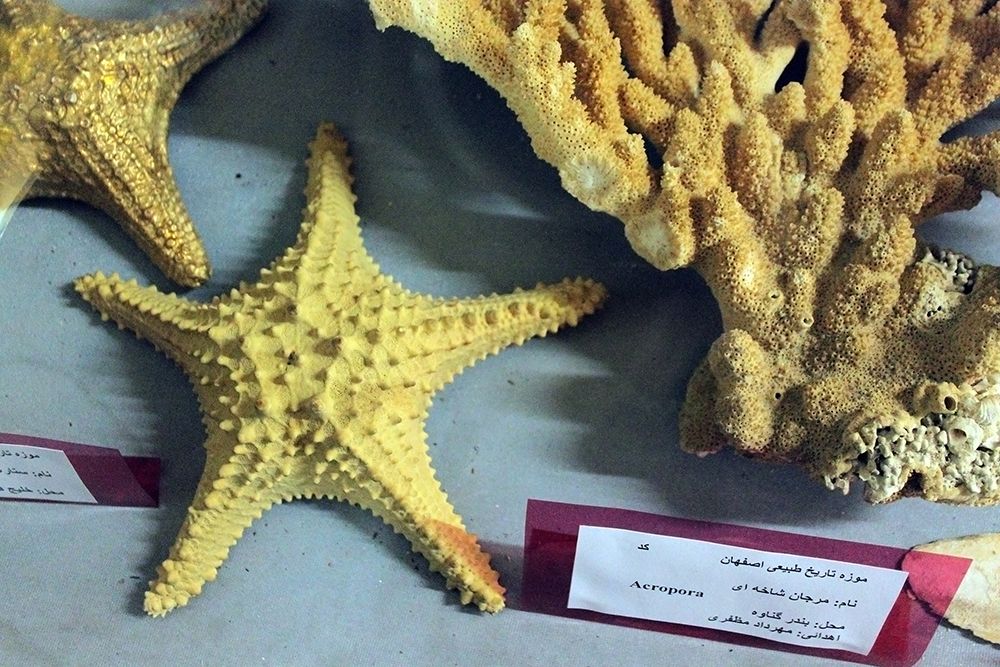
The museum organizes Iran's natural diversity across seven halls. The invertebrates hall ranges from unicellular organisms to sponges, corals, arthropods, and seashells. A separate botany hall displays flowering plants, medicinal species, and cross-sectioned tree trunks that reveal growth rings spanning decades. The geology hall assembles minerals, crystals, ore samples, and sedimentary rocks -- a survey of the earth's crust presented in a building that has survived on top of it for six hundred years. The vertebrates hall takes the most dramatic approach, filling its space with taxidermy specimens of fish, amphibians, reptiles, birds, and mammals native to the Iranian plateau and surrounding regions.
Where Architecture Argues with Exhibits
The tension between container and contents gives this museum its odd charm. The muqarnas vaulting overhead was designed to inspire contemplation of geometric perfection and divine order. Below it sit glass cases of pinned beetles and preserved plant specimens. The Timurid architects who shaped these halls could not have imagined their work housing taxidermy deer and geological maps, yet the large proportions of the rooms accommodate the exhibits comfortably. The building breathes in a way that purpose-built museum spaces often do not. And then there are those dinosaurs out front -- fiberglass models that some visitors find incongruous with the 15th-century facade behind them. Others see them as an honest statement of intent: this is a place where the very old and the slightly kitschy coexist without apology.
Isfahan Beyond the Tilework
The Natural History Museum sits in downtown Isfahan, within walking distance of Naqsh-e Jahan Square and the Grand Bazaar. Most visitors to the city come for the Safavid masterworks -- the Shah Mosque, the Sheikh Lotfollah Mosque, the Ali Qapu Palace. The museum offers something different: a reminder that Isfahan's history did not begin with Shah Abbas I in 1598. The Timurid period, the Seljuk period before it, and the deeper geological and biological history of the Iranian plateau all have their representatives here, housed in a building that is itself an artifact. It is a small museum with a modest collection, but it occupies a structure that most cities would showcase as a monument in its own right.
From the Air
Located at 32.658N, 51.674E in central Isfahan, Iran, within the dense urban core of the old city near Naqsh-e Jahan Square. The museum building is not individually distinguishable from altitude, but lies within the historic district visible as a cluster of traditional low-rise structures and courtyard buildings. Best appreciated in context with nearby landmarks. Isfahan Shahid Beheshti International Airport (OIFM) is approximately 20 km northeast. Viewing altitude of 3,000-5,000 feet AGL provides the best perspective on the old city layout.