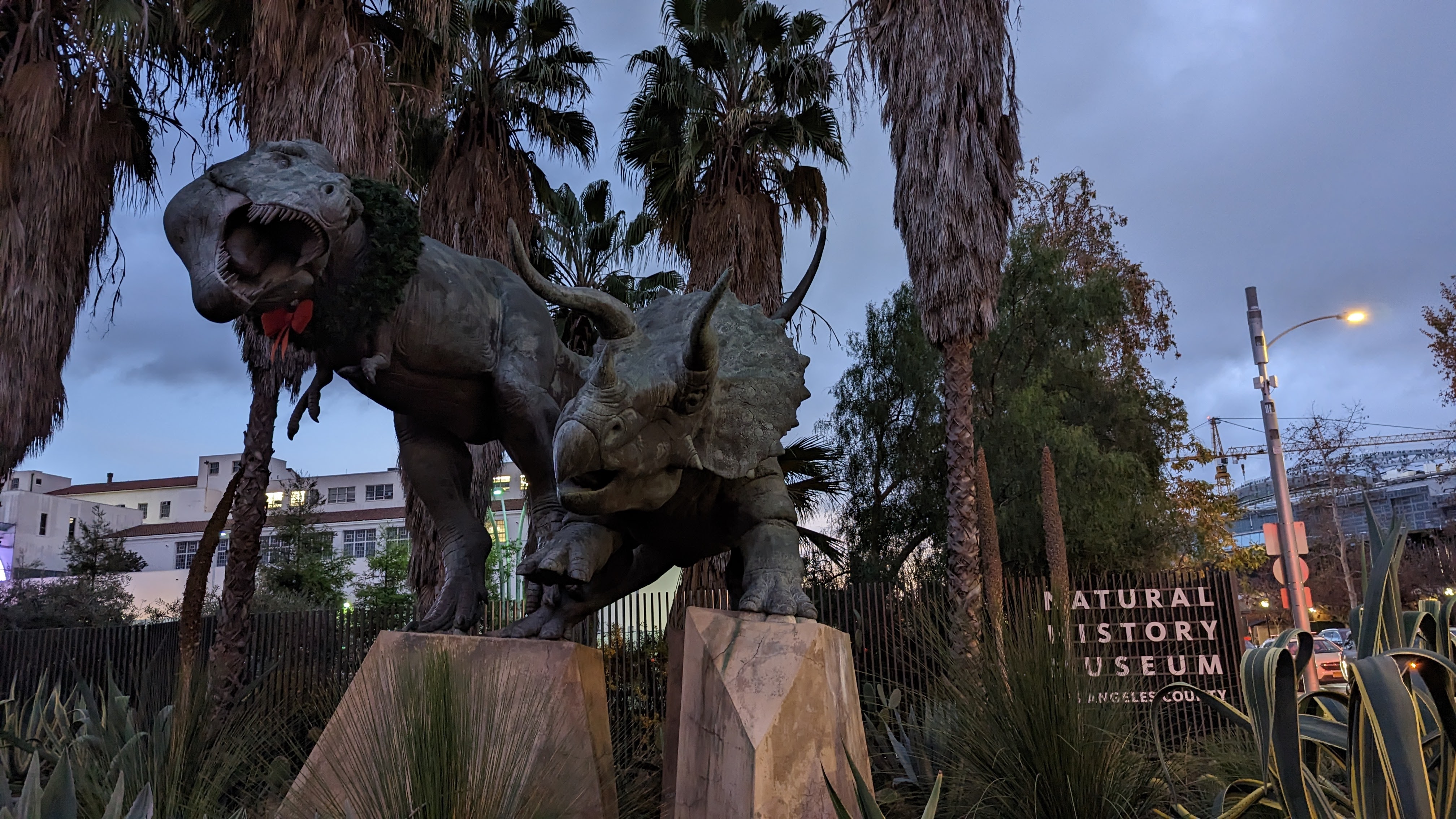
Natural History Museum of Los Angeles County
The rotunda is the first thing most visitors notice: a soaring, domed space of marble and granite, decorated with the kind of confident grandeur that Edwardian-era civic buildings wore like a birthright. Above the door, Three Muses by Julia Bracken Wendt gazes down — the first public artwork funded by Los Angeles County. The building opened in 1913. Everything inside spans the distance between that moment and the beginning of time.
The Scale of Things
The Natural History Museum of Los Angeles County holds approximately 35 million specimens across its collections — more than most visitors will ever comprehend. They include rocks from the earliest period of Earth's formation, fossils from the Cambrian seas, Ice Age fauna from the La Brea asphalt deposits a few miles north, and specimens from every major taxonomic group that has ever lived on this planet.
The museum opened in 1913 as the Museum of History, Science and Art, a single institution meant to hold everything Los Angeles wanted to preserve and display. In 1961 it split: art went to LACMA, history and natural science remained in the Exposition Park building. The rotunda and much of the original structure are on the National Register of Historic Places — a rare designation for a working museum.
Dinosaur Hall, which opened in July 2011, reorganized the museum's remarkable fossil collection into a narrative that visitors can walk through: the Triassic, Jurassic, and Cretaceous periods laid out in sequence, punctuated by specimens that represent decades of fieldwork in Montana and New Mexico.
Gnatalie and the Commons
In 2024, the museum completed its most ambitious expansion in decades: the NHM Commons, a 75,000-square-foot addition that changed the relationship between the institution and its surrounding park. The Commons is designed to open the museum outward — not a sealed collection but a porous institution that invites the neighborhood inside.
The centerpiece of the Commons is Gnatalie, a 75-foot-long sauropod skeleton whose bones are an unusual green-brown color — the result of mineral replacement over millions of years. She moves through the space with the unhurried presence of something that lived for decades and died 150 million years ago, and now anchors a building designed for the next century of visitors.
The museum's relationship to Exposition Park — itself a historic space that has hosted the 1932 and 1984 Olympics, that contains the California Science Center and the Rose Garden — reflects something particular about how Los Angeles thinks about its institutions. They cluster, they borrow each other's gravity, they create a civic landscape that is greater than any individual building.
What a City Keeps
Natural history museums are, at their core, acts of collection and interpretation — decisions about what matters enough to preserve, to label, to explain. The NHM's history reflects the biases of its era: early collections focused on taxidermy and geology, on the dramatic and the exotic, on specimens gathered by collectors who did not always ask the communities from which they took.
Contemporary natural history museums are reckoning with this history, and the NHM is no exception. Its extensive research programs in urban biodiversity — studying the coyotes, opossums, spiders, and birds that inhabit the city around the museum — represent a different kind of natural history, one in which the specimens do not need to be captured at all, simply observed.
The building that opened in 1913 was meant to teach Los Angeles what the world contained. The institution it has become is more interested in teaching Los Angeles about itself — about the place it occupies in deep time, about the living systems that persist even in a city of four million people.